
A gTLD strategic decision is one of the most complex calls an organization can make as the next ICANN application window approaches. For executives, founders, and board members, the decision to pursue a new generic top-level domain (gTLD) – like a .brand, .shop, or .law – is a multi-million dollar commitment shrouded in ambiguity. The central question isn’t just “yes” or “no.” It’s a strategic choice with three distinct outcomes: apply now, delay the decision, or walk away entirely. This framework is designed to provide clarity, not persuasion, for that final call.
A winning gTLD isn’t born from a single flash of brilliance. It’s the result of reinforcing signals across your entire organization. A killer marketing concept for .awesome is just noise if your operational budget is a rounding error and your legal team is still debating the memo from last quarter. Real strategic decision making is about finding coherence, not just isolated strengths. This checklist is designed to move your team beyond gut feelings and into a data-informed assessment of your true readiness. Look for consistency across all signals; contradictory signs are a flashing red light.
Does this gTLD directly support a primary business objective? It must be a strategic tool, not a vanity project. If you can’t draw a straight line from the gTLD to a key result on your corporate roadmap, you have a problem.
A gTLD is a long-term operational commitment, like buying a hotel, not just a room. You’re responsible for the plumbing, security, and keeping the lights on for decades. This is where bold vision often collides with the hard reality of budgets and headcount.
An idea that sounds brilliant in your conference room can land with a deafening thud in the real world. A solution in search of a problem is just an expensive hobby. Look at gTLDs from the 2012 round; while some like .app found a clear audience, others like .creditcard struggled to find a sustainable market.
.com or .io doesn’t?
In an echo chamber of industry hype, launching a gTLD can feel like a foregone conclusion. But in the world of high-stakes strategic decision making, the bravest – and often smartest – move is to do nothing at all. Choosing to delay or walk away isn’t failure; it’s strategic discipline. It’s a conscious decision to preserve capital, protect your brand, and keep your organization laser-focused. Just because Google launches .app or Amazon secures .book doesn’t mean you must follow suit. A wise ‘no’ is infinitely more valuable than a hesitant ‘yes,’ especially when the data screams danger.
A misaligned gTLD project is a black hole for resources. It’s not just about the $227,000 ICANN application fee; it’s about the opportunity cost. Every executive hour spent debating TLD policy is an hour not spent on product innovation. This decision friction carries a heavy price tag. McKinsey research found that inefficient decision-making costs a typical Fortune 500 company around 530,000 days of managers’ time each year.
Protecting your downside requires immense discipline over the fear of missing out (FOMO). A poorly executed TLD becomes a public monument to a strategic misstep, eroding the very brand equity it was meant to enhance. Choosing to walk away demonstrates strategic maturity and a commitment to deploying capital where it will have the greatest impact. For a deeper look at this, check out our post on why strategy matters before the next application window.
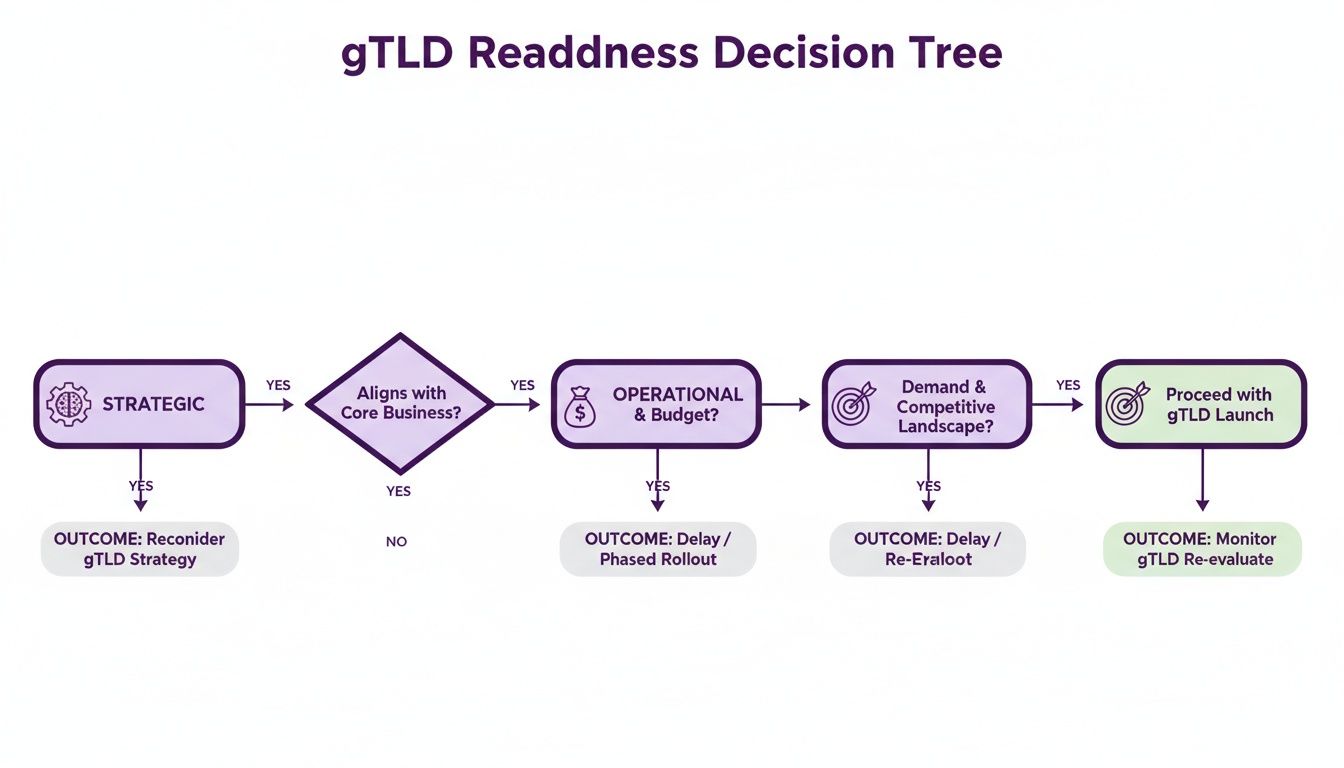
Before committing millions, the leadership team must have solid, unequivocal answers to a few non-negotiable questions. Any ambiguity at this stage is a massive red flag. This isn’t a box-ticking exercise. It’s about building a foundation of clarity, ownership, and accountability before the first check is written.
1. The Accountability Question: Who is the ultimate executive sponsor with P&L responsibility? A gTLD project without a single, empowered executive owner is an orphan. The sponsor must be someone with the authority to command a budget and answer to the board for the project’s success or failure. This is not a job for a committee.
2. The Outcome Question: What is the exact, measurable business outcome this gTLD is expected to achieve in 3–5 years? “Building our brand” is a platitude. A genuine strategic decision demands a specific, quantifiable goal. Are you trying to cut defensive registration costs by 20%? Boost direct-navigation traffic by 15%? Lift customer trust metrics, as the .bank TLD did?
3. The Execution Question: Who owns the operational, legal, and marketing workstreams? The executive sponsor sets the vision, but a dedicated team manages the day-to-day grind. You need named individuals responsible for operations, legal, and marketing. If these roles are just tacked onto existing job descriptions, the project will stall.
4. The Contingency Question: What is our contingency plan if adoption is slower than projected? Hope is not a strategy. The emotional burden of high-stakes decisions is intense; research shows 85% of business leaders have experienced “decision distress” by regretting or second-guessing major calls. A solid plan includes pre-defined triggers for a “plan B,” whether it’s pivoting the marketing strategy or sunsetting the TLD.
If your leadership team can’t give crisp, confident answers to each of these, the smartest move is to hit pause.

When it comes to the gTLD process, the most dangerous answer isn’t ‘no’ – it’s ‘maybe.’ Undecided organizations often drift into failure, caught unprepared when critical deadlines loom. A genuine strategic decision making process demands a deliberate, documented conclusion, even if that conclusion is to walk away. A vague consensus is a recipe for confusion.
An explicit decision, recorded and communicated, forces the leadership team to stand behind their choice. It turns a fleeting opinion into a durable strategy, ensuring that no matter the outcome, the decision was a deliberate act, not a passive accident.

In the high-stakes world of digital assets, a disciplined decision will always outperform a reactive one. The real victory in the gTLD process isn’t just securing the domain – it’s the analytical rigor that leads you to the final call. A well-reasoned decision to walk away from a gTLD like .security or .cloud can be a bigger strategic success than a poorly planned application. It saves your organization from a costly and very public misstep, preserving capital and focus for the battles that truly matter. The ultimate measure of success is the quality of the thinking that produced the choice. A confident ‘no’ is infinitely more valuable than a hesitant ‘yes’.
Most gTLD initiatives fail before the application is even submitted.
If your organization is considering a gTLD, the most important work happens before the application window opens.
The question is not whether utility-driven gTLDs make sense in theory.
It’s whether your proposed model aligns with how digital identity actually functions in a mobile-first world.
We offer a short, signal-based readiness conversation for teams evaluating a new gTLD ahead of the ICANN application window opening in April 2026. It’s designed to pressure-test assumptions around model fit, adoption constraints, and long-term viability – before capital and credibility are committed.
Book a complimentary gTLD Signals Readiness Review to get the insights your team needs to make the final call with confidence.