
The most powerful macro signal in technology today is not a new device or a viral app. It is a fundamental shift in human behavior. At the center of this shift is digital identity – how individuals authenticate, verify, and express themselves in a mobile-first world. Our digital lives are now overwhelmingly mobile-first, identity-driven, and context-aware. Yet, the naming systems underpinning the internet – the very architecture of digital location and identity – still reflect a bygone desktop era. This disconnect is more than an inconvenience. It’s a structural gap. Naming systems always lag usage shifts, and the emergence of utility-driven generic Top-Level Domains (gTLDs) represents the inevitable realignment of system architecture with modern digital behavior.
This is the third post in the From Signal to System series, which explores how shifts in user behavior are reshaping internet infrastructure, particularly in the area of digital identity.
Digital identity refers to the collection of identifiers, credentials, and verification mechanisms that allow a person, device, or organization to prove who they are online. In a mobile-first environment, digital identity is no longer tied to a desktop login or static account – it is persistent, portable, and increasingly biometric-driven.
The smartphone has completed its conquest. It is no longer a mere communication device but the primary interface for our digital identity, authentication and interaction. From biometric logins that secure our finances to a quick tap that pays for coffee, our phones have become the master key to our digital lives. A staggering 92.3% of internet users now access the web via a mobile phone, making it the undisputed center of our digital gravity.
This behavioral shift is profound, but the infrastructure meant to support it is a patchwork of proxies. We’ve kludged together workarounds using phone numbers, app-specific logins, and social media handles to substitute for a coherent, universal naming system. Your phone number is a surprisingly common identifier, yet it’s controlled by a telco, not you. “Sign in with Google” is convenient, but it locks your identity inside a walled garden. This ad-hoc system creates friction and fragments our identity across dozens of insecure platforms, exposing a widening chasm between how we act and the infrastructure designed to serve us.
Legacy domain models were a brilliant solution for the problem of their time. TLDs like .com, .org, and the ever-quirky .info were designed to map a memorable name to a static website on a desktop browser. They were a phonebook for the early web, built for human navigation and destination-based browsing. Their job was to answer a single question: “Where is this website?“
But today’s digital interactions demand answers to far more complex, functional questions: Is this person authorized to access this data? Can this transaction be verified and routed to the correct wallet? Does this IoT device have the credentials to communicate with this network?
Trying to use a traditional domain to manage modern digital identity is like using a 1990s paper map to navigate a smart city. The map isn’t broken, it still shows the old roads, but it has no concept of real-time traffic, public transit APIs, or ride-sharing services (no Uber!). Legacy domains were built for presentation, not function. They point to a destination for human eyes, whereas modern digital life requires systems built for machine-readable verification, routing, and programmatic trust. This lag doesn’t signal failure. It signals opportunity for a new class of utility-driven naming systems to emerge.
In practice, utility gTLDs function as digital identity infrastructure, providing machine-readable naming layers for authentication, verification, and trust. Enter the utility gTLD – a top-level domain engineered not for marketing sizzle but for systemic function. Unlike its predecessors, a utility gTLD’s value is derived from its predictable, machine-readable purpose. It acts less like a signpost and more like an API endpoint. Think of it as a verb, not a noun.
Utility gTLDs are designed for resolution, integration, and embedding directly into workflows. Their success isn’t measured by website traffic but by the number of systems that depend on them to execute a task reliably and securely. In fact, the most successful utility gTLDs may be entirely invisible to the end-user, working silently in the background.
Consider these functional examples:
.wallet or .eth gTLD can resolve a human-readable name like myfunds.wallet to a long, complex cryptographic address, drastically reducing the risk of error in transactions.credential.verify to instantly check a user’s digital ID against a trusted source, creating a standard endpoint for authentication, much like the UK’s initiative to establish a trusted register of digital identity services.dispatch.bot within an IoT network could securely route instructions to a specific automated device, providing a clean naming layer for machine-to-machine communication.This marks the transition from identity as a surface-level signal to digital identity as durable infrastructure – a theme introduced earlier in the series.
Existing gTLDs like .bank and .app already point toward this future, where the TLD itself is a signal of trust and function. The real test of a utility gTLD is its indispensability. It wins when developers don’t just choose to use it, but find they can’t work efficiently without it.
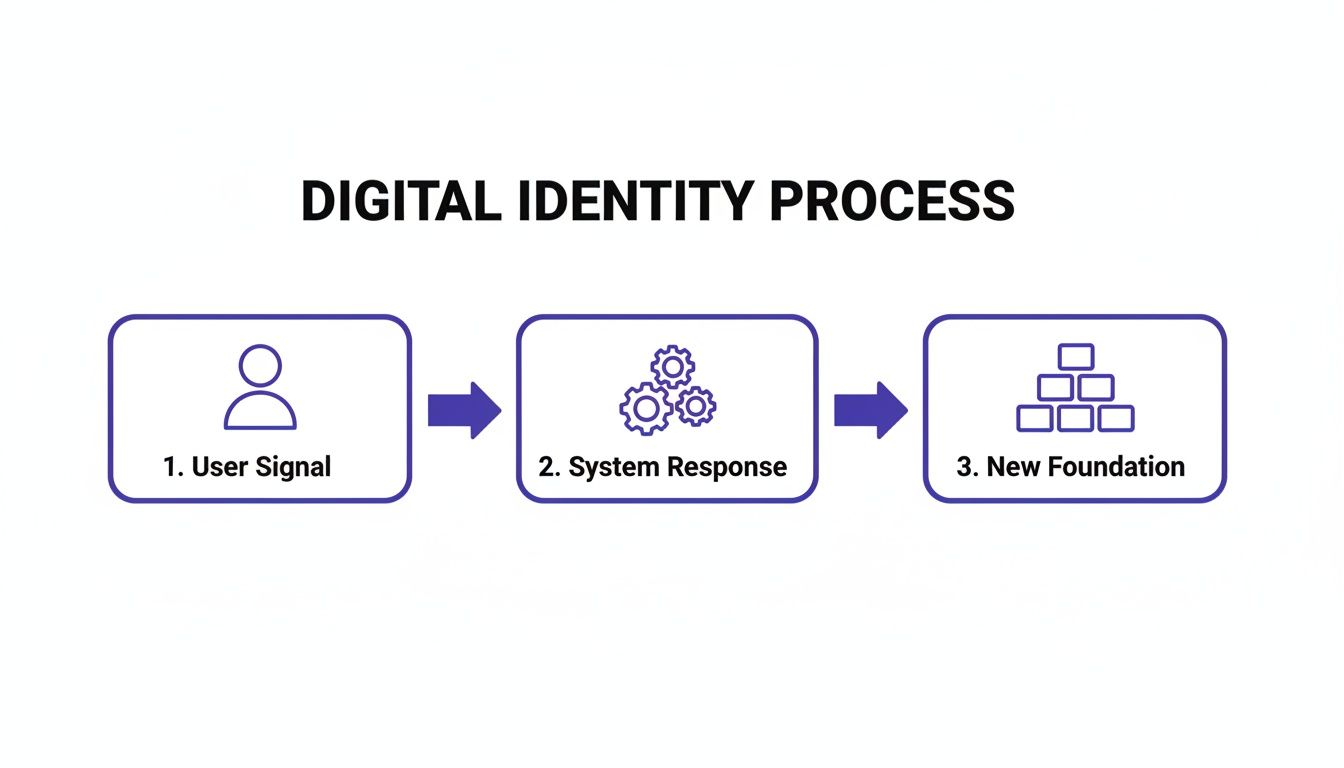
This is the transition digital identity is now undergoing, from fragmented signals of user behavior into a cohesive, system-level foundation. System-level change is rarely born in a boardroom. It’s forged by the pressure of repeated behavioral signals. When millions of people adopt a new way of doing things, they create a force that the underlying infrastructure must eventually accommodate. The friction, insecurity, and inefficiency of the old system become intolerable, creating a vacuum that new, better-aligned systems rush to fill.
The signal from our mobile-first, identity-centric behavior is deafening. Billions of daily actions from authenticating with a fingerprint, tapping to pay, to sharing a verifiable credential, have coalesced into a massive, undeniable demand for new naming primitives. This isn’t just a niche trend; the digital identity market is projected to surge from $34.5 billion in 2023 to $83.2 billion by 2028.
Utility gTLDs are the infrastructure that translates this raw signal into a durable system. They provide the stable, predictable naming components needed to build the identity solutions this market demands. They take a messy, ad-hoc user behavior, like trying to verify a credential, and give it a permanent, machine-readable foundation. In this way, a fleeting user need is transformed into a resilient piece of internet architecture that developers can build upon with confidence.
Utility gTLDs sit on one side of a fundamental tradeoff that every applicant must confront: control versus adoption.
Systems optimized for control prioritize governance, predictability, and restricted participation. Systems optimized for adoption prioritize integration, distribution, and external dependency. Utility gTLDs succeed only when adoption is the primary design constraint.
Many gTLD initiatives struggle because they attempt to preserve tight control while simultaneously expecting broad external usage. In practice, this tension undermines trust, confuses partners, and limits scale. Utility gTLDs work precisely because they resolve this tradeoff early, embedding themselves into workflows where adoption is driven by necessity, not marketing.
Launching a utility gTLD requires a radical departure from the speculative land-rush models of the past. A signal-aligned launch prioritizes systemic integration over marketing awareness. The goal isn’t to sell as many names as possible on day one, but to become indispensable plumbing within a target ecosystem.
This strategy begins not with a press release, but with deep partnerships. For a gTLD focused on mobile identity, this means embedding its logic directly into the core infrastructure of wallet providers, standards bodies, and enterprise identity platforms before the public can register a single name. By integrating with the systems users already trust, the gTLD launches with built-in relevance. Its value is proven through function, not promised in an advertisement.
Success is measured not in brand recognition but in transaction volume, API calls, and the number of systems that rely on it for secure operations. A utility gTLD doesn’t need to be famous like .com, it needs to be functional and reliable. This approach is a bet on structural fit over market hype, recognizing that in a mobile-first world, value is created through seamless integration into the tools people already use. This creates powerful network effects and ensures long-term viability, a crucial component for building a community with custom top-level domains.
Utility gTLDs are not speculative bets on the next trendy namespace. They are a necessary architectural response to a fundamental, irreversible shift in global digital behavior. The systems that win are never those that fight user behavior, but those that align with it, removing friction and providing a stable foundation for innovation. The era of treating domains as marketing assets is giving way to a new paradigm where naming systems are critical infrastructure for a digital identity ecosystem built on verification, portability, and trust.
The move to mobile-first behavior has exposed deep gaps between how people authenticate and how the internet names and verifies identity. These behavioral signals are now forcing a system-level response.
For executives, investors, and builders, the task is clear: look past the noise of speculative domain markets and focus on the powerful signal of user behavior. The most valuable gTLDs of the next decade will be the ones that function as essential, often invisible, components of our digital lives. They represent the inevitable alignment of system and signal.
For decision-makers, the implication is straightforward: a gTLD should not be evaluated as a branding exercise, but as an infrastructure commitment. The question is not how visible it will be, but how indispensable it can become.
In a mobile-first world, digital identity is no longer an application-layer feature – it is core infrastructure, and utility gTLDs are how that infrastructure becomes scalable.
In the next post in this series, we’ll examine how utility gTLDs move from infrastructure to adoption – and what determines whether a digital identity system actually achieves network effects.
From Signal to System Series
Most gTLD initiatives fail before the application is even submitted.
If your organization is considering a gTLD, the most important work happens before the application window opens.
The question is not whether utility-driven gTLDs make sense in theory.
It’s whether your proposed model aligns with how digital identity actually functions in a mobile-first world.
We offer a short, signal-based readiness conversation for teams evaluating a new gTLD ahead of the ICANN application window opening in April 2026. It’s designed to pressure-test assumptions around model fit, adoption constraints, and long-term viability – before capital and credibility are committed.