
The future of domain extensions is no longer speculative. As the 2026 ICANN application round approaches, the market has clarified what the 2012 round revealed over time: domain extensions are not a single asset class. They represent structurally different models with materially different risk profiles.
The first new gTLD round in 2012 resulted in over 1,900 applications and more than 1,200 delegated extensions. A decade later, the performance dispersion is stark. A small percentage of domain extensions account for the majority of active registrations and renewal rates, while many others plateaued early or declined after initial promotional surges.
The lesson is no longer theoretical.
Today, domain extensions split into two durable categories:
Utility-driven gTLDs built around enforceable function
Brand-controlled (.Brand) TLDs built around governance and control
This is not a branding distinction. It is an infrastructure distinction.
Organizations preparing for 2026 are not just choosing a string. They are choosing a structural model.

Utility domain extensions are the workhorses of the new internet – they exist purely to do something. These aren’t vanity plates. They are functional platforms engineered to deliver a specific, repeatable value that a generic .com simply can’t.
A utility gTLD must answer a single question clearly:
What does this extension enable that .com does not?
A gTLD like .bank promises a verified, secure financial environment. An extension like .realtor immediately confirms credentialed status. Even something like .app signals distribution intent. This is not branding. It is embedded function.
The entire success of a utility gTLD hinges on its ability to deliver on this promise, every single time. Real-world examples prove this point:
In the 2012 round, vertical and restricted domain extensions with embedded governance demonstrated stronger renewal resilience than broadly positioned generics. Extensions aligned with professional standards or defined industry ecosystems proved more defensible over time.
By contrast, open strings without structural differentiation often relied on heavy discounting to generate early registration volume. Once standard pricing returned, renewal rates declined sharply. Without a clear reason to exist beyond cost, those domain extensions were forced to compete primarily on price.
Utility is not marketing. It is governance executed consistently over time.
.Brand domain extensions operate on a different strategic axis. They are not public-market growth plays. They are private infrastructure.
Operating on shared domain extensions means operating within namespace constraints you do not control. A .Brand TLD reverses that dynamic by establishing a governed trust layer across an enterprise’s entire digital ecosystem.
A .Brand TLD like .google, .bmw, or .hsbc transforms DNS from rented distribution into controlled territory.
Key use cases demonstrate its power:
statement@mail.hsbc or support.bmw, they can be 100% certain it’s legitimate. It sends a clear message: “If it doesn’t end in our extension, it isn’t us.”careers.accenture or sustainability.audi, reinforcing the brand at every touchpoint.In the 2012 round, many .Brand applicants applied defensively. A decade later, enterprises evaluating domain extensions ahead of 2026 are approaching .Brand as strategic infrastructure. The return isn’t found in quarterly marketing metrics but in long-term resilience, control, and the unwavering trust of your customers.
The most instructive lesson from the 2012 ICANN application round is structural.
Generic domain extensions positioned for broad, undefined audiences frequently struggled to sustain differentiation. Without enforceable utility or brand governance, they defaulted to price competition against .com.
The lesson from the last decade is clear: a gTLD must either deliver undeniable utility or serve as brand-owned infrastructure. Trying to be everything to everyone is a surefire path to becoming nothing to anyone.
Several registries launched with ambitious growth expectations only to encounter:
The market did not reject domain extensions as a category. It rejected ambiguity.
Registries launched with vague concepts like .icu, .cool, or even .vip, hoping to capture broad market appeal. Instead, many found themselves in a race to the bottom, offering domains for pennies just to create the illusion of momentum. Speaking from experience, operating in that environment is not rewarding. Renewal rates were often abysmal, and significant time was spent managing abusive registrations where no one benefits.
Unclear positioning creates the highest risk. A TLD with a fuzzy identity cannot build a loyal base around function, nor cultivate a committed community around a brand. The market no longer rewards speculation on generic keywords. It rewards clarity, purpose, and a well-defined value proposition. The middle ground isn’t just shrinking – it’s a strategic dead end.
The 2026 ICANN round will take place in a more data-informed environment. Investors, boards, and operators now have a decade of evidence. Ambiguity will be identified faster and corrected earlier.
For a deeper dive, see our analysis on exploring exclusive vs open top-level domains.
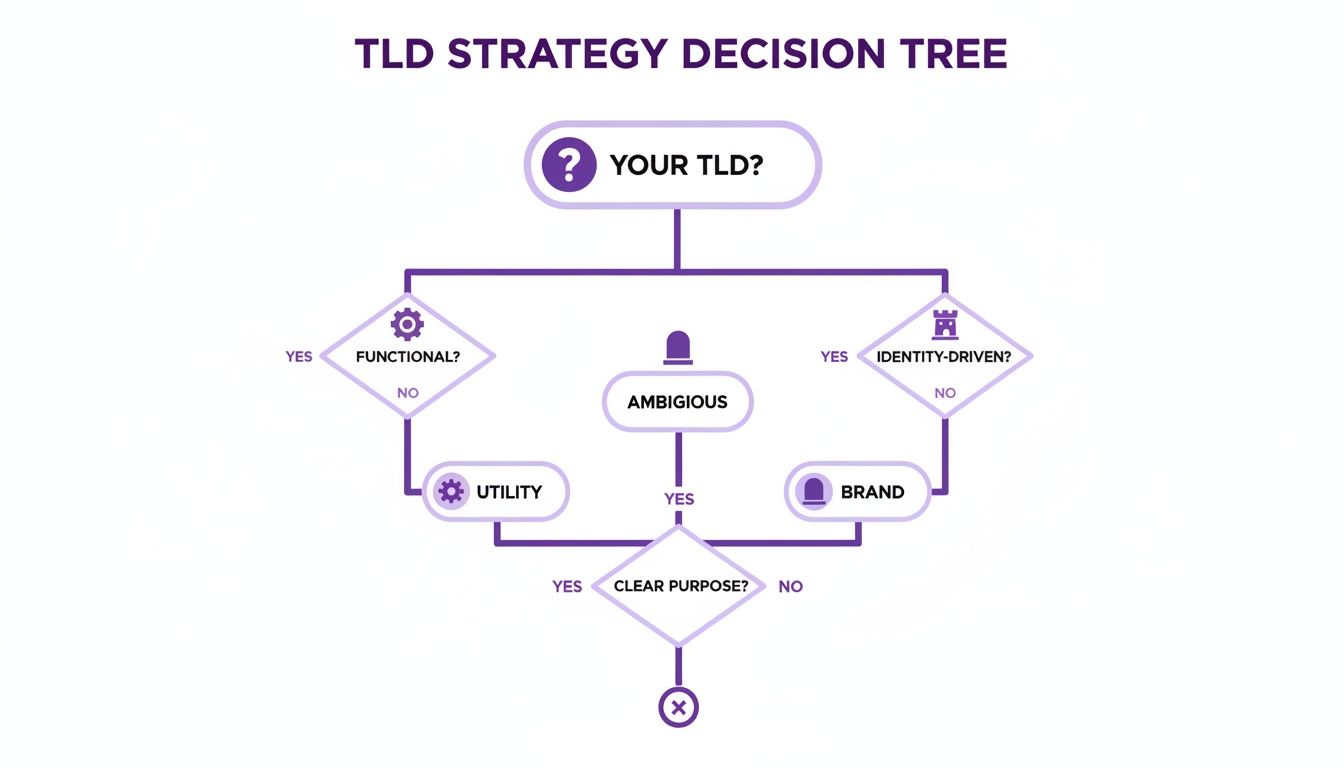
For applicants evaluating new domain extensions in the next ICANN round, positioning will matter more than ever. This choice dictates strategy, capital allocation, governance design, and long-term execution.
If you’re building a utility gTLD, your entire strategy must be aggressive and externally focused. Your capital will lean heavily toward go-to-market efforts: ecosystem building, partnerships with industry groups, and marketing campaigns that teach your target audience about your value. Success is measured in active registrations, high renewal rates, and becoming the go-to standard for a specific community. To learn more, read about the role of open top-level domains in enhancing digital trust.
Conversely, if you are building a .Brand TLD, the strategy is internal. The goal isn’t public adoption but corporate alignment. Capital is spent on airtight security and systems integration. The rollout must be careful and deliberate, requiring deep collaboration across IT, security, marketing, and legal. It’s a long-term infrastructure project, not a flashy sales campaign. That is why brands are gearing up for the 2026 gTLD application round.
The upcoming round won’t reward the organizations that simply show up. It will reward those who arrive with a clear, defensible model of the future they intend to build.
From direct experience across prior gTLD cycles, the most common failure point was not string selection. It was misalignment between ambition and operational readiness. Governance complexity was underestimated. Early momentum was overestimated. Repositioning often occurred only after capital had already been deployed.
Disciplined preparation consistently outperforms reactive enthusiasm.
The next wave of domain extensions will not resemble the last. The days of throwing generic domain extensions at the wall to see what sticks are long gone. Domain extensions that lack a clearly defined role will quickly struggle to justify further investment.
New gTLDs will succeed either by delivering real, enforceable utility to a specific audience or by operating as secure, brand-owned infrastructure. There is no durable third option.
For executives, investors, and brand guardians, the job now is to look past the novelty and evaluate the strategic role of a top-level domain with unsparing rigor. Is it a functional service platform or a critical piece of corporate infrastructure?
Choosing a path is only the first step. Execution is what separates a visionary digital asset from a million-dollar mistake, a topic we’ll dive into in future articles. The journey starts now, with a firm commitment to one of these two futures. Want to dig deeper? You can explore detailed market projections and insights.
Across prior application cycles, the difference between durable domain extensions and expensive repositioning exercises was rarely the string itself. It was the rigor applied before submission.
Applicants who stress-tested governance models, renewal sensitivity, abuse exposure, capital runway, and internal alignment early entered delegation with structural clarity. Those who relied on projected enthusiasm often discovered operational complexity after capital was already deployed.
As the 2026 ICANN window approaches, disciplined preparation will matter more than application volume. Evaluating domain extensions as long-term infrastructure – rather than short-term opportunity – requires experience with registry economics, policy realities, and post-delegation execution.
The organizations that approach this round methodically will not simply secure a string. They will build assets designed to endure.
Most gTLD initiatives fail before the application is even submitted.
If your organization is considering a gTLD, the most important work happens before the application window opens.
The question is not whether utility-driven gTLDs make sense in theory.
It’s whether your proposed model aligns with how digital identity actually functions in a mobile-first world.
We offer a short, signal-based readiness conversation for teams evaluating a new gTLD ahead of the ICANN application window opening in April 2026. It’s designed to pressure-test assumptions around model fit, adoption constraints, and long-term viability – before capital and credibility are committed.
Ready to choose your path and build a digital asset that will last for decades? TLDz offers end-to-end advisory to guide you through every single stage of the gTLD application and operational process. Book your strategic consultation today.