
In the domain name industry, flashy registration numbers get all the attention. But seasoned professionals know this metric often hides more than it reveals. You might say it’s the industry’s version of putting lipstick on a pig. Registrations alone do not determine real TLD viability.
The central question for any serious decision-maker is what the data shows versus what the industry often assumes. Measuring real TLD viability means separating speculative noise from evidence that a chosen string has a credible path to long-term success. That distinction is the foundation of any sound strategic decision in a market still buzzing with hype and short-term promotion.
That is why we developed TLD Strategic Intelligence – The Zen Report, a data-driven framework designed to assess the likelihood of success for new top-level domain strings by examining objective signals rather than inflated assumptions.
In the domain name world, raw registration numbers are the ultimate vanity metric. They are big, easy to count, and look fantastic in a press release. But for anyone serious about the industry, relying on those figures is like judging a restaurant by how many flyers it prints – it tells you nothing about whether the business will actually succeed.
Aggressive promotions, deep bulk discounts for registrars, and speculative hoarding create a short-lived sugar high of registration volume that quickly fades away. For example, a new gTLD like .work or .lol might launch with a $0.99 promotion and generate hundreds of thousands of registrations almost overnight. But when those domains are not renewed at standard pricing, the initial spike offers little insight into whether the string ever had a credible path to long-term success. In reality, it hurts the TLD due to increased volume of spam and phishing, and unexpected consequences.
For context on how ICANN has reassessed outcomes and evaluation considerations following earlier gTLD rounds, see the ICANNWiki overview of the Policy Development Process for New gTLD Subsequent Procedures.
A registration is simply the initial transaction, often driven by price rather than intent. Renewals provide a stronger signal, suggesting perceived ongoing value. Indicators such as active configuration – domains set up for websites, email, or services – are not measures of popularity, but they are meaningful signals that a string aligns with real-world use cases. These signals help assess real TLD viability by showing whether a namespace supports functional deployment beyond speculation.
The reality is that quality, not volume, is the metric that matters. Savvy operators understand that one domain actively used for a legitimate business is worth a thousand domains sitting dormant in a speculative portfolios. Chasing volume often leads to a ghost town of parked pages and can attract the wrong kind of attention. In fact, one study found that while new gTLDs make up just 11% of the market, they account for a shocking 51% of phishing domains, a direct consequence of prioritizing volume over value.
A gTLD does not fail because it lacked attention. It fails because its underlying assumptions about demand, usage, and long-term relevance were incorrect.
Registration volume measures initial interest. Viability depends on renewal behavior, legitimate use, and alignment with real-world needs. When these signals are absent, no amount of promotional activity can compensate.
For executives and applicants, the implication is clear: assessing real TLD viability requires evaluating structure first and outcomes second.

If registration numbers are the marketing brochure of the domain name industry, the TLD Strategic Intelligence – The Zen Report is the feasibility study. Rather than focusing on how many domains might be sold after launch, the Zen Report evaluates whether a specific TLD string is structurally positioned to succeed.
Instead of asking, “How many registrations could this generate?” the Report asks a more fundamental question: Does this string have the characteristics, context, and strategic alignment required to function as a successful top-level domain?
Our methodology examines the subject string across multiple dimensions that collectively inform real TLD viability, including string strength, usage context, popularity, audience alignment, brand risk, competitive landscape, and future adaptability. These dimensions are not treated in isolation. They are evaluated together to understand whether the string makes sense linguistically, semantically, commercially, and strategically within the broader internet ecosystem.
The Zen Report analyzes how a string already behaves in the world as a word, brand, or concept. This includes how frequently it appears in existing domain names, how it combines with other words, how recognizable and trusted it is, how it performs in search and social contexts, and where it may introduce brand, geographic, or competitive risk.
By aggregating these signals, the TLD Strategic Intelligence Report does not attempt to predict adoption or guarantee outcomes. Instead, it provides a disciplined, evidence-based assessment of whether a proposed string has a credible path to success if pursued as a top-level domain. This approach shifts the conversation away from speculative volume and toward informed decision-making – giving executives and applicants a clearer basis for determining whether a string is worth the investment, effort, and long-term commitment a TLD requires.
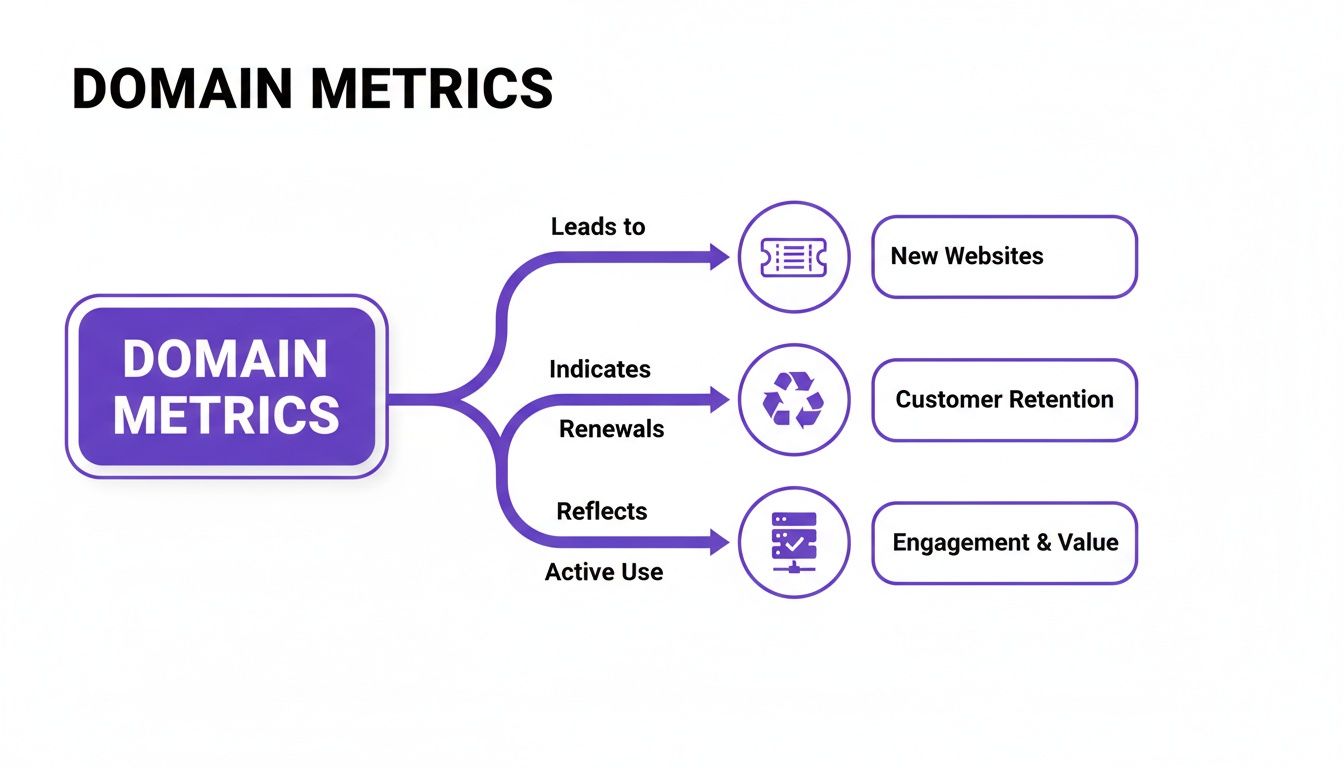
Once misleading noise is stripped away, the Strategic Intelligence Report reveals clear patterns in which types of strings are structurally positioned to succeed as top-level domains. Real TLD viability does not emerge from raw registrations alone. It shows up with a string offers clarity of meaning and a well-defined context. This is the critical difference between intent-driven adoption and speculative demand.
One of the strongest signals comes from TLDs serving a distinct professional or tech community. Tech-focused TLDs like .app and .dev have incredibly high rates of actual use for live projects and developer portfolios. Similarly, highly regulated extensions like .bank and .law provide an immediate signal of professional qualification and trust. In these categories, the TLD itself carries meaning that supports its role as a TLD.
On the other hand, many broad generic TLDs, like .xyz or .online, present a much cloudier picture. While their registration numbers are astronomical, the active usage rates are often diluted by a vast ocean of parked domains and speculative portfolios snapped up during $0.99 sales. Scale alone does not translate into structural strength. Signals of long-term viability may exist, but they are often buried beneath an immense amount of noise. Their broad semantics make them adaptable, but also require significant effort to establish purpose. In viability terms, these strings often rely heavily on marketing momentum rather than inherent fit.
The TLD Strategic Intelligence Report uses these contrasts to highlight a core principle: strings with a defined role, audience, or trust signal tend to exhibit a clearer path to success than those dependent on volume-driven adoption. Viability is strongest where a string’s meaning, context, and intended use reinforce one another, creating a foundation that can support sustainable deployment over time.
Rather than treating demand as a single metric, this approach reframes success as a question of fit. TLDs that align with a specific function, identity, or trust framework are better positioned to justify the long-term investment required to operate and maintain a top-level domain.

For anyone eyeing the next ICANN application window, the TLD Strategic Intelligence – The Zen Report acts as a strategic flilter. The core message is direct: the assumptions that fueled the 2012 round are dead. The next wave won’t be won with speculative hype. They’ll be defined by strategic fit and credible path to success for the chosen string(s).
Future applicants must build their business models in evidence. The data should push you to ask tough but necessary questions early in the process:
.bank signals trust through its contect, a string like .bio must demonstrate relevance beyond generic appeal..app which took off by being directly tied to a function.One of the clearest lessons from prior rounds is the risk of extrapolating success from inflated metrics. Many generic strings generated impressive early numbers but struggled to establish long-term relevance or differentiation. Basing a multi-hundread-thousand-dollar application on the flimsy hope that clever marketing can make up for a lack of utility is a recipe for disaster.
The TLD Strategic Intelligence Report exists to help applicants avoid that mistake. By focusing on real TLD viability – the likelihood that a string can succeed given its characteristics and context – it provides a stronger foundation for decision-making. For organizations considering this journey, understanding these dynamics early is essential. Our overview of how to get your own top-level domain provides a comprehensive roadmap.
The TLD Strategic Intelligence Report’s key lesson is not about chasing demand, but about understanding real TLD viability. Success is not hidden in a spreadsheet of .lol domains sold for a buck apiece; it’s in the active deployment of a .law firm’s email or a developer’s live project on .dev. A disciplined, data-driven approach is no longer a “nice-to-have”. It is the only way for future applicants to navigate the modern gTLD market.
This principle of disciplined interpretation of data should be the cornerstone of any sound TLD strategy. But even when a string demonstrates a credible path to success, viability alone is not the finish line. Applicants must still confront the harsh realities of cost, execution, and the immense operational lift required to run a registry.
Approaching these decisions with clarity and evidence is what separates durable TLDs from those that never progress beyond the application phase.
In the next post in this series, we will examine how utility gTLDs move from infrastructure to adoption, and what determines whether a digital identity system actually achieves network effects.
Most gTLD initiatives fail long before the application is submitted.
Most gTLD initiatives fail before the application is even submitted.
If your organization is considering a gTLD, the most important work happens before the application window opens.
The question is not whether new TLDs can attract registrations.
It’s whether the proposed string has the structural signals required to support long-term viability.
We offer a short, signal-based readiness conversation for teams evaluating a new gTLD ahead of the ICANN application window opening in April 2026. It’s designed to pressure-test assumptions around model fit, adoption constraints, and long-term viability – before capital and credibility are committed.