
A gTLD proposal is not just a technical application – it’s a board-level decision. Thinking about preparing a gTLD proposal for a new generic Top-Level Domain (gTLD) like .brand or even a broad, open namespace like .app, .shop or something more experimental like .lol? It’s not just another marketing project or a tech upgrade.
It’s a decision about owning a piece of the internet’s naming layer.
Applying for a gTLD is a massive strategic commitment that goes straight to the boardroom, and it’s ultimately a board-level decision, not a technical or marketing approval.
And increasingly, it’s not just about brand protection. It’s about control, distribution, and positioning in the next phase of the internet, where identity, trust, and discovery are being reshaped by AI, platforms, and decentralized systems.
Success hinges on mastering the art of board decision making. You have to translate the ambitious vision for your TLD’s digital future into the sober language of risk, governance, and long-term liability. This creates a central tension: your team is framing a massive opportunity, but the board is framing a perpetual risk. Forget selling an idea; your real job is to de-risk a strategic asset until approval is the only logical outcome.
If you want to understand how a board thinks, grasp this fundamental truth: boards are wired for downside protection, not upside speculation. It’s the core of their fiduciary duty. A recent Deloitte survey found that while boards are spending more time on deep strategy, they are laser-focused on company-specific risks.
When a project team walks in with a gTLD proposal bursting with optimistic talk of brand elevation and market capture, the board isn’t hearing opportunity – they’re scanning for threats. The team is selling a dream, while the board is quietly conducting a pre-mortem on a potential nightmare. They instinctively put downside risk ahead of upside potential because a single catastrophic failure can wipe out decades of success. A missed opportunity? That’s just business. This is precisely why opportunity-only pitches consistently fail in boardrooms.
This tension becomes even more pronounced when the proposal extends beyond a closed .brand into an open or restricted TLD strategy – where the scope shifts from internal control to external participation.
Now the board isn’t just evaluating internal use – they’re evaluating whether the company is prepared to operate a platform, not just a namespace. That shift – from usage to stewardship – dramatically expands both the perceived opportunity and the perceived risk – and changes the nature of the decision entirely.
When a gTLD application hits their desk, directors instinctively look for four specific kinds of risk. You must answer these questions before they’re even asked.
.apple, .amazon, or .fail, any misuse becomes a public reflection on the brand.Your goal isn’t to sell the board an idea. It’s to de-risk a strategic asset until approval becomes the only logical conclusion for your gTLD proposal.

When a board evaluates a gTLD proposal, they don’t just glance at the governance section – they live there. For directors, governance is the entire framework for assessing a long-term, high-stakes venture. A vague chart showing a “steering committee” is meaningless. Directors need to know exactly who is ultimately responsible for this gTLD, forever.
They will evaluate the governance structures and accountability with relentless and practical questions. What happens when the current project champion moves on? Who owns this initiative in a decade? Answering these shows you understand that a gTLD is an enduring corporate asset, not a fleeting campaign.
To most teams, ICANN compliance is a series of technical hurdles. To a board, it’s a permanent source of legal liability and enforcement exposure. They must understand the implications of long-term oversight. You have to translate ICANN’s dense rulebook into the language of business risk, detailing the real costs of enforcement, the burden of continuous reporting, and the liability of inaction. This isn’t about scaremongering; it’s about proving you’ve quantified a perpetual obligation. For a deeper dive, it’s wise to explore the specific legal considerations when applying for a new top-level domain.
The complexity increases further when considering open TLD models.
Unlike a closed .brand, where usage is tightly controlled, an open TLD introduces external registrants, third-party behavior, and ecosystem dynamics. To a board, this doesn’t just look like growth potential – it looks like expanded exposure.
But it also represents something more strategic: the ability to shape a category, define trust signals, and own a layer of digital identity at scale.
That duality – platform upside vs. systemic risk – is exactly where most proposals either gain traction or collapse.
For any board, reputational risk is a first-order concern that trumps almost all others. A financial loss can be recovered, but a tarnished brand can take decades to repair. A gTLD elevates this risk because it creates a permanent link between your brand and a piece of global internet infrastructure. Whether it’s .bank, .cars, or .sucks, any association with phishing, hate speech, or illegal activity becomes an immediate PR crisis. The board needs to see an almost paranoid level of preparation for these scenarios. Strong proposals don’t just promise to protect the brand; they demonstrate exactly how, with a robust Acceptable Use Policy, a clear takedown procedure, and a crisis communications plan ready for activation.
A gTLD permanently attaches your corporate name to a piece of the internet, making any misuse a direct and public reflection on the brand. A well-defined plan for governance and reputation isn’t just nice to have; it’s the price of admission.
An ICANN application form is a masterclass in structured, predictable questions. But it never gets to the one question every single director is thinking: “What happens when this all goes horribly wrong?”
This is the critical gap where most gTLD proposals die. Proponents arrive ready to talk about opportunity, but the board’s mind is on adversity. They aren’t looking for a guarantee of success; they are searching for a comprehensive, unflinching plan for failure. Clarity over optimism is the entire game.
Boards are paid to be professional skeptics. While your team imagines a successful launch, the board is conducting a “pre-mortem” on a catastrophic failure.
But increasingly, they are also asking a second, quieter question:
“What happens if we don’t do this?”
In a world where platforms control distribution, AI agents mediate discovery, and digital identity is becoming more fragmented, not owning a piece of your naming infrastructure may itself become a strategic risk.
This is especially true as companies begin to rethink their dependence on third-party ecosystems and look for ways to reclaim control over how users find, trust, and interact with them online.
They expect you to have done the same, and these are the scenarios, failure modes, and exit paths they will explore:
A director’s worst nightmare is an indefinite financial drain with no clear way out. A clear-eyed analysis of what could go wrong shows respect for their fiduciary duty. You aren’t just pitching a project; you are stewarding corporate resources.
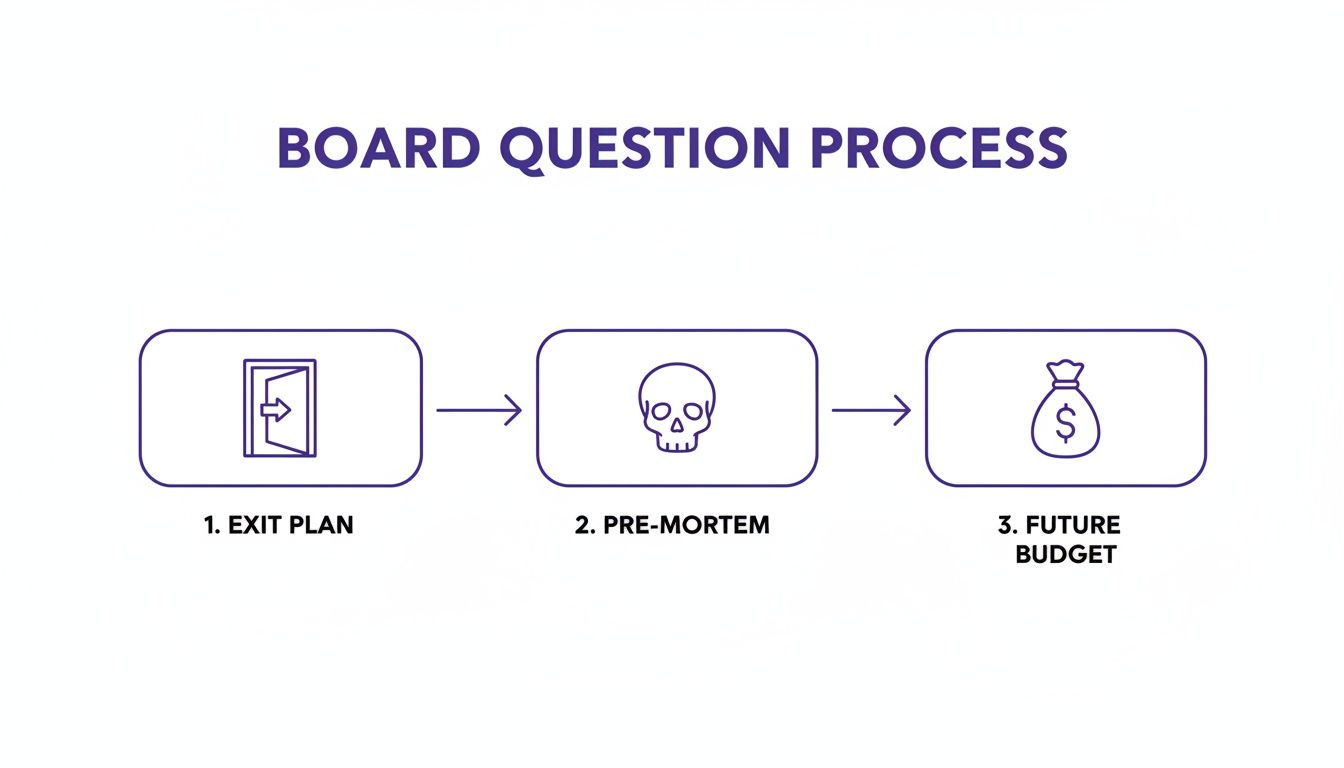
Boards aren’t looking for a guarantee of success; they are looking for a comprehensive plan for adversity. They need to see you’ve anticipated the storm, not just forecasted sunshine.
An application built for ICANN is a technical document and a business plan. A proposal for your board must be a compelling business case. Successful proposals perfectly align strategy, risk, and governance, connecting the gTLD directly to core corporate goals. Done right, the conversation shifts from, “Should we do this?” to “How can we afford not to?“
Strong framing anticipates board objections before they’re even raised. It’s not about hiding the downsides; it’s about presenting a balanced view that acknowledges risks head-on and lays out credible plans to manage them.
Think of your proposal as a three-legged stool: strategy, risk, and governance. If any leg is shaky, the whole thing collapses under board scrutiny.
.youtube and .google did? A defensive play like the one banks made for .bank? Or is it something more forward-looking:The strongest proposals don’t just justify the present. They position the company for where the internet is going next.
Preparedness, not persuasion, is the currency of the boardroom. A strong proposal doesn’t sell a dream; it de-risks a strategic investment until approval becomes the only logical outcome.
When you take this structured approach, you’re showing respect for the board’s role. It proves you have more than a vision for success – you have a pragmatic plan to handle the inevitable bumps in the road. That level of preparedness is what earns a confident “yes.”
Getting your board to approve a gTLD proposal isn’t about generating hype. It’s about demonstrating absolute, unwavering clarity on risk. But it’s also about showing that this isn’t just a defensive move – it’s a strategic position in the future architecture of the internet. Board approval depends on risk clarity, not enthusiasm. But momentum comes from framing the decision in context:
Not just “Should we do this?”
But “What role do we want to play in the next phase of how the internet works?”
To succeed, you must speak the language of executive leadership – a language that prioritizes protecting the downside over celebrating optimistic forecasts. You’re not selling a dream; you’re de-risking an investment. But the best proposals go one step further: they make it clear that inaction carries its own form of risk. Your proposal must be board-ready, not just ICANN-ready. Getting that internal green light is always the highest and toughest hurdle. Because in the end, this isn’t just about applying for a gTLD. It’s about deciding whether to participate in shaping the future of digital identity – or simply operate within it.
As you get started, you might find it useful to check out the draft applicant guidebook and how to get ready for your own gTLD.
Most gTLD initiatives fail before the application is even submitted.
If your organization is considering a gTLD, the most important work happens before the application window opens.
The question is not whether utility-driven gTLDs make sense in theory.
It’s whether your proposed model aligns with how digital identity actually functions in a mobile-first world.
We offer a short, signal-based readiness conversation for teams evaluating a new gTLD ahead of the ICANN application window opening in April 2026. It’s designed to pressure-test assumptions around model fit, adoption constraints, and long-term viability – before capital and credibility are committed.