Why strategy matters ahead of the next gTLD window is a critical question for brands considering a .brand or open gTLD in the next ICANN application round. With the next gTLD window approaching, early planning can determine whether a brand gains long-term advantage or faces costly limitations.
For years, brand top-level domains (TLDs) have been framed as a nice-to-have: a clever marketing idea, a digital experiment, or something to revisit “when the time is right.” But the next gTLD window of applications changes that narrative entirely.
With only months remaining before the application window opens, the organisations that succeed will not be those that merely like the idea of a .brand. They will be the ones that approach it with a clear strategy, evidence, and intent.
At TLDz, we are seeing this shift happen in real time. The conversation is moving from: “Should we apply for a brand TLD?” to “What would we actually do with it?”
That distinction is everything.
Applying for a brand TLD is not about acquiring another web address.
It is about redefining how your organisation expresses identity, trust, and structure across the internet.
A brand TLD becomes:
A trust layer for customers, partners, and regulators
A framework for internal and external digital architecture
A long-term platform for innovation, authentication, and experience design
This is precisely why strategy must come first.
Without clarity on why the TLD exists, who it serves, and how it creates value, even the strongest brands risk launching a namespace that is underused, misunderstood, or quietly abandoned. That is why strategy matters ahead of the next gTLD window. (Read more: Why Brands Are Gearing Up for the 2026 gTLD Application Round and Custom Top-Level Domain: A Guide For Your Brand)
This is where data-driven planning becomes essential.
At TLDz, we developed the TLD Power Score (TPS) to quantify something that is often discussed abstractly: how powerful a brand is as a digital namespace.
TPS evaluates a brand’s potential TLD across multiple dimensions, including:
Trust and authority
Semantic clarity
Global recognition
Ecosystem leverage
Adoption and navigation potential
In simple terms, TPS answers a critical strategic question: “If this brand owned its namespace, how meaningful would it be?”
Some of the brands we’ve highlighted recently are not hypothetical examples. Their TPS scores reveal real strategic weight.
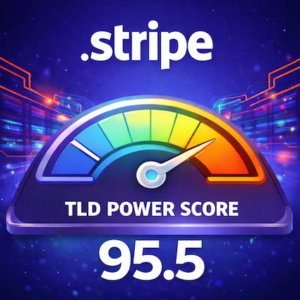
Stripe’s score highlights a different strategic advantage: infrastructure trust.
Embedded into millions of businesses worldwide, Stripe already operates as a financial backbone. The TPS reveals significant potential for:
api.stripe
docs.stripe
pay.stripe
identity.stripe
This is not about marketing pages.
It is about authenticated environments, reduced phishing risk, and globally consistent integrations.
In strategic terms, .stripe becomes a security and identity layer, not just a brand expression.

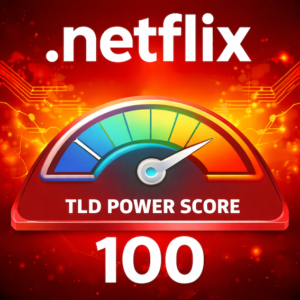
A perfect TPS score is rare.
Netflix achieves it through exceptional global recognition and unmatched semantic clarity. A .netflix namespace could structure content, regions, and experiences in a way that feels instantly intuitive:
original.netflix
korea.netflix
anime.netflix
family.netflix
This is not cosmetic branding.
It is navigational architecture.
The TPS confirms what users already demonstrate: Netflix functions as a platform. A brand TLD would simply formalise that reality.

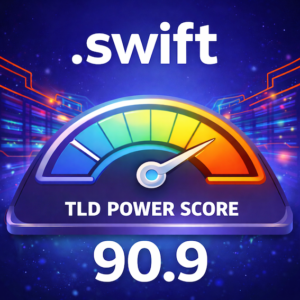
SWIFT’s strength lies in institutional trust.
Our modelling shows that a .swift namespace could fundamentally change how legitimacy is communicated online:
pay.swift
compliance.swift
partners.swift
aml.swift
Here, the domain itself becomes a signal of authenticity. Trust is no longer claimed in content- it is embedded in the address.
That represents a structural shift in how financial identity operates on the internet.
The next gTLD application window is approaching fast.
While applying for a brand TLD is a technical process, deciding to apply is a strategic one.
The organisations that will extract long-term value are not asking: “Can we operate a TLD?”
They are asking:
How does this reshape our ecosystem?
Where does it reduce digital risk?
How does it enable new forms of trust, engagement, or scale?
What problem does this solve that traditional URLs cannot?
This is where tools like the TLD Power Score (TPS) become critical.
TPS provides leadership teams with evidence:
Evidence that a TLD is not just feasible, but strategically meaningful
Evidence that it aligns with brand architecture and customer behaviour
Evidence that it belongs in long-term digital planning
A brand TLD is a once-in-a-generation infrastructure decision.
The next gTLD application window may last months. The impact will last decades.
Whether your TPS sits in the 70s, 80s, or pushes toward 100, the question is not simply: “Should we apply?”
It is: “What would this allow us to become?”
That is the strategy conversation worth having now – before the next gTLD application window opens. If you’d like to understand what your brand’s TLD Power Score looks like, or why strategic planning is critical for gTLD Applicants, we’re always happy to share what the data reveals.
Subscribe to Our Monthly Newsletter
Join our mailing list to receive exclusive content only our newsletter members have access to.