
When executives hear about applying for a .brand gTLD – think .google or .bmw – they often picture a flashy marketing gimmick. An expensive vanity plate for the internet. It’s a common misconception. And a costly one.
The decision to secure one isn’t about chasing a temporary campaign metric or a clever URL. It’s an infrastructure investment on par with building a private data center or deploying a global identity management system. The central thesis is simple: .brand gTLD applicants are not focusing on domain name volumes. They are buying deterministic control, unimpeachable trust, and long-term, flexible digital infrastructure.
To understand why a .brand gTLD matters, you have to appreciate what the Domain Name System (DNS) actually is. It’s not just a convenient phonebook for the internet. It’s a foundational layer of digital trust. Every time a customer, partner, or employee interacts with your brand online, they are putting their faith in the DNS to take them to a trusted, secure place. This is why DNS-based brand control has become a strategic priority for enterprises operating at global scale.
When you operate on a shared gTLD like .com, .org, or even a quirky one like .pizza, you are effectively a digital tenant. You’re renting space in a crowded building, subject to the landlord’s rules, security flaws, and the reputational baggage of your neighbors. This dependence on third-party platforms creates inherent risk and limits your control. A .brand gTLD flips this dynamic entirely. You stop being a tenant and become the owner of your exclusive digital real estate, enabling deterministic control over naming, routing, and authentication for your entire digital ecosystem.
In a digital world saturated with phishing, domain squatting, and brand impersonation, a .brand gTLD is one of the most powerful security tools an enterprise can deploy. By controlling the entire namespace, you create a closed, authenticated environment where only legitimate, company-authorized domains can exist. The attack surface for bad actors shrinks dramatically.
This control enables a materially stronger security model. The ability to enforce universal policies such as DNSSEC and DMARC across every domain is a governance advantage that cannot be replicated within a fragmented .com or .net domains. You move from a reactive posture – constantly respondin to abuse – to proactive control, defining the rules of engagement at the foundation.
Recent industry analysis shows that companies operating a .brand gTLD can reduce phishing and brand impersonation incidents by more than 90%. The financial implications are substantial. Fewer fraudulent domains mean lower incident response costs, reduced legal exposure, less customer remediation, and materially lower brand protection overhead. The ROI can quickly offset the cost of your .brand gTLD.
According to IBM’s Cost of a Data Breach Report 2025, the global average cost of a data breach was $4.44 million. As phishing remains one of the most common entry points, reducing impersonation risk at the DNS layer is not just a security enhancement – it is direct, measurable cost avoidance.
Instead of continuously monitoring, litigating, and cleaning up abuse across dozens of third-party extensions, organizations consolidate risk inside a governed namespace. The result is measurable savings, stronger governance, and long-term resilience not to mention headaches.
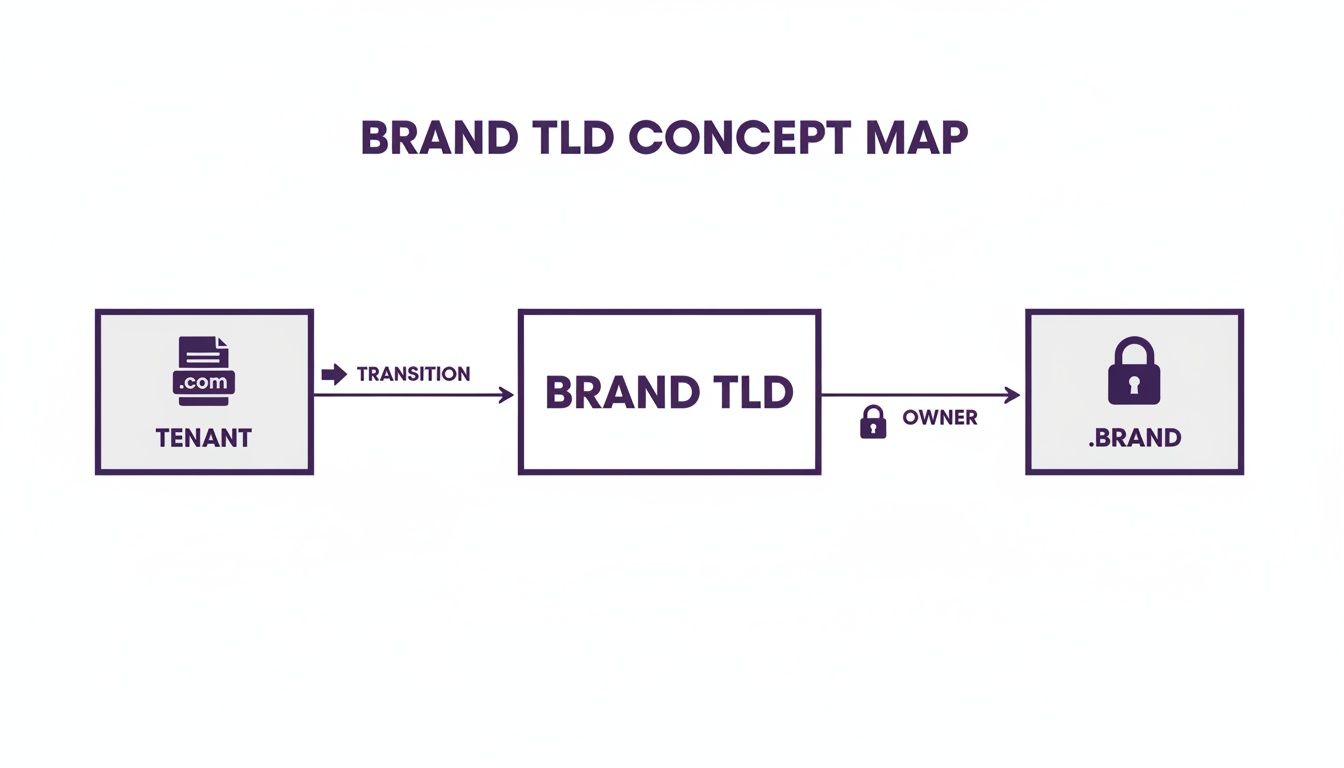
Trying to justify a brand TLD with a traffic-based or conversion-based ROI model is a category error. The true ROI of a brand TLD is not measured in clicks, but in risk reduction, governance efficiency, and long-term resilience. It’s like measuring the value of your corporate firewall by how many sales leads it generates. The lens is wrong because a .brand gTLDis not a marketing campaign (although it can be an extremely valuable to marketing). It’s a piece of core digital infrastructure.
The investment is better compared to other strategic, long-term decisions like building a private network or deploying a global identity system. How do you calculate the ROI of a multi-million-dollar data breach that never happened because you eliminated an entire class of attack vectors? The primary value drivers are risk reduction, enhanced control, and operational resilience – metrics that rarely appear on a marketing dashboard. When viewed as an insurance policy against that level of damage, the financial case becomes considerably clearer. For a deeper look at this, see measuring success with your brand’s TLD.
Many executives eventually arrive at the same question: should my company apply for a .brand? The answer depends less on marketing ambition and more on operational complexity, regulatory exposure, and the cost of unmanaged digital risk.
Let’s be clear: a brand gTLD is not for everyone. The financial and operational commitments are significant. The organizations that benefit most are defined not by strictly marketing ambitions, but by scale, complexity, and regulatory exposure.
Ideal candidates include:
.brand brings order to chaos, enabling centralized governance and security..brand gTLD provides a verifiable, secure channel for all communications.Who should not apply? Startups, small businesses, and any organization focused primarily on short-term marketing goals. The investment is simply too great and the payback period too long. A traditional domain in a gTLD like .com, .io, or even .app is perfectly sufficient. The value of a .brand gTLD is realized when the cost of not having one – in terms of risk and complexity – becomes unsustainable.

A .brand gTLD is not just a marketing asset. It is internet infrastructure.
It delivers long-term control, enforceable governance, and authenticated trust at scale. It shifts an organization from operating inside a shared namespace to owning its digital foundation outright.
The value of a .brand gTLD lies not in what it advertises, but in the risks it prevents and the future capabilities it enables. In an increasingly fragmented and hostile online environment, it is one of the clearest expressions of digital sovereignty.
Evaluating this opportunity requires more than surface-level ROI modeling. It requires a structural assessment of risk, governance, and long-term digital strategy.
If your organization is considering a .brand ahead of the next ICANN application window, start with a signal-based readiness conversation to pressure-test model fit, adoption constraints, and infrastructure alignment – before capital and credibility are committed.
Most gTLD initiatives fail before the application is even submitted.
If your organization is considering a gTLD, the most important work happens before the application window opens.
The question is not whether utility-driven gTLDs make sense in theory.
It’s whether your proposed model aligns with how digital identity actually functions in a online world.
We offer a short, signal-based readiness conversation for teams evaluating a new gTLD ahead of the ICANN application window opening in April 2026. It’s designed to pressure-test assumptions around model fit, adoption constraints, and long-term viability – before capital and credibility are committed.