
In the high-stakes game of new top-level domains, not all contenders compete on equal footing.
In the high-stakes game of new top level domains, not all contenders compete on equal footing. While the digital landscape appears crowded, a clear pattern has emerged: vertical focus consistently outperforms broad, generic positioning in adoption, distribution, and long-term sustainability.
For executives, investors, and registry operators evaluating their next move, understanding this dynamic is not just an advantage – it’s the foundation of a winning strategy.

This analysis dissects why precision beats breadth and provides a strategic framework for future gTLD applicants aiming to build a valuable, digital asset in the next application round.
The core weakness of a generic gTLD is ambiguity.
An “open for anything” positioning, as seen with extensions like .xyz or .online, forces a registry into a constant, costly battle for relevance. The value proposition is a blank slate, requiring millions in marketing just to answer the basic question: “What is this for?”
This lack of clarity creates friction across the business model:
In contrast, a focused, vertical gTLD like .bank or .law enters the market with a built-in value proposition. These extensions sell more than just a domain name. They offer:
The meaning is inherent in the string itself, eliminating guesswork for the end-user. You don’t need a Super Bowl ad to explain what .cpa means to an accountant. The relevance is immediate and intuitive.
This clarity is the engine of adoption. While over 90% of startups must seek alternatives to their first-choice .com, they gravitate toward extensions that offer clear meaning. Vertical TLDs reduce the cognitive load for potential registrants, making the decision to adopt simpler and faster.
In a crowded market, clarity is currency. A vertical gTLD starts with a full coffer of meaning. A generic one begins in debt, forced to spend to establish a brand identity from scratch.

Distribution is where the structural advantage of a vertical gTLD becomes undeniable.
Generic TLDs are locked in a commoditized struggle for shelf space among mass-market registrars, competing primarily on price and promotion. It’s an expensive, high-volume, low-margin numbers game.
Vertical gTLDs sidestep this rat race entirely. Their distribution strategy prioritizes precision over breadth.
Instead of fighting for registrar attention at GoDaddy, NameCheap, etc., a gTLD like .realtor can form direct, high-trust partnerships with the platforms its audience already relies on:
This alignment changes the conversation.
Imagine pitching .online to the American Bar Association – it’s a non-starter. Now, imagine pitching .law. The conversation shifts from a sales transaction to a strategic partnership. The gTLD reinforces the association’s mission while delivering tangible member value and benefits.
This go-to-market efficiency drastically reduces reliance on mass registrar marketing. When a professional body endorses your TLD, it’s not an advertisement. It’s a stamp of approval that builds immediate trust and drives high-quality adoption. This targeted approach yields a higher Lifetime Value (LTV) per registrant and a more stable, abuse-resistant namespace.
For a clear example of this model in practice, the success in establishing the .kids TLD through community alignment provides a compelling blueprint.
A generic gTLD is trapped in a perpetual cycle of education. It must constantly explain what it is, who it’s for, and why anyone should care. This is not just a marketing challenge. It is a significant ongoing cost that inflates Customer Acquisition Costs (CAC) and limits long-term leverage.
Vertical gTLDs benefit from the power of implicit meaning. The extension itself carries context and authority. A domain name like christa.taylor.cpa requires zero additional explanation to communicate professionalism and scope.
The financial implications are significant:
.law domain is far less likely to churn than someone who registered a .cyou domain.These are not theoretical advantages. Market data shows that new gTLD registrations are projected to reach 37.8 million by Q1 2025, with growth increasingly driven by sector-specific demand. The explosive 400%+ growth in AI-related domains fueling .ai‘s rise is a stark testament to how the market rewards focus (and a bit of time 😉 ).
A vertical strategy removes the tax of ambiguity. Capital can be deployed for growth rather than explanation.
For applicants evaluating new top-level domains, vertical alignment has emerged as one of the most reliable predictors of long-term viability.
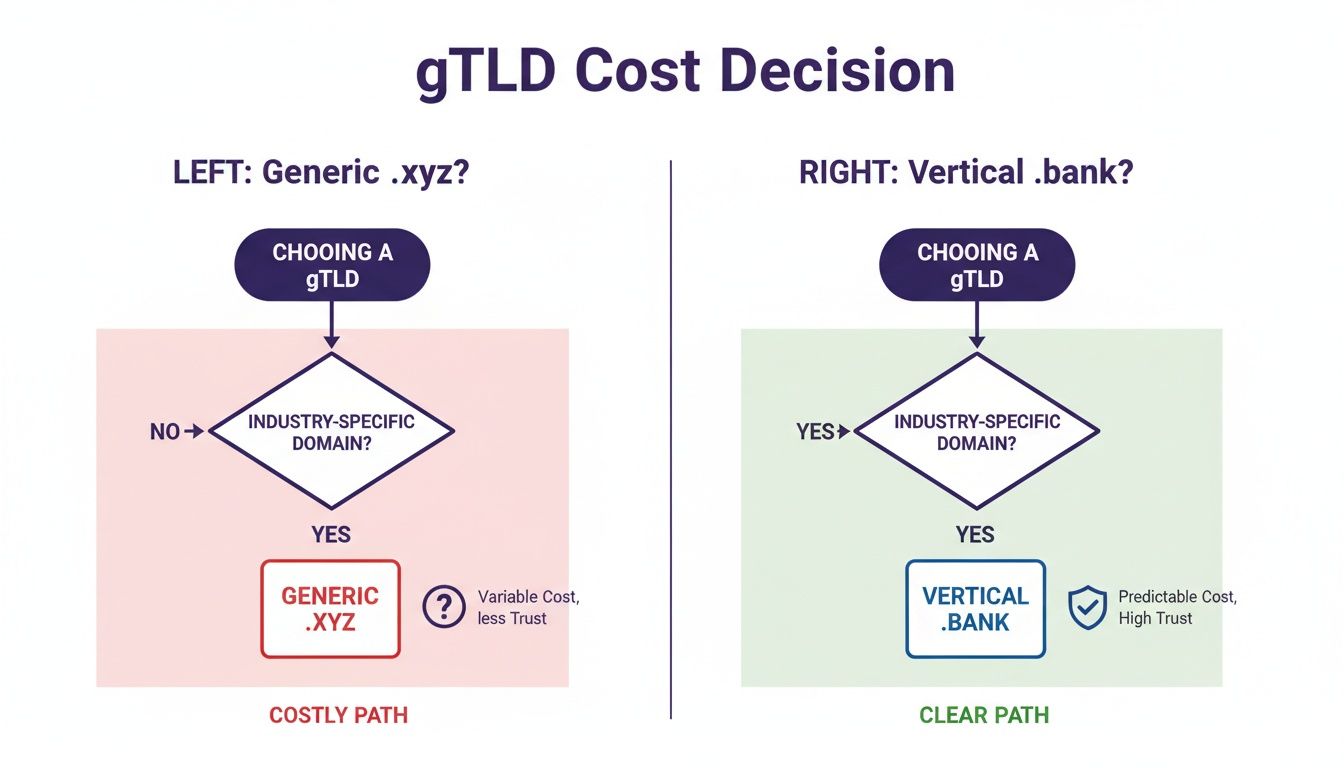
As the next application window for new top-level domains approaches, potential applicants must confront a critical question: does the proposed string represent a true, defensible vertical, or a forced concept without a cohesive community?
Signals of a strong vertical alignment include:
.med).Conversely, red flags of a weak or forced vertical include a concept that is too broad (.holiday), lacks a natural constituency, or relies on a novelty factor (.ninja) rather than professional identity.
The most expensive mistake is confusing a marketing angle with a self-sustaining community.
Vertical alignment must be intentional from the outset. It cannot be layered on later. It must shape the application, financial model, and the entire go-to-market execution plan from day one. For a deeper analysis on this pivotal decision, our guide on how gTLD string selection provides the secret sauce is essential reading.
The evidence is clear. Vertical focus is a structural advantage, not a branding choice.
By embedding meaning, enabling precision districution, and reducing marketing friction, vertical gTLDs build stronger, more resilient and profitable digital assests.
The next gTLD round will reward clarity and relevance over breadth. The internet namespace has matured beyond novelty, and success will be defined not by the theoretical size of a target market but by the depth of connection with a dedicated community. Registries that attempt to serve everyone will continue to compete on price and promotion. Those that align with real-world industries, professions, and identities will compound value over time.
As ICANN prepares to expand the digital landscape again, applicants who embrace the power of vertical alignment will be positioned to win. Not through hype, but through durable adoption, credible usage, and long-term viability. For organizations evaluating this opportunity, the strategic question is no longer whether vertical gTLDs work. It is whether your proposed string is anchored in a community strong enough to sustain one.
Most gTLD initiatives fail before the application is even submitted.
Most gTLD initiatives fail before the application is even submitted.
If your organization is considering a gTLD, the most important work happens before the window opens. We offer a short, signal-based readiness conversation designed to pressure-test assumptions around model fit, adoption constraints, and long-term viability before capital and credibility are committed.