
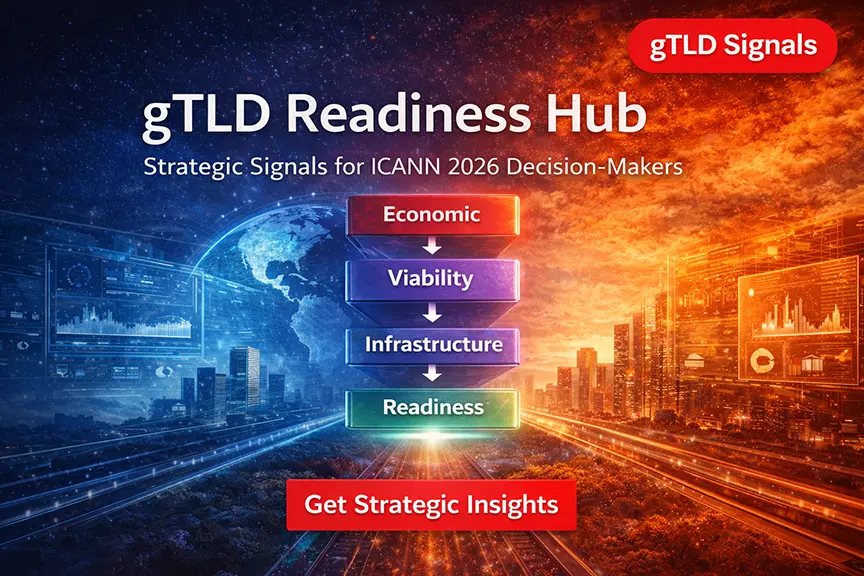
gTLD readiness is now the defining question facing organizations evaluating participation in the ICANN 2026 application round.
The next gTLD application round is not a land grab.
It is an economic and strategic filter.
This hub brings together the critical signals executives, investors, and builders need to evaluate whether a gTLD fits their organization ahead of ICANN opening the April 2026 application window. It is designed to support judgment, not hype, and to help teams decide whether to apply, delay, or walk away.
Who this is for
Executives and board members
Strategy and innovation leaders
Brand owners and platform builders
Registry operators and investors
Who this is not for
Tactical application walkthroughs
Speculative domain promotion
Short-term registration strategies
If you are looking for mechanics, this is not the place.
If you are evaluating long-term viability, you’re in the right place.
These briefings are designed to be read out of order, depending on where you are in the decision process.
Start with the Economic Signal if you’re asking whether this round is different
Move to Viability Signals if you’re evaluating a string
Read Infrastructure Signals if your model depends on adoption and usage
Use the Readiness Conversation if you need to pressure-test assumptions
This is not a course.
It’s a decision framework.
Each briefing isolates a specific signal shaping the next gTLD round.
Across each briefing, gTLD readiness is evaluated through economic discipline, structural viability, infrastructure alignment, and execution capability.
Each briefing isolates a specific signal shaping the next gTLD round.
Why the upcoming gTLD round functions as an economic filter rather than a speculative land grab, and how applicant behavior, capital discipline, and execution readiness now determine viability.
Key signal: Fewer applicants reflect stronger intent, not reduced opportunity.
[ Read Briefing 01 ]
Why registration volume is a vanity metric – and which signals actually determine whether a TLD can sustain legitimate usage, renewals, and long-term credibility.
Key signal: Structural viability matters more than launch momentum.
[ Read Briefing 02 ]
How mobile-first behavior is reshaping digital identity and why utility-driven gTLDs are emerging as machine-readable infrastructure rather than marketing assets.
Key signal: Adoption depends on infrastructure alignment, not awareness.
[ Read Briefing 03 ]
What determines whether a utility gTLD moves from infrastructure to adoption, and why most identity systems fail to achieve network effects.
Why a .brand gTLD is not a marketing asset, but a long-term infrastructure decision – and how control at the DNS layer reshapes security, governance, and digital sovereignty.
Key signal: The real ROI of a brand TLD is measured in control, risk reduction, and structural resilience – not traffic volume.
[ Read Briefing 05 ]
As the 2026 ICANN application round approaches, domain extensions are no longer a single asset class. This briefing examines the structural divide between utility-driven gTLDs and brand-controlled infrastructure, why the strategic middle failed, and how applicants must choose a defensible model before committing capital.
Key signal: Model clarity determines durability.
[ Read Briefing 06 ]
Most new gTLDs did not fail because of string quality or technical execution. They failed because they lacked a defensible path to market.
In the next ICANN round, success will hinge on distribution architecture – channel leverage, registrar alignment, vertical integration, and controlled access to demand. Without structural control over how names reach users, even strong concepts stall.
Owning the string is optional. Owning distribution is decisive.
[ Read Briefing 07 ]
Most new gTLDs did not fail because of weak demand. They failed because of flawed pricing systems.
Pricing defines who adopts, who renews, and whether a namespace develops real usage or collapses into speculation. In the next ICANN round, success will depend on pricing models that align with actual market behavior – balancing accessibility, value capture, and long-term retention.
Owning the string creates opportunity. Pricing determines whether it survives.
[ Read Briefing 08 ]
Across this series, a clear pattern emerges: most new gTLDs did not fail due to lack of demand, but because their models did not support sustained usage.
Early growth is often driven by launches, promotions, or speculation – signals that rarely translate into long-term value. What matters is what happens after adoption.
Sustainable growth depends on whether domains are used, renewed, and solving real problems.
From pricing and activation to retention and machine-driven interactions, the conclusion is consistent: growth is driven by utility, not visibility.
[ Read Briefing 09 ]
A gTLD proposal is not evaluated as a technical application – it is assessed as a long-term strategic risk. Boards focus on downside exposure, governance clarity, and reputational impact, not just opportunity.
Successful proposals align strategy, risk, and ownership while addressing failure scenarios, exit paths, and ongoing liability. Without this framing, even strong concepts fail at the board level.
Owning the vision is optional. De-risking the decision is decisive.
[ Read Briefing 10 ]
Most applicants focus on the ICANN fee and underestimate the real cost of operating a gTLD. The true financial burden lies in ongoing compliance, abuse mitigation, staffing, and long-term operational overhead.
Hidden costs don’t just impact budgets – they erode momentum, strain resources, and undermine execution. Leadership distraction and underinvestment create compounding risk over time.
Owning the string creates opportunity. Funding the operation determines survival.
[ Read Briefing 11 ]
A gTLD strategic decision is not a binary choice – it is a structured evaluation of readiness, alignment, and risk. Organizations must assess whether strategy, operations, and market demand reinforce a clear path forward.
The strongest teams don’t default to action. They make an explicit decision: apply, delay, or walk away. Without alignment across signals, even well-funded initiatives fail.
Clarity creates momentum. Indecision creates risk.
[ Read Briefing 12 ]
Across the briefings, the same signals appear repeatedly:
Capital discipline filters unserious applicants
Viability is structural, not promotional
Adoption requires embedded distribution
Control and adoption are competing design constraints
Most failures occur before the application is submitted
These signals form the basis of readiness.
Understanding gTLD signals is only useful if it informs action.
This is the point where gTLD application readiness moves from abstract interest to an executable decision.
At some point, every serious team faces the same question: Are we actually ready?
Readiness is not enthusiasm.
It is alignment, across strategy, capital, execution, and governance.
If your organization is considering a gTLD, the most important work happens before the application window opens.
The question is not whether participation is possible.
It’s whether your proposed strategy can survive real-world economic, operational, and adoption constraints.
We offer a short, signal-based readiness conversation for teams evaluating a gTLD ahead of ICANN opening the application window in April 2026. It’s designed to pressure-test assumptions around strategy, viability, and execution – before capital and credibility are committed.
Start a Readiness Conversation
This is not a sales call.
It’s a strategic fit check for organizations deciding whether to apply, delay, or walk away.
Most gTLD initiatives fail long before the application is submitted.
This hub exists to ensure yours doesn’t.
Subscribe to Our Monthly Newsletter
Join our mailing list to receive exclusive content only our newsletter members have access to.