Counting the Costs: Fees, Refunds, and Support in ICANN’s 2026 gTLD Round
The gTLD Application Journey (2/12)
Thinking about launching a new top-level domain in the 2026 round? The number that gets tossed around is the $227,000 gTLD application fee. While that’s certainly a hefty price tag, assuming it’s the final bill is a bit like buying a ticket to a theme park and forgetting you still have to pay for parking, food, and that cool lightsaber for your nephew. The initial fee is just the entry ticket; many forget about conditional fees, potential refunds, or the ongoing costs to actually run the thing.
Understanding the real costs of applying for a gTLD in ICANN’s 2026 round.
The reality is that many aspiring registry operators get blindsided. They focus on the big application number and completely overlook the conditional fees, potential dispute costs, and the ongoing operational expenses that kick in long after an application gets the green light. Forgetting these “hidden” costs is a critical mistake.
This guide will break down all the ICANN 2026 gTLD costs, from the core fees and refund policies to the financial support options available. By the end, you’ll have a clear, realistic roadmap for budgeting your gTLD venture.
Section 1: The Core ICANN 2026 gTLD Costs
ICANN’s 2026 gTLD application fee starts at $227,000 – the entry ticket to the process
The first number you need to know in the ICANN 2026 gTLD game is $227,000 USD. Think of this non-negotiable evaluation fee as your cover charge to get into the world’s most exclusive digital real estate club. It’s a steep price of admission, but it’s there for a good reason: to ensure the internet remains stable and secure for everyone.
This core gTLD application fee funds all the critical checks ICANN performs. They’re making sure your proposed TLD is technically sound, that you’re financially stable enough to run it, and that you won’t accidentally break a piece of the internet. So, if your application for something like .CARS or .ART requires a deeper dive, the cost of those ‘extended evaluations’ is already baked in.
While $227,000 is a noticeable jump from the $185,000 fee in the 2012 round, it’s not as dramatic as it first appears. That 22.7% nominal increase over 14 years actually comes in below the general inflation rate of 30-35% for the same period. It’s a measured adjustment, not a random price hike.
Here’s where things get serious for aspiring registry operators. The entire $227,000 USD must be paid in full within seven days of the application window closing. There are no IOUs, no payment plans, and no second chances.
If the funds don’t clear within that one-week timeframe, your application is simply cancelled. Your dream of running .YOURTLD could be over before it even truly begins, making prompt financial planning absolutely essential.
A Small Perk for TLD Veterans
There is, however, a small advantage for those who’ve been here before. Existing gTLD operators from the 2012 round – the teams behind TLDs like .NINJA or .BUZZ - might get certain fee waivers for what are known as “variant” applications. These are usually for translated or transliterated versions of their existing TLDs in different scripts. For everyone else, that $227,000 is the first major financial hurdle.
Section 2: Conditional Evaluation Fees
Just when you think you’ve got the budget locked down around the main gTLD application fee, ICANN slides over an à la carte menu. These are the “conditional” fees, charges that only pop up if your application has specific characteristics, and they can completely change your financial picture. Think of it less like a fixed price and more like a restaurant bill where a few fancy add-ons can suddenly double the final check.
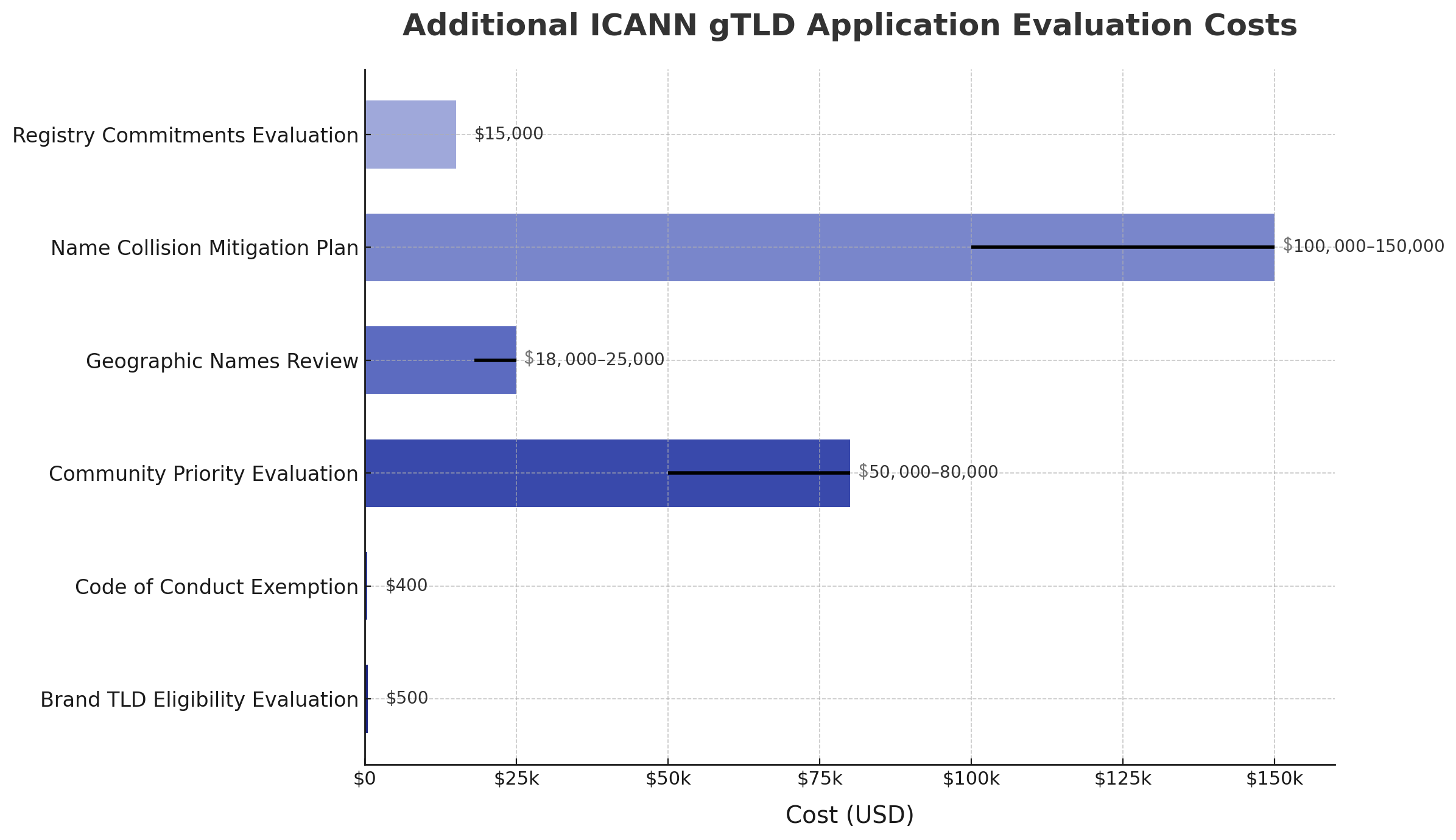
Brand TLD Eligibility Evaluation: Applying for .YOURAWESOMEBRAND? That’ll be an extra $500 to prove you have the rights to the name
Code of Conduct Exemption: A niche fee, but asking for an exemption from certain operational rules costs $400
Community Priority Evaluation: Trying to represent a community with something like .ECO or .MUSIC? Proving you have their backing will cost you between $50,000 and $80,000
Geographic Names Review: If your TLD could be a geographic name – think .PARIS or .BERLIN - it automatically triggers a mandatory review costing between $18,000 and $25,000
Name Collision Mitigation Plan: This is the big one. If your TLD might conflict with names used on private networks, evaluating your plan to fix it is the most expensive add-on, ranging from $100,000 to $150,000
Registry Commitments Evaluation: Making specific public interest promises? ICANN will evaluate them for $15,000
A name collision fee alone can jack up your initial application cost by over 65%. This is the biggest “gotcha” in the entire gTLD budgeting process and shows why a deep understanding of all potential ICANN 2026 gTLD costs is so critical.
Breakdown of additional ICANN gTLD application evaluation costs for the 2026 round, showing fees for brand, community, geographic, and name collision reviews.
Additional evaluation costs in the gTLD application system range from $400 for exemptions to $150,000 for Name Collision Mitigation
As you can see, these variable costs can quickly turn your ICANN 2026 gTLD costs of $227,000 project into a $350,000+ endeavor before you even get the green light. Modeling these potential extras isn’t just smart – it’s essential for survival.
Budget planning for ICANN’s 2026 gTLD round requires reviewing financial documents, projected costs, and evaluation fees.
So, what happens if you jump into the gTLD application process but need to back out? The good news is your entire investment isn’t gone in a flash. ICANN has a structured ICANN gTLD refund policy, but it’s all about timing. The closer you get to the finish line, the smaller your refund becomes. Think of it like cancelling a concert ticket. If you cancel months ahead, you’ll likely get most of your money back. Wait until the day of, and you’re probably out of luck.
The Three Main Refund Windows
ICANN’s refund system is tiered, designed to reward applicants who decide to withdraw early on. Dragging your feet on a withdrawal decision can cost you a huge chunk of your gTLD application fee.
Window 1 (The Golden Hour): Up to 10 days after “String Confirmation” → 65% refund ($147,550)
Window 2 (The Silver Lining): After that, but before evaluation begins → 35% refund ($79,450)
Window 3 (The Last Call): During evaluation, but before signing a contract → 20% refund ($45,400)
Special Circumstances for Refunds
Beyond these standard windows, a few special cases offer better terms:
Material Changes: If ICANN makes a major change to the Applicant Guidebook after you apply, you might get a better refund
High-Risk Name Collision: If you withdraw due to a high-risk name collision warning from ICANN, you can get a 65% refund
IDN ccTLD Overlap: If your TLD string unexpectedly conflicts with an Internationalized Domain Name country code, you may be eligible for a full refund
Application Volume Refunds: If ICANN receives over 1,000 applications and over-recovers its costs, it might issue partial refunds to everyone. It’s like a surprise dividend for being part of the process!
Feeling a bit of sticker shock from the $227,000 ICANN 2026 gTLD costs of application? Don’t walk away just yet. ICANN’s Applicant Support Program (ASP) is designed to level the playing field, creating a viable path for applicants from developing economies. Think of it as the closest thing to a scholarship in the world of digital real estate.
If you qualify, the gTLD financial assistance program is a game-changer. It slashes the core application fee by a massive 75 – 85%. This brings the total cost down from an intimidating $227,000 to a far more manageable range of $34,050 to $56,750 USD. Better yet, this discounted fee includes support for up to four variant strings – like different language versions of your TLD – offering additional value.
Of course, qualifying requires a rigorous evaluation. You have to prove your financial need by submitting extensive documentation. To help you get started, TLDz has created a completely free course breaking down the ASP requirements.
So, you got the green light for your gTLD application. Fantastic! Break out the good stuff, celebrate the win, but don’t kick your feet up just yet. The recurring costs are just getting started. It’s a classic rookie mistake: applicants get so laser-focused on the initial ICANN 2026 gTLD costs that they completely overlook what comes next.
First on the list of new bills is the fixed annual fee you’ll pay directly to ICANN, which kicks off at $25,750 USD. But that’s not all. You’ll also owe a transaction fee for every single domain you sell above a volume of 50,000 names, at $0.2575 per domain registration year. If your new .FANCYTLD takes off and you sell a million domains, you’re looking at an extra $257,500 check to ICANN every year.
Then you have dispute resolution costs, auction fees if you’re competing for a string, and – crucially – your marketing and launch budget. You can have the coolest TLD in the world – think .AWESOME or .ROCKET - but if nobody knows it exists, nobody will buy domains. These ongoing fees are the lifeblood of your TLD.
Section 6: Pitfalls to Avoid
Navigating the finances for a new gTLD application can feel like walking through a minefield blindfolded. Here are the biggest pitfalls to avoid:
Assuming refunds cover most of the fee. The maximum refund is 65%, meaning you’re still out over $79,000 if you withdraw early. It’s a safety net, not a golden parachute
Forgetting conditional evaluation costs. That potential $150,000 name collision fee can blow up an otherwise perfect budget
Applying without budgeting for ongoing registry operations. The $227,000 gTLD application fee is just the start. Ongoing ICANN fees, backend provider costs, and marketing can easily cost hundreds of thousands per year
Relying on ASP without preparing full documentation. The ASP is a fantastic program, but it requires rigorous proof of financial need. Don’t assume you’ll qualify without doing the homework and the deadline is just around the corner so you better get a move-on.
Conclusion
The $227,000 gTLD application fee is just the entry ticket – the true costs depend entirely on your application type, contention risks, and operational strategy. The smartest applicants model all potential fees, understand the refund windows, and budget for long-term operations from day one. It’s not just about paying a fee; it’s about building a sustainable business on the internet’s new frontier.
Even if you’ve budgeted perfectly, can you navigate the TLD Application Management System? Next, we look at TAMS.