
You’ve got a killer brand, a flawless marketing plan, and your team on standby. Fantastic. But ICANN doesn’t just want your application fee – they want ironclad proof you can survive as a registry. A brilliant brand and a sharp team won’t save an application that flunks the final boss of the gTLD application process: the gTLD financial projection evaluation.
This isn’t just about paying a fee; it’s about proving you have the grit, the resources, and the spreadsheets to sustain a piece of the internet’s infrastructure for the long haul. Many stumble here.
This financial evaluation is one of the final hurdles in the gTLD journey. For a complete strategic and operational roadmap that shows how financial projections fit into the entire application process, see our Build a TLD: Ultimate Guide to Launching Your Own TLD.

Let’s be blunt: a brilliant brand and a sharp team won’t save an application that flunks the ICANN gTLD financial projections in 2026. This is where your dream meets the cold, hard reality of cash flow. ICANN isn’t just collecting an application fee – they want ironclad proof that you can responsibly operate a piece of the internet’s infrastructure, especially when things go sideways.
Plenty of powerful applicantions stumbled right here in the 2012 round. They learned the hard way that ICANN’s financial evaluation is a high-stakes stress test designed to separate serious contenders from hopeful dreamers. Forget the hockey-stick growth charts for a moment; this is where your spreadsheet skills will either validate or vaporize your entire business plan.
The evaluation isn’t about how much money you could make. It’s about whether you’ll go bankrupt if you don’t. ICANN wants to see a business model that can endure the often-brutal realities of a new TLD launch. This scrutiny is why a community-focused TLD like .MUSIC had to demonstrate a long-term vision, while a high-volume play like .XYZ needed to show it could manage razor-thin margins at scale.
This is the stage where the evaluators ask the toughest questions. Can you weather a severe revenue shortfall? What happens if your technical costs balloon? Your gTLD financial projections must provide convincing answers.
ICANN’s core mission is ensuring the stability and security of the DNS. To them, an underfunded registry is a direct threat. They need to see that you’ve planned for every contingency and have the financial resilience to execute on that plan.
At its heart, the financial evaluation is a test of three critical pillars of your operation:
This guide will break down exactly what you need to build a bulletproof gTLD business plan for 2026, conquer the infamous templates, and pass this critical test.
Let’s get one thing straight right away. ICANN’s financial evaluation isn’t about whether you’ve got the next .AI on your hands. They’re far less interested in your explosive growth potential and much more concerned with your ability to avoid a complete meltdown.
Think of the whole process as a stress test. ICANN’s job is to ensure you’re a stable, reliable custodian for a new piece of the internet’s infrastructure. Your slick branding and iron-clad legal work won’t mean a thing if your ICANN gTLD financial projections for 2026 don’t pass muster.
The entire evaluation really boils down to three core pillars that every serious applicant has to nail.
This is the big one: can you actually keep the lights on? ICANN needs to see, in no uncertain terms, that you have enough capital to fund all the critical registry functions for at least three years. And here’s the kicker – that’s even if your revenue projections totally tank.
They are essentially asking for proof that you won’t just pull the plug if your TLD isn’t an overnight success. This is precisely why your startup costs and operating expenses get put under a microscope.
For a bit of perspective, ICANN itself has already earmarked around $22 million for this next application round, with about $10 million of that budgeted just for processing applications. That level of investment on their end tells you everything you need to know about how seriously they take operational costs. They expect you to show the same financial diligence.
For this part, ICANN wants you to put on your pessimist hat. Your application has to show that you’ve thought long and hard about what could go wrong and that you have a concrete plan to deal with it. This isn’t just some hypothetical exercise; it’s a fundamental part of your ICANN financial evaluation.
They expect you to model out a whole range of potential disasters:
Imagine a highly specialized TLD like .BANK, which carries massive compliance and security overhead. Their gTLD financial projections model had to prove it could sustain those high costs even with a small, carefully vetted user base. Your model needs to demonstrate that same level of foresight.
ICANN’s number one priority is the stability of the DNS. An underfunded registry that has to cut corners on security or technical upkeep is a direct threat to that stability. Your job is to prove you are not that applicant.
Finally, every number in your spreadsheet needs to connect directly to your operational plan. Your gTLD financial projections and business plan can’t just be a standalone document; every single dollar you project has to be tied to a real-world person, contract, or function.
This means your financial model must be able to realistically support everything you claim you’ll do:
If you want a better handle on the upfront costs, check out our detailed guide on ICANN’s application fees and timing. Any discrepancy between your gTLD financial projections and your supporting documents – like contracts or Letters of Intent – is a huge red flag for the evaluators. It’s all about proving you’re a prepared, serious operator, not just a flashy brand with a good idea.
When it comes to the ICANN gTLD financial projections for 2026, there’s zero wiggle room. ICANN gives you a set of rigid, non-negotiable templates, and you have to play by their rules. Trying to submit a modified version or leaving a field blank isn’t a simple mistake – it’s a surefire way to get your application disqualified.
This part of the process is all about the numbers. Getting these spreadsheets right is absolutely critical, so let’s walk through exactly what you’ll be up against.
You can think of the MLS template as your core gTLD business plan, but told entirely through spreadsheets. It’s your standard three-year forecast, mapping out everything from initial startup costs to the day-to-day operational expenses that will keep your registry afloat.
Here, you’ll lay out your expected revenue from domain registrations, renewals, and any premium name sales. On the flip side, you have to account for every single cost with meticulous detail:
Every figure you put in this document needs a justification, whether it’s a signed contract or solid market research.
Now for the real stress test: the ICANN gTLD financial projections in the worst case scenario. This is where ICANN essentially asks you to plan for a disaster. What if your registration numbers are just a tiny fraction of your forecast? What if your main vendor suddenly doubles their prices overnight?
The WCS needs to prove your gTLD won’t just fold under pressure. It’s less about showing profitability during a crisis and more about demonstrating pure survivability. One of the toughest requirements is that you must still show positive cash flow by the end of Year 3, even in this nightmare scenario. This proves you have enough funding to ride out a long storm. A niche TLD like .ART, for example, would have to show it could cover its high operational costs even with sluggish adoption, leaning on its initial funding to bridge the gap.
ICANN isn’t just looking for a Plan B; they’re looking for a Plan Z. The WCS template is designed to see if you’ve capitalized your venture to survive market indifference or the complete failure of your initial strategy.
Beyond just the numbers, ICANN wants to understand your thinking. The Risk Assessment Template forces you to identify potential financial and operational risks and then score them on two fronts:
From there, you have to outline concrete mitigation strategies for every risk you’ve identified. This isn’t just about listing things that could go wrong; it’s about showing you have an actionable plan ready for any major threat. It adds a qualitative story to your quantitative WCS model.
This is where your market research truly hits the spreadsheet. Your registration projections have to be believable and anchored in reality. You can’t just throw out a claim that you’ll sell a million domains without backing it up. You need to forecast registration volumes, average fees, renewal rates, and any income from premium names.
Building a solid forecast is a structured process. It often involves analyzing historical data from comparable TLDs to create projections that will pass muster with ICANN.
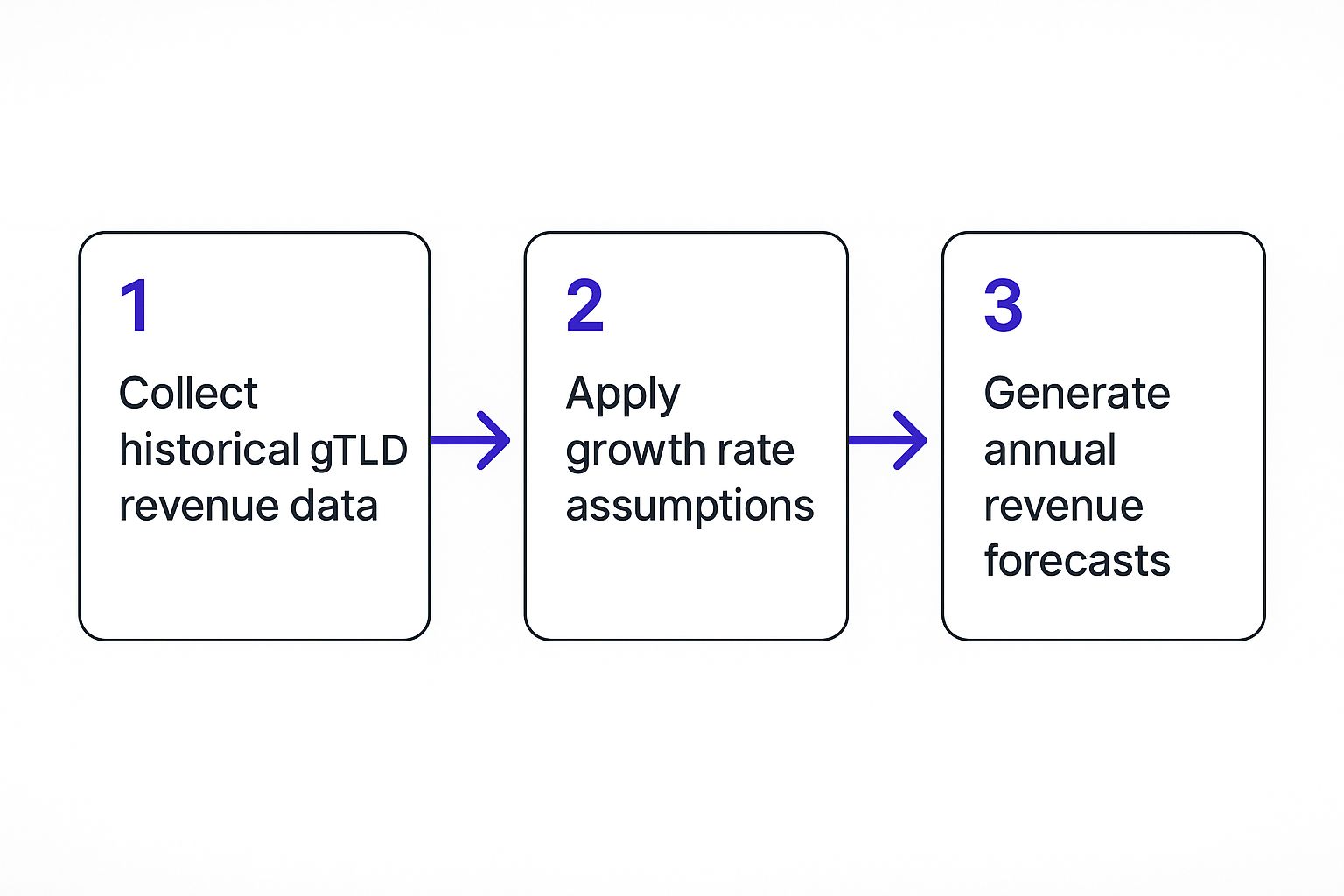
As the flow shows, a credible forecast isn’t a guess; it’s a methodical process that applies informed assumptions to real-world data. Your model has to mirror your strategy. Are you aiming to be a high-volume, low-fee TLD like .XYZ, or a low-volume, high-fee niche like .LUXURY? Your numbers need to tell that story consistently.
For a full rundown of all application requirements, check out the insights in the recently released draft Applicant Guidebook, which lays out the complete process. Mastering these gTLD financial projection templates takes careful planning, conservative assumptions, and an almost obsessive attention to detail.

Your beautifully crafted financial models are just a story without the evidence to back them up. Think of your spreadsheets as the claim, and your supporting documents as the proof. ICANN evaluators will pour over this evidence to make sure your ICANN gTLD financial projections for 2026 are built on solid ground, not wishful thinking.
Submitting a flawless projection with weak or missing documentation is a classic mistake. It’s like building a skyscraper on sand – it might look good for a minute, but it’s going to crumble under scrutiny. Every single number in your model needs a direct line back to a concrete piece of evidence.
This is your non-negotiable starting point. ICANN needs to see that the entity applying for the gTLD is financially stable, and the gold standard for that is audited or reviewed financial statements.
For a massive corporation, this is usually a breeze. When a giant like Google applies for .APP or Amazon goes for .AWS, they can simply provide financials from a Qualified Parent Entity. This one move satisfies the requirement, as the parent company’s enormous balance sheet guarantees the gTLD venture won’t run out of cash.
But for a startup or a Special Purpose Vehicle (SPV) created just for the application, it’s a much tougher climb. Without a corporate giant backing you, the applicant entity itself has to prove its financial strength, which is where the other documents become absolutely vital.
Every significant cost in your Most Likely Scenario (MLS) and especially your Worst Case Scenario (WCS) has to be locked down and proven. The best way to do this is with signed contracts and detailed Letters of Intent (LOIs).
Your financial model is a story, and your contracts are the footnotes that prove it’s non-fiction. ICANN evaluators will cross-reference these documents meticulously. If your spreadsheet says RSP costs are $250,000 annually but the contract shows a different figure, your credibility is shot.
The global domain market is heating up. New gTLDs saw a 13.5% year-over-year increase, adding about 5 million new domains in 2024 alone. With this kind of growth, ICANN wants to be certain that new registries are built on solid financial footings. You can learn more about the economic value and growth of the domain industry on besthosting.ge.
This is where the rubber meets the road, particularly for applicants without a deep-pocketed parent company. You have to provide undeniable proof that you have the capital needed to survive your own ICANN worst case scenario financials. ICANN will accept a few different forms of proof:
Finally, you’ll need to submit a few self-certifications. These are formal declarations confirming that your organization is in good standing in its jurisdiction. You’ll attest that you’re current on taxes, hold the right business licenses, and comply with local laws. It might seem like a simple box-tick exercise, but a failure here can cast doubt on your operational integrity and undermine the entire application.
In the last gTLD round, I saw a lot of well-funded, brilliantly conceived applications go down in flames. It wasn’t because the core idea was bad. It was because of completely avoidable mistakes in their financial modeling. This is where we get serious.
Ready to build a gTLD financial model that can withstand ICANN’s toughest scrutiny? Don’t take on the final boss alone. Our team of Certified Public Accountants has guided applicants of every size through the financial evaluation – ensuring projections that pass and plans that endure.
Book a consultation at https://tldz.com today.