Imagine owning not just a digital address, but the entire online zip code. That’s the real power behind a custom Top-Level Domain (TLD). Instead of your website ending in a generic .com or .org, it could end in .yourbrand, giving you complete control over your own corner of the internet.
Welcome to the Internet’s Most Exclusive Real Estate
Think of a standard domain like leasing an office in a massive skyscraper. You have an address, but you share the building with thousands of others. A custom top-level domain is like owning the entire building. You set the rules, you control the security, and you define the identity for every single “tenant” in your digital ecosystem.
Visionary companies like BMW (.bmw) and Google (.google) have already made this exact move. They’ve shifted from simply renting online space to building their own private, trusted digital worlds. This isn’t just about a fancy URL. It’s a strategic play to build a secure and authentic foundation for your brand. In a crowded market, a custom gTLD instantly signals authority and trust.
If you want the step-by-step strategic and operational breakdown, see our Build a TLD: Ultimate Guide to Launching Your Own TLD.
The Rise of Branded Digital Ecosystems
The internet is a vast and noisy place. As of the first quarter of 2025, the global domain market was sitting at around 368.4 million registrations. Traditional extensions like .com and .net still command a huge piece of the pie, making up nearly 46% of that total. You can dive deeper into these domain name statistics to get the full picture.
But even with the old guard still going strong, the introduction of new gTLDs has blown the doors wide open. Brands are no longer stuck with the handful of extensions that defined the early web. Now, you see everything from the playful .lol and .pizza to the professional .inc and .law. And yes, there’s even a .ninja, for all your stealthy digital operations.
This official list from ICANN shows the gTLDs that have already been delegated and are live on the internet.

The screenshot gives you a real sense of the variety out there, from brand-specific domains like .youtube and .aws to generic options like .app and .blog. It’s a fundamental shift in how we think about digital identity.
Before we go further, it helps to see a direct comparison. Here’s a quick breakdown of how a custom gTLD stacks up against a traditional domain.
This table makes it clear: moving to a custom gTLD is a significant upgrade in nearly every strategic area.
Owning a custom top-level domain gives you advantages a traditional domain simply can’t. It’s the difference between being a participant in the market and becoming the market itself. The strategic benefits are clear and powerful:
offers.yourbrand or support.yourbrand.You’re no longer scrambling for what’s left under .comA custom gTLD transforms your brand from a tenant on the internet into a landlord. You’re not just creating a website; you’re building a sovereign digital territory where you define the rules and own the entire user experience.
This level of control is the ultimate form of digital branding. It’s about securing your brand’s future in a way that’s permanent, proprietary, and powerful.
When brands think of custom top-level domains, the default assumption is often: “We’ll apply for one, our .brand, and call it a day.” But limiting your strategy to a single TLD can be shortsighted. Multiple TLDs unlock flexibility, protection, and long-term efficiency that one alone cannot deliver.
Think about a global giant like The Coca-Cola Company. While everyone knows Coke, the corporation also owns Sprite, Fanta, Minute Maid, Smartwater, Powerade, and many more. If Coca-Cola only applied for .coke, the digital identity of Sprite or Fanta would still be dependent on third-party domains.

By going after a multi-TLD strategy – securing .coke, .sprite, and .fanta – the company could give each brand its own trusted namespace, building clarity and authenticity. Imagine running sub-brand campaigns that instantly connect with consumers (e.g., share.sprite or flavors.fanta) or preventing competitors from controlling names tied to valuable sub-brands. For any multi-brand corporation, one TLD isn’t a complete strategy – it’s just the start.
This isn’t just about playing defense; it’s about unlocking powerful new capabilities that a single domain simply can’t offer. You’re building a cohesive, secure, and future-ready digital ecosystem.
Deciding to apply for more than one custom TLD is an investment, absolutely. The initial application fee with ICANN is roughly $227,000 per TLD, with an annual maintenance fee around $25,000. These figures might seem steep, but you have to weigh them against the long-term costs of not securing your digital assets.
Owning one custom TLD is a statement. Owning a portfolio of them is a strategy. It shifts the brand from a defensive posture to an offensive one, actively shaping its digital future rather than just reacting to it.
Think about the cost of buying premium .com domains for every new product launch or marketing campaign. Those expenses can quickly add up and even dwarf the investment in a proprietary TLD. Plus, managing a scattered collection of domains across different registrars is an administrative headache that introduces unnecessary security risks.
A multi-TLD portfolio centralizes control, simplifies management, and creates a predictable cost model for future growth. Owning your brand’s digital real estate is a powerful advantage. For companies with diverse brand families, extending that ownership across the entire portfolio isn’t just smart – it’s essential for long-term protection and growth.
Applying for multiple custom TLDs isn’t just a defensive play – it’s a smart, strategic investment with tangible business benefits. Once you move past seeing a single .brand TLD as a major cost, your perspective shifts. You start to see a portfolio of TLDs as a powerful, ROI-generating engine for your entire business. These advantages aren’t just theoretical; they directly impact your bottom line, marketing flexibility, and long-term security.
Let’s be real, nobody wants to spend more than they have to. But looking at a multi-TLD portfolio as a pure expense is like viewing a factory as only a cost center. It’s the engine that drives production. In the digital world, your TLD portfolio is the engine that drives brand growth and control.

Trying to manage a massive collection of domains scattered across different registrars is a recipe for chaos. It’s like handing out copies of your house key to a dozen different people – hard to manage and easy to lose control. A multi-TLD strategy brings everything back under one roof, centralizing your digital assets in a single private registry. It also cuts down on the need to chase registrations across other extensions, especially country codes where costs can quickly add up.
This consolidation immediately shrinks your risk profile. Instead of playing whack-a-mole with cybersquatters who register variations of your brand under new TLDs like .zip or .mov, you own the entire namespace. This proactive stance is far more efficient than getting tied up in reactive legal battles. With brand-impersonation attacks constantly on the rise, a secure, unified domain ecosystem has never been more critical.
Owning your TLD portfolio means you are no longer just a tenant on the internet, subject to the whims of other landlords. You become the master of your own digital domain, setting the rules and controlling access to every address on the block.
This centralized control simplifies compliance, streamlines IT management, and creates a consistent security posture across every single one of your digital properties.
Picture this: you’re a car company launching a new EV. With a standard domain, your campaign URL might be yourbrand.com/new-electric-car-2026. It’s clunky, long, and totally forgettable. Now, imagine sending customers to electric.cars or drive.auto.That’s the kind of marketing firepower a multi-TLD portfolio gives you.
By securing TLDs that are directly relevant to your products, services, or campaigns, you can create short, memorable, and powerful URLs that truly connect with consumers.
.shoes or .jackets to build dedicated, intuitive online hubs for specific product lineslaunch.tech for a short-term, high-impact marketing blitz.london or .tokyo to craft localized experiences that forge stronger bonds with regional customersThis approach makes it faster and more cost-effective to launch new initiatives. You don’t need to chase expensive premium names on the open market. You already own the prime digital real estate. It’s trusted by your customers, with no risk of phishing or fraud.
Securing your custom top-level domain portfolio today is about future-proofing your brand. The internet isn’t getting any less crowded. By applying for your ideal extensions in the next ICANN window, you stake your claim to your digital territory at a known, predictable cost. The alternative is waiting and potentially paying massively inflated prices for premium domains later on – or, even worse, finding out a competitor beat you to the punch.
Over the long haul, this strategy leads to incredible portfolio efficiency. Consolidating domains under your own custom TLDs cuts down on the recurring fees from managing hundreds, or even thousands, of individual domain names across various registrars. The administrative headache for your IT, legal, and marketing teams simply disappears. You can get a deeper dive into these decisions with our guide covering the key considerations when choosing a brand top-level domain.
This proactive investment gives you strategic flexibility and creates a secure space for innovation. Whether you’re launching a new venture, breaking into a new market, or experimenting with new ways to engage customers, your TLD portfolio provides the foundational assets you need to move fast and decisively. It’s about building a digital infrastructure that grows with you, not one that holds you back.
Getting a custom top-level domain isn’t like snagging a .com from an online store in five minutes. It’s more like an epic quest through the intricate, bureaucratic world of ICANN (the Internet Corporation for Assigned Names and Numbers). This is a marathon, not a sprint, and it demands serious planning, resources, and expert guidance to even get to the starting line.
Successfully navigating this process means understanding it’s a journey with distinct phases. Think of it less as a one-off transaction and more as a multi-stage expedition where each step builds on the last. From your initial strategy to the final delegation, every single detail matters.
Long before you fill out a single form, the real work begins. This initial phase is all about strategy and painstaking preparation. You have to build a rock-solid business case that justifies the massive investment. This isn’t just about wanting a cool domain; it’s about defining its purpose and proving its viability.
During this stage, you’ll need to assemble a multidisciplinary team. Getting buy-in from your legal, financial, marketing, and technical departments is essential to create a robust application that aligns with your company’s long-term vision. This is also when you’ll run a thorough cost-benefit analysis, weighing the $227,000 ICANN application fee and $25,000 annual maintenance costs against the strategic advantages you hope to gain.
This simple workflow gives you a high-level look at the journey from a concept to a live custom TLD.
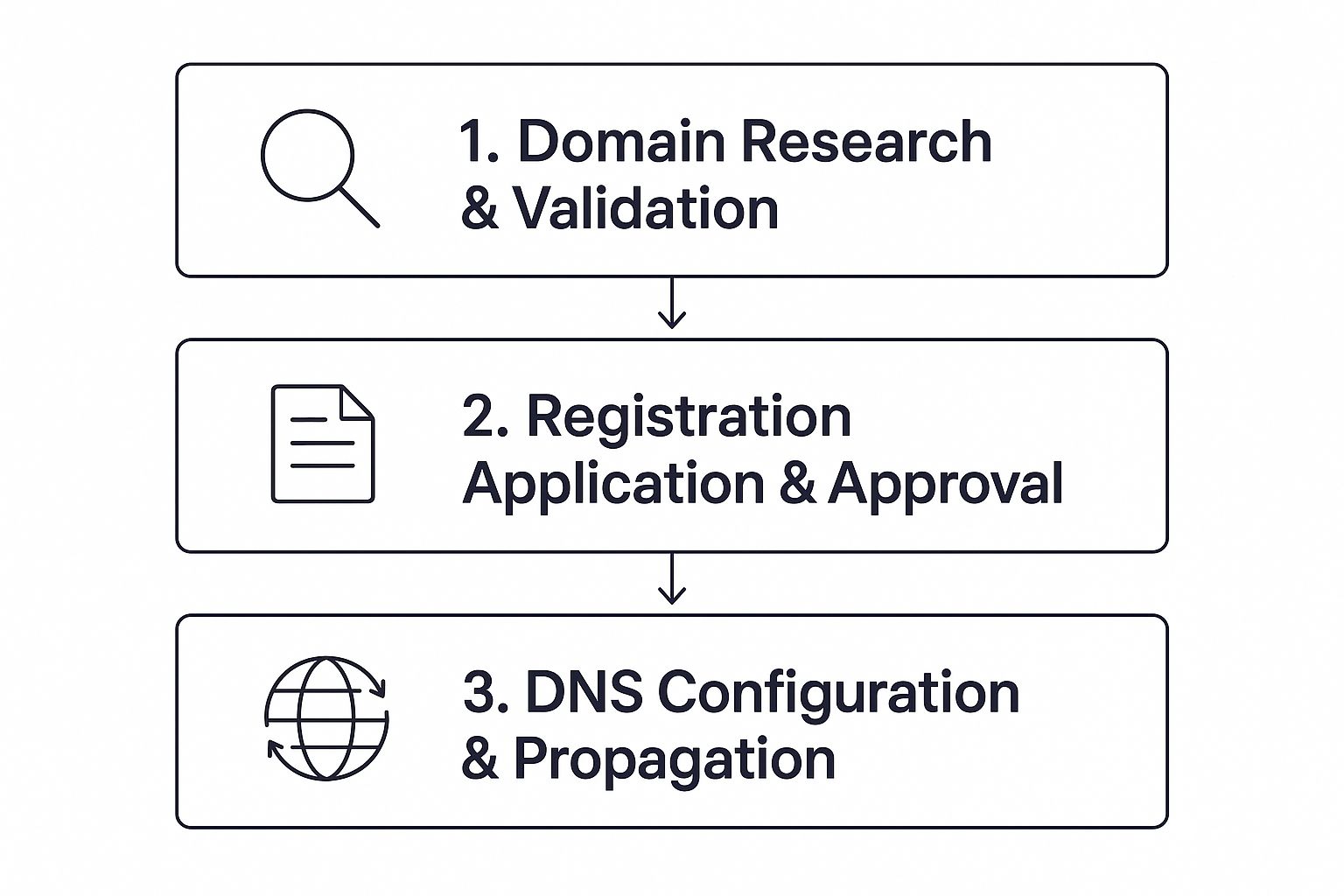
As you can see, the process starts with validation and a formal application long before any technical work kicks off, which just goes to show how critical that upfront strategy really is.
Here’s the catch: ICANN doesn’t just accept applications year-round. It opens specific, time-limited “windows” for new gTLD submissions. The last major window was back in 2012, and the next one is in Apri 2026. If you miss this window, you could be waiting years for another shot. When it finally opens, you submit your painstakingly prepared application.
Once it’s in, your application enters ICANN’s rigorous evaluation process. This is where your proposal gets put under a microscope. ICANN’s evaluators conduct several key checks:
This is no rubber-stamp approval. In the 2012 round, roughly 1 in 4 applications that went through a full evaluation initially failed at least one of these checks. It’s a high-stakes process where every detail of your proposal is scrutinized.
Congratulations, your application made it through! But the journey isn’t over yet. After getting the green light, your TLD enters the “delegation” phase. This is the technical process of adding your new extension to the internet’s root zone, officially making it a live part of the global DNS.
A successful ICANN application doesn’t just grant you a TLD; it transforms your organization into a registry operator. You are now responsible for the stability, security, and integrity of your own slice of the internet.
This is a profound shift in responsibility. You’ll need to set up the technical backend, establish partnerships with registrars, and define the final policies for who can register domains under your TLD. The complexity of this final stage is exactly why partnering with experts is so critical – they can help you navigate the last technical hurdles and ensure a smooth launch.
For a detailed breakdown of the entire journey, explore our complete guide on how to apply for your own TLD.
So, your custom top-level domain application got the glorious green light from ICANN. Congratulations! You’re officially a registry operator. The good news? You don’t have to build the ridiculously complex technical infrastructure from the ground up. Instead, you get to partner with a backend registry service provider – the silent, powerful engine that runs your entire TLD.
Think of it this way: getting ICANN approval is like winning the rights to build your own city. You have the land and the authority, but you still need someone to lay the power grid, manage the water supply, and pave the roads. Your backend partner is that essential utility company, handling all the critical infrastructure so you can focus on actually building the city.
This is one of the most important – and costly – decisions you’ll make. Don’t let the technical jargon fool you; this isn’t just an IT decision. It’s a strategic one that will directly shape your budget, your operational efficiency, and your ability to hit your business goals.
A backend registry service provider handles the core functions of your TLD. They’re the technical wizards behind the curtain, making sure everything runs smoothly, securely, and in line with ICANN’s strict rules.
Their main responsibilities boil down to a few key areas:
hello.yourbrand actually points to the right place on the internet. This requires rock-solid reliability and securitySelecting a backend partner isn’t about finding the cheapest option. It’s about finding the right one. The right partner becomes a seamless extension of your team, ensuring your TLD is a high-performing asset, not a costly technical headache.
Not all backend providers are created equal. Some are massive operations supporting hundreds of TLDs, while others are boutique firms offering more specialized, hands-on service. The right choice depends entirely on your specific needs and goals. For instance, a closed “.brand” TLD for a single corporation has vastly different requirements than an open TLD like .music or .news, which is aiming for millions of registrations.
A partner like TLDz can guide you through this complex selection process, making sure you don’t overspend or pick a provider that can’t support your vision. This guidance is critical for developing a smart portfolio strategy, optimizing costs by consolidating operations, and making a choice that drives a sustainable return on investment.
This decision is especially crucial in a growing market. By the second quarter of 2025, global domain registrations hit 371.7 million, a 2.6% increase year-over-year. And while custom TLDs offer a unique identity, the sustained demand for .com and .net – which climbed to 10.4 million new registrations in Q2 2025 – shows that brands must be strategic to stand out. You can dive deeper into this growth with Verisign’s domain industry report. Choosing the right backend ensures your custom TLD can compete on a technical level, offering the same reliability users have come to expect from the giants.
The journey to your own top-level domain is a big one, packed with strategic decisions, technical puzzles, and a serious investment. After digging into the “why” and “how,” it’s totally normal for a few practical questions to pop up. Think of this section as your friendly FAQ, here to clear up any lingering doubts before you take the plunge.
Let’s tackle some of the most common questions we hear from folks considering their own TLD.
In the world of custom gTLDs, patience isn’t just a virtue – it’s a requirement. This isn’t an overnight thing. From the moment you decide to go for it to the day your TLD is live on the internet, you should be planning for a multi-year journey.
The timeline really breaks down into three big phases:
Bottom line? A safe bet is anywhere from three to five years from start to finish. It’s a marathon, not a sprint.
That $227,000 ICANN application fee definitely gets your attention, but it’s just the tip of the iceberg. To build a solid business case, you have to understand the total cost of ownership. The expenses really fall into a few key buckets.
First, you have the direct ICANN fees. Beyond that initial application cost, you’ll be paying an ongoing annual fee of around $25,000 just to keep your TLD in good standing.
Next up are the operational costs. You’ll need to partner with a backend registry service provider to handle the heavy lifting, and their services can run from $10,000 to over $50,000 annually, depending on how complex and busy your TLD is. They manage the core tech – DNS, security, compliance, and all that.
Finally, don’t forget the internal and advisory costs. This includes consultants to help you navigate ICANN’s dense policies, experts to support your application, and the salary of your internal team managing the project. These “soft costs” can really add up over a few years.
A custom TLD is not a one-time purchase; it’s an ongoing operational commitment. Budgeting for the full lifecycle – from application to long-term maintenance – is essential for success.
A realistic all-in budget for the first three years can easily land somewhere between $500,000 and well over $700,000. It’s a hefty sum, but the return is far greater. You’re investing in massive strategic value, stronger security, and unmatched marketing power for your brand. The savings alone can be substantial – avoiding fraud losses, cutting back on costly paid placements, and reducing the sprawl of your domain portfolio. Over time, those efficiencies don’t just cover the cost – they compound into a lasting competitive advantage.
This is one of the coolest parts of owning a custom gTLD: you make the rules. The answer is completely up to you and the policies you put in place. You have total control over who gets to register a domain in your corner of the internet.
Generally, you’ll choose one of two models:
.google -only Google can create names like maps.google or ai.google.This creates a protected city of trust where every address is guaranteed to be official..app or .dev are great examples. This can turn your TLD into a business that generates revenue, but it also means you need stronger policies to handle abuse and manage your customers.Your choice here comes down to your strategic goals. Are you building a digital fortress for your brand, or are you creating a new public square on the internet?
Figuring out the return on investment for a custom TLD isn’t as simple as tracking sales from a single link. The value is spread across security, brand equity, and even day-to-day efficiency. You need to look at it through a wider lens to see the true impact.
A good ROI model tracks metrics in a few key areas. For example, you can measure risk reduction by tracking how much less you spend on defensively registering domains or fighting cybersquatters. A 30% drop in those costs in the first two years is a very realistic target for many brands.
Marketing impact is another huge piece of the puzzle. You can measure the lift in engagement and recall from using short, memorable campaign URLs (offers.yourbrand instead of yourbrand.com/special-offers).This is something you can quantify with A/B testing and brand sentiment tracking. Our dedicated article has a lot more ideas on measuring success with your brand’s TLD and setting up the right KPIs.
Finally, think about operational efficiency. How much time and money do you save by centralizing your domain management and making it easier for teams to launch new digital projects? When you look at it from all these angles, the ROI of a custom gTLD becomes crystal clear.
Navigating the path to a custom top-level domain is complex, but you don’t have to do it alone. TLDz provides the expert guidance needed to turn your vision into a strategic digital asset. From the initial application to long-term growth, we’re here to ensure your investment delivers measurable returns. Start your journey with TLDz today.