
Ever looked at the ‘.com’ at the end of a URL and thought, “I could do that better”? Or maybe, “I could make that weirder, like ‘.ninja’ or ‘.horse'”? Welcome to the wildly ambitious, surprisingly creative world of building your own Top-Level Domain.
This isn’t just some vanity project; it’s the digital equivalent of founding a city. Instead of renting a storefront on Main Street, you get to own the entire zip code, name the streets, and decide who gets to build there. It’s a power move.
Creating a TLD is about staking your claim on the internet’s foundational architecture. For any brand, community, or forward-thinking entrepreneur, it’s the ultimate expression of digital identity and control.
Ever looked at the .com at the end of a URL and thought, “I could do that better”? Or maybe, “I could make that weirder, like .ninja or .horse“? Welcome to the wildly ambitious, surprisingly creative world of building your own Top-Level Domain.
This isn’t just some vanity project; it’s the digital equivalent of founding a city. Instead of renting a storefront on Main Street, you get to own the entire zip code, name the streets, and decide who gets to build there. It’s a power move.
Creating a TLD is about staking your claim on the internet’s foundational architecture. For any brand, community, or forward-thinking entrepreneur, it’s the ultimate expression of digital identity and control.
For decades, .com has been the undisputed king of the internet. But let’s be honest, the digital world is getting far too big and diverse for a single, one-size-fits-all extension. It’s like having only one flavor of ice cream for the entire planet. Vanilla is great, but sometimes you need .pizza.
The introduction of hundreds of new generic TLDs (gTLDs) finally fractured this monoculture, opening up a universe of possibilities. We’ve seen the incredible rise of community-focused TLDs like .art for creatives and .dev for programmers. Even cities are getting in on the action with TLDs like .nyc and .tokyo, creating a genuine digital sense of place.
This explosion in diversity proves there’s a real appetite for domains that are more descriptive, memorable, and meaningful. New gTLDs have seen rapid adoption, with registrations climbing past 39 million in mid-2025 – a 14.2% increase year-over-year. That’s not just a number; it’s a clear signal of a market shifting toward specificity and identity.
When you build your own TLD, you’re not just creating a name. You’re creating a category.
So, why would any sane organization embark on this long and complex journey? The motivations are surprisingly varied and deeply strategic.
For Brands: The Ultimate Digital Fortress For companies like Google (.google), Amazon (.aws), and BMW (.bmw), a branded TLD is all about control, security, and trust. It creates a walled garden where every single domain (like search.google or careers.bmw) is verifiably authentic. This instantly eliminates phishing risks and reinforces brand authority in every digital interaction. It’s a definitive statement that you own your digital ecosystem.
For Communities: A Digital Rallying Point TLDs can unite dispersed communities under a single digital banner. A TLD like .eco provides a trusted space for environmentally focused organizations, while .gay offers an inclusive and identifiable home for the LGBTQ+ community. It transforms a shared interest into a recognizable and unified digital identity.
For Entrepreneurs: The Next Frontier of Digital Real Estate Visionary entrepreneurs see TLDs as completely untapped markets. By identifying a niche, they can launch a TLD that serves a specific industry or interest. Think of .xyz, which brilliantly branded itself as the domain for the next generation, or .club, which built a global brand around the universal concept of belonging. Launching a TLD allows you to become the registrar for an entire idea.
Owning a TLD is less about managing domain names and more about curating a digital identity. It’s a long-term asset that provides authority, security, and a unique platform for innovation.
Ultimately, the decision to build a TLD is an aspirational one. It’s for those who want to shape a piece of the internet rather than just exist on it. It’s the “why” that will fuel the entire, challenging, but potentially game-changing process to launch a TLD.

Before you start fantasizing about a glamorous TLD launch party, you need a bulletproof business strategy. A cool idea for a TLD is just the beginning; turning it into a viable, multi-year business is where the real work begins. This is your command center, where the architectural blueprint for your digital empire gets drafted.
Think of it this way: launching a TLD without a strategy is like trying to build a skyscraper without blueprints. It’s expensive, chaotic, and almost certain to end in a very public collapse.
The first big decision you’ll make is defining the fundamental nature of your TLD. Will it be an exclusive club or a party open to everyone? Your choice here will dictate your entire operational and marketing approach.
There are two main models to consider:
.xyz, .online, or .lol. Their success hinges on mass-market appeal, high volume, and building a brand that resonates with a broad audience..bank, where only verified financial institutions can register, instantly signaling security and trust to consumers. Brand TLDs like .google are the ultimate restricted model.A TLD’s model is its mission statement. An open TLD says, “Come one, come all!” A restricted TLD says, “Only the chosen few may enter”. Both can be wildly successful, but they serve entirely different purposes.
Choosing your path requires a deep understanding of who you want to serve. You’re not just selling a domain extension; you’re building a community and an identity. It’s wise to review the key considerations when choosing a brand Top-Level Domain, as the core principles of brand identity apply universally.
Once you know what kind of TLD you want to build, it’s time to do your homework. Who are your potential customers? More importantly, who are your rivals in the TLD space? If you’re launching .foodie, you’re not just competing with .com; you’re also up against .recipes, .kitchen, and .menu.
A thorough competitive analysis is non-negotiable. It helps you identify gaps in the market and craft a unique value proposition. For instance, the team behind .app didn’t just see another open TLD; they saw an entire ecosystem of developers needing a secure, relevant namespace. They smartly enforced HTTPS on all .app sites, a move that instantly differentiated them and built trust within the tech community.
From there, you have to get into financial modeling. This is where many TLD dreams meet a harsh reality check. Launching a TLD is a serious financial undertaking, with ICANN’s application fee alone historically costing $227,000. And that’s just the entry ticket.
Your financial plan needs to answer some tough questions:
shop.store or vacation.deals can generate substantial upfront revenue.Your strategy has to be a living document – aspirational in its vision but brutally realistic in its financial projections. This blueprint will guide every decision you make on the long but rewarding journey to launch a TLD and establish your corner of the internet.
So, you’ve got a killer concept and a business plan that’s built to last. Now for the main event: squaring off with the Internet Corporation for Assigned Names and Numbers (ICANN). This is the highly regulated, notoriously complex, and expensive gatekeeper for getting your TLD approved. Think of it less like registering a domain and more like applying to create a new country with its own digital constitution – it’s that serious.
The ICANN application process isn’t something you tackle on a whim. It only happens during specific, pre-announced windows that can be years apart. When the next window opens in April 2026, you’re expected to submit a mountain of documentation covering every conceivable aspect of your proposed TLD. This isn’t just filling out forms; it’s a deep-dive examination of your financial stability, technical competence, and operational readiness.
The application itself is a gauntlet. It’s designed to prove you have the resources and expertise to run a piece of the internet’s core infrastructure. You will be scrutinized on every single level.
ICANN’s review is nothing short of meticulous. They aren’t just looking for typos; they’re ensuring you won’t accidentally break a small corner of the internet. The evaluation is broken down into a few critical areas:
This visual guide breaks down the high-level journey from the initial application all the way to activation.
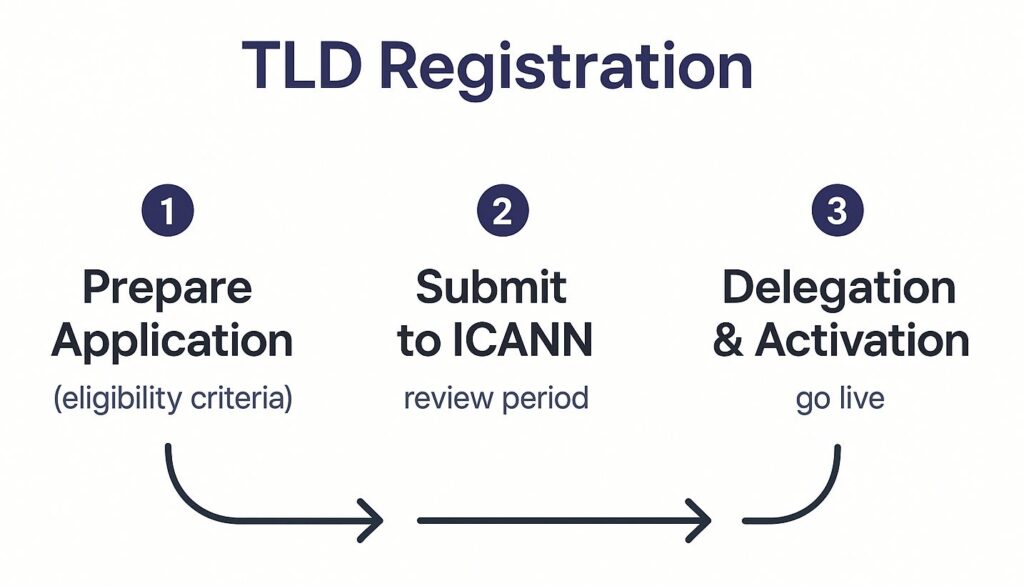
As the infographic makes clear, the path is broken into distinct phases. Each one requires immense preparation and a rigorous review before you can even think about moving on to the next stage.
Let’s get straight to the point on cost. For the upcoming round, the application fee alone is $227,000, and that’s just to get your foot in the door. That price tag doesn’t cover your legal team, technical consultants, or the operational cash you’ll burn through. Getting through this process requires a serious financial commitment. For a more detailed breakdown, check out our guide on how to apply for your own TLD.
Then you have to worry about competition. What if someone else has the exact same brilliant idea for .zen? This scenario is called “String Contention,” and it’s one of the toughest hurdles. If multiple qualified applicants are vying for the same TLD, ICANN can trigger an auction where the highest bidder wins. This is precisely why having expert advisors isn’t just a good idea. It’s non-negotiable. They are your seasoned guides through the intricate, and often contentious, world of ICANN policy.
The ICANN application is less of a submission and more of a campaign. It requires strategic planning, political savvy, and the endurance of a marathon runner to see it through to the finish line.
Meanwhile, the new gTLD marketing continues to grow. As of Q1 2025, registrations reached 37.8 million – a 13.5% increase year-over-year. But here’s the catch: renewal rates averaged only 34.2%, compared with 74.3% for legacy TLDs. That gap highlights the challenge of retaining customers in a crowded market. Getting approved is only the first battle. Building a sustainable business is the real war.
So, you’ve made it through the ICANN gauntlet. Congratulations, you’ve survived the paperwork apocalypse. Now for the fun part: actually making it work. This is where the abstract concept of your TLD slams into the concrete reality of global internet infrastructure.
Think of it like building a city’s power grid. It has to be ruthlessly reliable, capable of handling millions of connections without a flicker. It needs to be secure enough to fend off constant threats and scalable enough to grow with your community. Without that rock-solid foundation, your TLD is just an idea.
At the heart of your TLD’s operations is the Registry Service Provider (RSP), often called a backend registry operator. Choosing the right RSP is one of the most critical technical and financial decisions in the entire gTLD process.
Trying to build this infrastructure from scratch is a monumental undertaking. You’d be on the hook for engineering a global DNS network, creating a secure gateway for registrars, and guaranteeing 100% uptime, all while staying compliant with ICANN’s laundry list of technical requirements. It’s no wonder the vast majority of TLD operators partner with an established RSP.
Choosing your RSP is one of the most critical decisions you’ll make. It’s the difference between plugging into a fully functional power grid and trying to build your own nuclear reactor in the basement.
A great RSP brings the core systems your TLD needs to function, saving you years of development and millions in upfront costs. They handle the heavy lifting, freeing you up to focus on what you do best: marketing and growing your TLD.
Your technical backend isn’t one single thing; it’s a few critical systems working in perfect harmony. In fact, each piece is non-negotiable if you want to build a TLD that’s both functional and compliant.
Shared Registration System (SRS): This is the brain and central database of your TLD. The SRS is what allows accredited registrars – think giants like GoDaddy or Namecheap – to connect to your registry. They use it to check domain availability and then register, renew, or transfer names for their customers.
Global DNS Infrastructure: These are the servers that tell the rest of the internet where to find websites using your TLD. This network must be globally distributed to ensure lookups are lightning-fast, no matter where someone is in the world. Security here is non-negotiable, which is why DNSSEC (Domain Name System Security Extensions) is mandatory to prevent things like DNS hijacking.
ICANN-Mandated Services: To keep the internet stable and accountable, ICANN requires every registry to provide certain services. A key one is data escrow, where a daily backup of all your registration data is sent to a trusted third party. It’s a safety net – if your registry were to fail, the domain data is still safe.
The importance of this robust infrastructure is underscored by the TLD market’s continued growth. New generic TLDs are showing strong momentum, hitting 39.5 million registrations by mid-2025. That’s a 4.6% jump from the previous quarter and a 14.2% increase year-over-year,. It’s a growth rate that outpaces even the country-code TLDs. You can dive deeper into these trends and more at DNIB.com.
Before your TLD can go live, it has to pass a series of tough pre-delegation technical tests. These checks are designed to validate everything – that your SRS works, your DNS is solid, and all systems are communicating properly. Passing these tests is the final technical hurdle before your TLD is officially added to the internet’s root zone, making it a live part of the web.
You’ve wrestled with the ICANN application and built a technical backend that could power a small country. Fantastic. However, here’s the hard truth: a technically perfect TLD is completely worthless if nobody knows it exists or wants to use it.
This is where the real battle begins – launching your TLD and getting it in front of the world. A slick go-to-market strategy turns your piece of digital real estate into a bustling, thriving community. Screw this up, and you’re left with a very expensive ghost town.
You don’t just flip a switch and hope for the best. A successful launch is a carefully choreographed event, designed to build hype, protect valuable intellectual property, and squeeze every drop of value from your most desirable domain names. There’s a reason the entire industry follows a phased approach.
Here’s how the dance usually goes:
Sunrise Period: This is your velvet-rope, exclusive opening for trademark holders. It’s a mandatory phase required by ICANN, allowing big brands like Apple or Nike to register apple.yourtld or nike.yourtld before the floodgates open. It’s about protecting IP and showing you’re a serious player.
Landrush Period: Think of this as the VIP pre-party. Landrush is a limited-time window where you offer up the really juicy, non-trademarked premium names – think shop.yourtld or crypto.yourtld. These are often sold at a higher price or through an auction, and this phase is absolutely critical for generating a big chunk of your upfront revenue.
General Availability (GA): This is it, the main event. The doors are thrown open, and anyone can register an available domain on a first-come, first-served basis. Your marketing machine should be firing on all cylinders to drive a massive wave of sign-ups right from day one.
This phased rollout isn’t just procedural; it manufactures excitement and scarcity. It turns a simple product release into an event people are eager to be part of. For a deeper dive into the entire journey, check out our detailed roadmap to acquire your TLD in 2026, from concept to reality.
Let’s get one thing straight: as a registry operator, you don’t sell domains directly to the public. That’s the job of registrars – the GoDaddys, Namecheaps, and Google Domains of the world. Your success is completely dependent on how well you build and nurture this sales channel.
Getting these giants to simply list your TLD is tough enough. Getting them to actively promote it? That’s a whole different level of challenge.
Getting your TLD listed on a major registrar is like getting your product on the shelves at Walmart. Getting them to feature it in an end cap display is a whole different ballgame.
To even get in the door, you need a killer pitch. Registrars will grill you on a few key things:
The good news is, you have some compelling data on your side. While legacy TLDs like .com and .net actually saw registrations decline by 2.6 million in early 2025, the new gTLD market is exploding. Registrations grew to 37.8 million domains – a 13.5% year-over-year jump. This proves there’s a real, growing appetite for new and specific extensions. You can get more stats like this from this domain name industry report.
Some TLDs have absolutely crushed it with their marketing, becoming part of the very fabric of the communities they serve. Just look at .io. It was originally the country code for the British Indian Ocean Territory, but it was brilliantly repositioned as the go-to TLD for the tech startup scene. Why? “Input/Output” is a term every single developer instantly recognizes. Genius.
Then there’s .xyz, which launched with a bold, slightly anti-establishment vibe. They positioned themselves as the TLD for the next generation of internet users – the “xyz” generation. It was a pure branding play that paid off spectacularly, making it one of the most successful new gTLDs ever.
These wins weren’t accidents. They came from a deep, almost intuitive understanding of a target audience and a story that hit all the right notes. This is the final, crucial step: giving your TLD a soul.

If you’re seriously considering creating your own TLD, you’ve probably got a few big questions swirling around. Let’s cut right to the chase and tackle the most common ones I hear from entrepreneurs and brands diving into this space.
That $227,000 ICANN application fee gets all the attention, but honestly, it’s just the tip of the iceberg. Think of it as the cover charge to get into the club.
The real, all-in cost to successfully get a TLD off the ground and running smoothly typically lands somewhere between $500,000 to over $2 million. As a result, your broader budget covers everything from expert legal help and the technical backend buildout to the multi-year marketing and operational costs you’ll need to actually succeed. It’s a significant financial undertaking that requires a solid plan from day one.
Patience isn’t just a virtue here; it’s a non-negotiable requirement. From the moment you start mapping out your strategy to the day your TLD goes live, you should plan for a timeline of two to three years.
And that’s assuming ICANN opens the April 2026 new application window without any delays. The application review process itself can easily take 12-24 months. After that, you still have the technical setup and phased launch periods to get through.
Think of it as a marathon, not a sprint. The journey to build a TLD is long, but the finish line is owning a piece of the internet’s core infrastructure.
Absolutely – it takes grit, but that’s what makes it exciting. Sure, Apple (.apple) has deep pockets, but I’ve watched startups, visionaries, and bold entrepreneurs carve their own path and win. With the right idea and determination, success isn’t just possible. It’s waiting.
No matter who you are, the keys to success are the same:
The most obvious revenue stream is the recurring annual registration fees you collect from registrars. yet, that’s only part of the story. A huge chunk of income, especially early on, comes from selling “premium” domains.
These are the short, memorable, or high-value names – think insure.us or vacation.deals. These can command prices from thousands to even millions of dollars, giving you a powerful upfront revenue boost to fuel your growth.
For a complete strategic and operational overview, see our guide on how to build a top-level domain.
Ready to move from idea to reality? The path to building a TLD is complex, but you don’t have to walk it alone. The experts at TLDz have helped launch over 50 TLDs and can guide you through every step of this journey.
Ready to see if your TLD idea has what it takes? Download a complimentary Zen Report to validate your TLD idea today.
Subscribe to Our Monthly Newsletter
Join our mailing list to receive exclusive content only our newsletter members have access to.