
At its core, gTLD string contention is what happens when two or more applicants submit an application for the same – or a “confusingly similar” – gTLD string. It’s like multiple prospectors showing up to stake a claim on the same plot of land. Except the land is digital, and the sheriff is ICANN.
To manage the inevitable chaos, ICANN groups these overlapping applications into what it calls ICANN contention sets. Think of a contention set as a single battle arena where all applicants for a specific string (or similar strings) are forced to face off.
This process applies to two types of conflict:
.cloudor .app..shop and .shoppe would likely be thrown into the same arena to prevent user confusion. This means your biggest rival might not be who you expect.
Before ICANN unleashes the multi-million dollar chaos of an auction, it provides a few clever off-ramps. Think of them as strategic detours to avoid a costly pile-up. For the gTLD string contention round in 2026, mastering these pre-auction pathways is everything.
This is the ultimate trump card. If your application represents a clearly defined and organized community (like an organization for .cpa representing Certified Public Accountants), you can essentially jump the line and claim the gTLD, no auction required. It’s a game-winner, but the criteria are incredibly strict. In the 2012 round, this was a rarely used but highly effective strategy. Out of nearly 1,930 applications, only 84 were community-based, but when they won, they bypassed the auction entirely.
New for the 2026 round, applicants can propose an alternate string as a backup. If you apply for .media and find yourself in a crowded field, you can pivot to your pre-selected (yes, pre-selected) backup, like .press, to sidestep a fight you might not win. It’s a brilliant way to dodge a financial bullet.
Unlike the wild west of 2012, private auctions and side deals are now largely off the table. ICANN has implemented strict communication prohibitions, meaning you can’t just pay your competitors to walk away. The game is now played through official channels only.

When all other paths fail, it’s time for the main event: the ICANN Auction. This is the last-resort mechanism, a high-stakes financial showdown to settle contention once and for all. Before you can bid, you must have all evaluations complete, objections resolved, and no open disputes.
The expected method is the ascending-clock, second-price format used in 2012. It’s like a high-stakes game of chicken:
For indirect contention sets (like .shop vs. .shoppe), a single auction may have multiple winners, each claiming their respective string.
There’s also a twist for the Applicant Support Program: eligible applicants from underserved regions can receive bid credits, giving them a fighting chance against deep-pocketed corporations. It’s a crucial leveling force in the gTLD Hunger Games.
The road to delegation is paved with peril. One misstep can lead to disqualification, massive budget overruns, or years of infuriating delays.
The 2012 application round was the stuff of legend. The battles were fierce, and the prices were eye-watering. The string .app drew 13 separate applications, sparking a bidding war that ended with Google paying $25 million. The fight for .shop was even more intense, closing at a jaw-dropping $41.5 million. Even .blog fetched a cool $19 million.
These auctions proved that even the most well-funded applicants underestimated the competition’s willingness to spend. The key lesson? Whatever you think a string is worth, someone else probably thinks it’s worth more. A lot more.
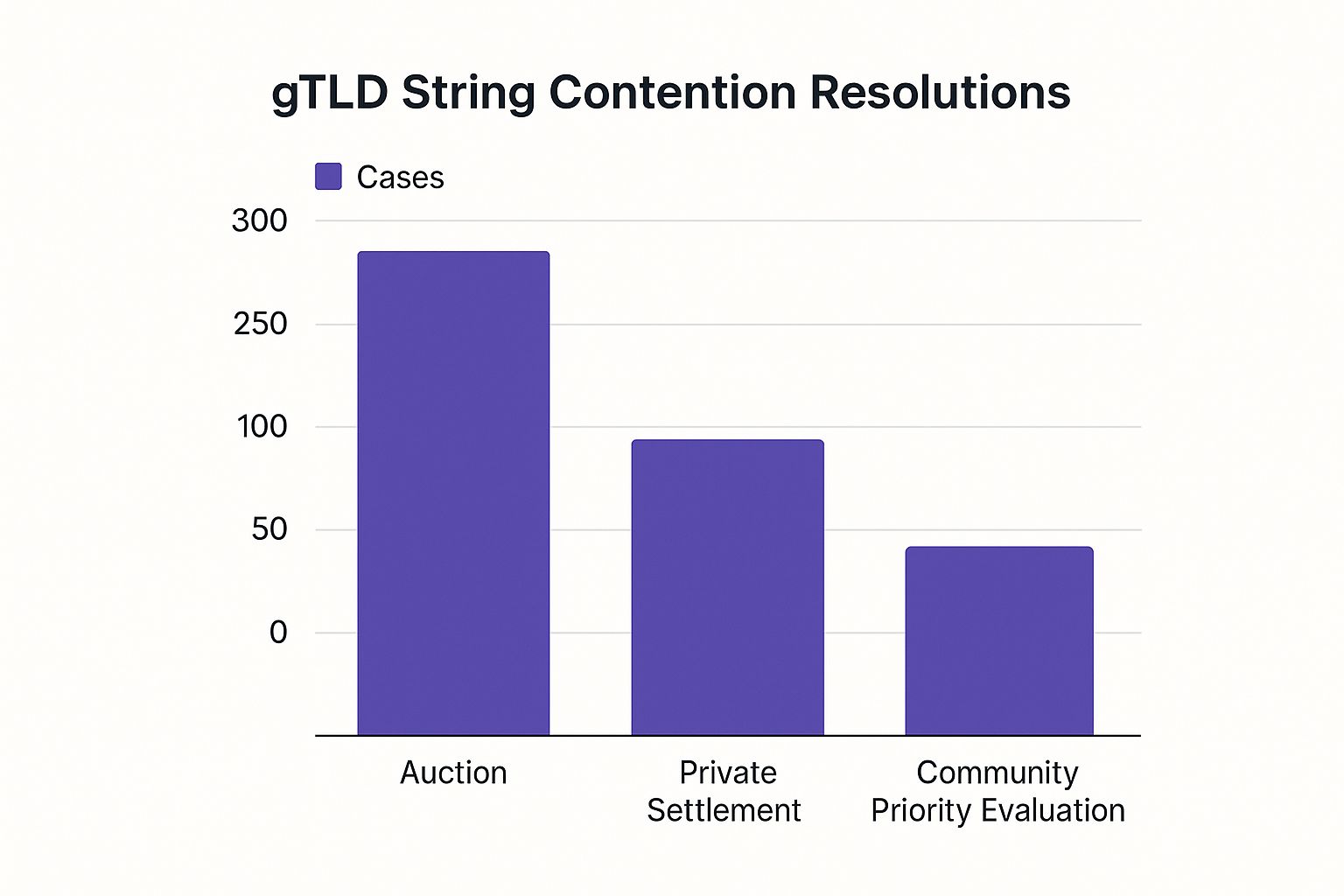
As you can see from the 2012 data, auctions were by far the most common resolution method, dwarfing private resolutions and community evaluations. Prepare accordingly.
Knowing the rules is one thing; having a winning strategy is another. Success in the gTLD string contention gauntlet comes down to foresight and preparation.
.server ready if .cloud gets too hot) can be your salvation.shop ($41.5M) and .app ($25M) and ask if you can survive that kind of fightFor those needing a leg up, it’s also worth exploring how ICANN’s Applicant Support Program helps you get a gTLD for under $60k.
Navigating the contention process is daunting, but you don’t have to do it by yourself.
Download our String Contention Survival Guide 2026 – packed with strategies, case studies, and a pre-auction budgeting checklist.
At TLDz, we turn complex challenges like string contention into clear, actionable strategies. Our team has a 100% success rate across more than 50 applications, and participated in budget preparation and actions. We’re ready to guide you through every milestone of the 2026 round. Schedule your free consultation today at https://tldz.com and build your digital future with confidence.