
Applying for a new generic top-level domain (gTLD) isn’t a one-size-fits-all deal. Oh no. ICANN, the internet’s slightly intimidating landlord, recognizes multiple types of gTLD applications, and not all are created equal. Each category has its own unique rules, fees, risks, and secret handshakes for the upcoming ICANN gTLD application types 2026 round.
Think of it as a high-stakes personality quiz. Are you a trailblazing General applicant, a protective Brand, a passionate Community, a place-based Geographic, or a globally-minded IDN? This guide helps you figure out which type of gTLD application fits your goals before you drop a small fortune on the application fee. Picking the wrong one is a mistake that’s hard to recover from.
The first major round in 2012 gives us a clue about how diverse the interest is. Out of 1,930 applications, there were 84 for communities, 66 for geographic names, and 116 for internationalized domain names (IDNs). You can dig into more of these initial application statistics on ICANN’s website.
If your gTLD idea doesn’t fit neatly into the other specialized boxes, congratulations! You’re what ICANN calls a General applicant. This is the most common type of gTLD application and the default category for any entity applying for an open, standard gTLD. It’s the route taken for many of the internet’s most recognizable digital marketplaces, like .shop, .app, or .mobile.
As a General applicant, you won’t get any special priority points, but you also don’t have to jump through the unique hoops required for other types of gTLD applications. You will, however, have to face the full gauntlet of ICANN’s standard evaluations, proving your financial stability, technical capability, and passing detailed string similarity reviews.
Pitfall: The biggest hurdle is pure, unadulterated competition. This path is open to anyone with a solid plan and deep pockets, so you’re far more likely to find yourself in a “contention set” — ICANN’s polite term for a digital duel that usually ends in an auction where the biggest checkbook wins. While over 1,900 new gTLDs have been launched, a stark winner-take-all dynamic has emerged. Just 10 of these new extensions capture over 50% of all registrations. You can dive deeper into the data on new gTLD market concentration from DNIB.com.
For companies aiming to build a fortress around their digital identity, the brand TLD application ICANN path is the ultimate power move. This exclusive path is designed for organizations that own a registered trademark matching the exact string they’re applying for – think of industry titans like .google, .apple, or .bmw. It’s the digital equivalent of owning the entire city block where your headquarters is located.
To go down this road, you must apply for a special clause in your Registry Agreement known as ICANN Spec 13 (Brand TLDs). This is the key that unlocks the door to operating your TLD as a closed ecosystem, restricting registrations to your own company and its affiliates. This level of control offers incredible security; in fact, Brand TLDs have a stunning 0% detected abuse rate, making them the safest neighborhoods on the internet. ICANN tacks on a conditional evaluation fee of just $500 for this review.
Pitfall: Your trademark has to be rock-solid. A weak or questionable trademark basis is the fastest way to get your application rejected. This isn’t the place for emerging brands; it’s a high-stakes play for established companies seeking total command of their online presence. For those weighing this powerful option, it’s worth exploring the key considerations for a brand top-level domain strategy.
Is your TLD string a city, a region, or a culturally distinct area? If so, you’re looking at a Geographic TLD application. Think .nyc, .london, or .bcn (for Barcelona) – these are the digital addresses that give a location its own unique identity online.
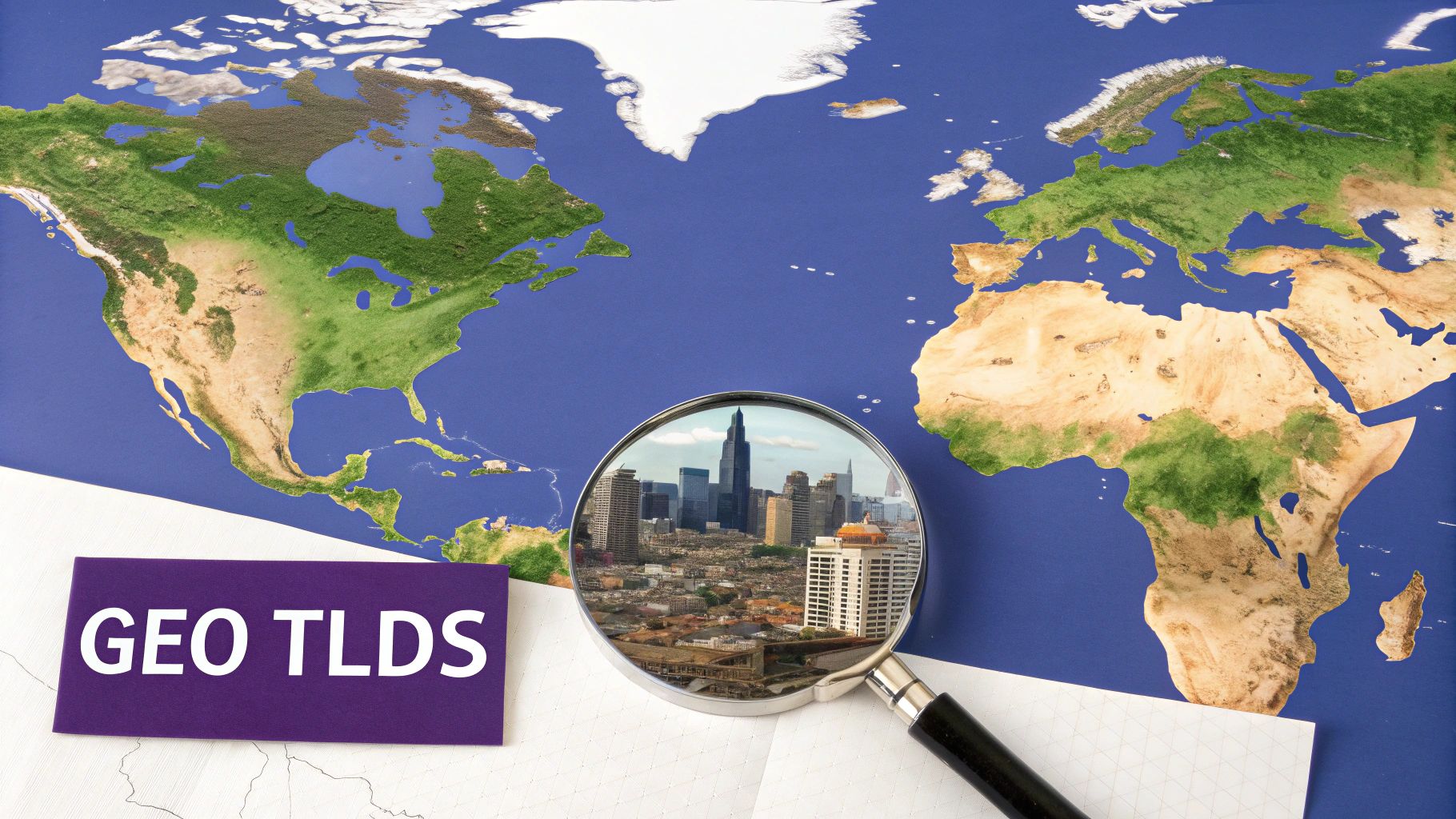
This application type stands apart because it’s less about your business plan and more about getting the official blessing from local authorities. The core of the geographic TLD rules is having documented support or non-objection from the relevant government(s). The process also involves a special Geographic Names Review panel, which tacks on its own conditional fee of $18,000–$25,000.
Pitfall: Lack of government approval means automatic failure. This isn’t just a suggestion; it’s a non-negotiable requirement for ICANN geographic TLD government approval. Countless aspiring applicants have burned through significant time and money, only to be stopped cold because they couldn’t secure the necessary political backing. You can dive deeper into the benefits of geographic top-level domains to learn more.
If your vision is to build a digital home for a specific group – united by a shared cause, culture, or industry – then the community gTLD application is your path. Think back to the 2012 round and strings like .gay, .eco, and .music. Each was meant to serve a distinct, passionate group.
This route holds a massive strategic advantage: the Community Priority Evaluation (CPE). If you are in contention with a General applicant for the same string (say, .art) and you pass the CPE, you automatically win the string. No auction, no bidding war – it’s yours.
Pitfall: Of all the types of gTLD applications, the community model can be the trickiest to prove. The number one reason community applications failed in the past was a weak “community definition.” In 2012, many applicants stumbled because their definition was too broad or lacked formal structure. ICANN demands concrete proof of a clearly defined community, not just a vague shared interest. You can dive into the nitty-gritty scoring details in the official ICANN CPE Guidelines.
While much of the web operates in the Latin alphabet, the internet is truly a global village. Internationalized Domain Names (IDNs) allow TLDs to exist in scripts like Arabic (.شبكة), Cyrillic (.онлайн), or Chinese (.닷컴).
The biggest hurdle in the ICANN IDN gTLD application process is complying with the Root Zone Label Generation Rules (RZ-LGR) for a specific script. Think of the RZ-LGR as a rulebook that prevents digital chaos. For the application, both the U-label (what users see, e.g., .คอม) and the A-label (the Punycode version computers read, e.g., .xn--o3cw4h) must be submitted. There’s even a special refund if your string overlaps with an existing IDN country code TLD (ccTLD). You can dive into our guide on mastering IDNs and their strategic value.
This category is applicable mainly to IDNs. In many scripts, characters can be written in different ways but mean the same thing (think simplified versus traditional Chinese). ICANN gets this, so they allow an applicant to include up to 4 related variant strings within a single application fee. You must show the linkage between the variants and demonstrate that their inclusion doesn’t create security or stability problems for the internet. It’s a technical but crucial step for serving multilingual communities properly.
Choosing your type of gTLD application is the most critical strategic decision you’ll make. It affects your evaluation path, fees, risks, and even your outcome if you end up in contention. Don’t self-misclassify or try to game the system by filing a generic word as a “community” application just to gain priority – ICANN‘s evaluators have seen it all before, and these missteps are nearly impossible to recover from.
Once you know your type, what happens on Reveal Day? The ICANN Oscars await.
In the meantime, if you need help figuring out the difference between brand and community gTLDs or any other application path, feel free to book a free 20-minute consult.
Thinking about applying for a gTLD can bring up a lot of questions. Getting clarity on the different application types is a crucial first step, as the path you choose will define your entire journey through the upcoming ICANN gTLD application round in 2026.
Let’s break down some of the most common questions we hear.
At first glance, they might seem similar, but their core purpose and operating rules are worlds apart. The key difference between brand and community gTLDs comes down to who they serve.
A Brand TLD is built on a registered trademark and is run as a “closed” registry. Think of it as a private digital estate for that brand’s exclusive use, like .google or .apple. It’s a walled garden, controlled entirely by the brand owner.
A Community TLD, on the other hand, has to represent a genuine, clearly-defined community. More importantly, it must be operated in that community’s best interest. This isn’t just a label; it’s a commitment that can give it a huge advantage – priority over standard applicants if there’s a fight for the same name. It’s a digital commons, not a corporate headquarters.
That’s a hard no. For any Geographic TLD application, you absolutely must have documented support or a letter of non-objection from the relevant government or public authority. This isn’t just a suggestion; it’s a non-negotiable requirement.
Under the official geographic TLD rules, an application for a name like .paris or .tokyo that shows up without this official blessing will be dead on arrival. It will automatically fail the Geographic Names Review, no questions asked.
This is a common misconception. While all types of gTLD applications start from the same baseline – proving your technical and financial stability – each path quickly diverges into its own specialized maze of reviews and requirements.
These unique evaluations add distinct layers of complexity, cost, and strategy to each application type. It’s definitely not a one-size-fits-all process.
Feeling unsure which application type fits your vision? The expert team at TLDz can help you analyze your goals and choose the right strategic path for the upcoming 2026 application window.
Book a free 20-minute consult to identify your application type.