

So, you’ve done it. After months of quiet, strategic work, your new gTLD application is officially published. Pop the champagne, but don’t get too comfortable. Once your application is live on the ICANN site, it’s no longer just for their evaluators – it’s out there for the whole world to see, scrutinize, and critique.
And that’s no exaggeration. The public comment period is an open invitation for anyone with an internet connection and an opinion to weigh in. Competitors, NGOs, academics, or just some random stakeholder who really, really cares about domain names – they’re all coming to the party. These comments won’t always derail you, but they can certainly sting if ignored.
Think of it as the internet’s most eclectic open mic night. The feedback can come from highly influential organizations, direct competitors, or just individuals with a bone to pick. You can expect to hear from a few key groups:
If history is any guide, this process attracts a massive and diverse crowd. During the 2012 application round, for instance, ICANN received thousands of comments from all over the world after publishing 1,930 applications from 60 different countries. It was a clear signal of just how many people have a vested interest in the internet’s structure. ICANN doesn’t formally score applicants on their responses. However, evaluators review comments and replies as part of the application record, which can influence perceptions of credibility and preparedness
A few negative comments probably won’t sink your application on their own, but ignoring a strong tide of feedback could be a fatal mistake. This entire phase is designed to be a stress test. ICANN wants to see how you handle public pressure and whether you can engage constructively with legitimate concerns.
In fact, managing this period well can significantly strengthen your application.
A proactive, transparent approach during the comment period does more than just address criticism; it builds a foundation of credibility that evaluators and the broader internet community will remember.
This isn’t just about playing defense. It’s about proving you are a prepared, credible, and responsible operator ready to manage a piece of the internet’s infrastructure. How you perform in this public arena sets the tone for your entire gTLD journey. Let’s pull back the curtain on what to expect.
So, what exactly is the Application Comment Forum (ACF)? Think of it less like a casual internet forum and more like an official public record, permanently etched into the history of the domain name system. This is ICANN’s dedicated public platform where your carefully crafted gTLD application gets put on display for the global community to review.
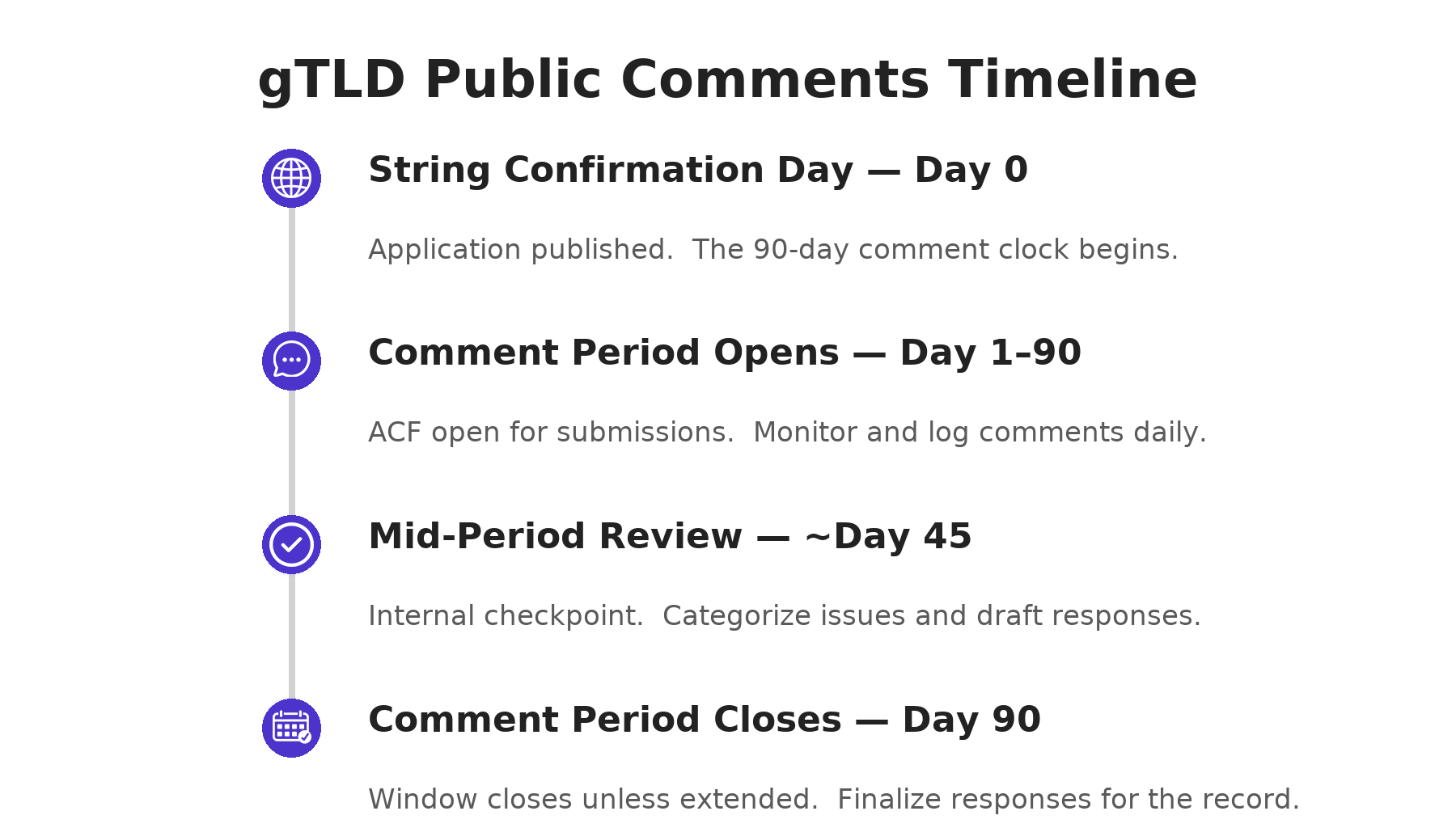
The doors to the ACF swing open on what’s known as String Confirmation Day – the moment your proposed gTLD is officially published. From that day, a 90-day clock starts ticking. This creates a window for anyone, anywhere, to submit their thoughts on your application’s merits, risks, or sensitivities. While ICANN reserves the right to extend this period, you should absolutely plan for that three-month sprint.
At its core, the ACF is all about gathering diverse global perspectives. Its purpose isn’t to create chaos but to ensure transparency and accountability in the gTLD program. It’s how ICANN collects feedback on your application’s merits, potential risks, or any unforeseen sensitivities you might have missed.
Comments can range from highly technical critiques of your operational plan to cultural concerns about the gTLD string itself. This is the phase where abstract plans meet real-world scrutiny. For instance, an application for .bank in the 2012 round naturally attracted comments from financial regulators, while .wine drew feedback from agricultural associations. Every gTLD has a unique stakeholder ecosystem, and the ACF is where they all converge.
The Application Comment Forum is the first true stress test of your gTLD’s viability. It’s where the community gets to kick the tires on your proposal before ICANN even thinks about handing you the keys.
This is a critical period for any applicant, demanding close attention and strategic planning. Here’s a quick overview of what to expect.
This timeline breaks down the critical milestones you’ll need to navigate during the 90-day Application Comment Forum window.
| Milestone | Timing | What Applicants Need to Do |
|---|---|---|
| String Confirmation Day | Day 0 | Your application is officially published. The 90-day comment clock begins |
| Initial Comment Window Opens | Day 1-90 | Monitor the forum daily for new comments. Begin categorizing them |
| Public Comment Period | Day 1-90 | Anyone can submit comments on your application through the official ACF |
| Response & Clarification Phase | Ongoing | Draft responses to address concerns and clarify your application’s details |
| Comment Period Closes | Day 90 | The window for public submissions officially closes (barring any extensions) |
Staying on top of these stages ensures you’re prepared to manage feedback effectively and demonstrate your readiness to operate a gTLD.
The short answer? Pretty much anyone. The ACF is an open stage, and the cast of characters can be extensive. Here’s a quick look at who you can expect to hear from:
This broad participation is a feature, not a bug. Understanding the rules and rhythms of this process is crucial, as detailed in the official gTLD public comments 2026 guidelines. For a deeper dive into what to expect from the full application journey, you can get ready to acquire your own gTLD with the draft applicant guidebook.
The key is to see this not as an obstacle, but as the first and best opportunity to demonstrate just how prepared you are.

Alright, the comments are starting to roll in. So what happens now? It’s easy to dismiss the Application Comment Forum as a bit of a sideshow, but that would be a serious mistake. This isn’t just background noise; the evaluation panels will see every relevant comment and your response to it, as long as it was submitted within the official window.
This public feedback can either pour rocket fuel on your claims or punch devastating holes in your arguments. A glowing endorsement from a well-respected industry group for your .eco application is priceless. On the flip side, a sharp critique from a government advisory committee could raise major red flags about your operational plans, putting you on the defensive. Comments can support or challenge your eligibility, community alignment, or technical and financial robustness.
Evaluation panels are tasked with taking a holistic view. While your application is the main event, the gTLD public comments 2026 provide crucial context and a real-world stress test of your entire proposal. Comments can directly shape how evaluators see your application’s strength in several key areas.
For example, a comment might:
.data application. That adds instant, third-party credibility.art gTLD doesn’t properly represent the global arts community, directly questioning your community standingThe sheer volume and variety of applications mean the scope of comments will be massive. We’re talking everything from broad concepts like .shop to highly specific brand TLDs. In fact, by early 2022, around 34% of the 1,930 applications from the last round were for brand TLDs like .netflix or .walmart. This trend guarantees that all sorts of corporate, legal, and community interests will be digging into the details of every application. You can dive deeper into the structure of the new gTLD landscape from Namecheap’s data study.
This is a critical distinction: comments are not formal objections. An objection is a completely separate, formal dispute process with its own rules, fees, and procedures. Public comments are the appetizer; objections are the expensive main course you want to avoid.
However, a public comment is very often the spark that ignites the fire of a formal objection. They can, and often do, feed directly into them later.
Think of a negative public comment as the preliminary hearing. It puts a potential issue on the official record, creating the foundation that a formal objector might later build their case upon.
A smart, strategic response can extinguish that spark before it spreads. By addressing a concern clearly and factually right there in the comment forum, you can often satisfy the commenter and show evaluators that the issue is resolved. It’s a sign of maturity and competence.
Ignoring a legitimate concern, on the other hand, can come across as dismissive. It might even encourage the commenter – or someone else watching – to escalate the issue into a formal dispute. Your response strategy isn’t just about PR; it’s a fundamental part of your risk mitigation plan.
Here’s where things get serious. The public comment process isn’t just about managing your image or dealing with a bit of internet drama. The Application Comment Forum (ACF) has a direct, mechanical link to the formal dispute resolution process. It’s the bridge between casual feedback and a costly, full-blown objection.
If you only pay attention to one part of this whole affair, make it this one.
There’s one rule that is absolute and non-negotiable: the Independent Objector (IO) can only file an objection if at least one public comment in opposition to your application already exists.
Let that sink in for a moment. The IO is an official role funded by ICANN, tasked with protecting the global internet community’s interests. They are a powerful, neutral party with the authority to kick off a formal dispute that could completely derail your application. But their hands are tied unless someone – anyone – first plants a flag of opposition in the ACF. This makes the comment forum your first and most important line of defense.
Think of it as a legal trigger. A single, seemingly minor negative comment from a disgruntled competitor or a concerned non-profit could become the gateway for a major, expensive challenge. This is why smart applicants track and respond early to reduce escalation. You’re not just responding to comments; you are actively neutralizing potential legal and financial threats before they can grow.
This connection transforms the gTLD public comments 2026 from a public relations exercise into a critical risk management function. For instance, an application for a gTLD like .green might get a comment from an environmental group questioning the applicant’s sustainability bona fides. If that comment is ignored, it provides the perfect foundation for the IO to launch a formal community objection.
Every unresolved negative comment is a potential foothold for a formal objector. Proactively addressing them in the ACF isn’t just good practice – it’s a core part of your legal defense strategy.
By actively monitoring comments and providing clear, fact-based responses, you can cut off these pathways before they’re ever used. This is especially true for applications touching on sensitive areas. For a deeper dive into these challenges, you can review some of the key legal considerations when applying for a new top-level domain.
A proactive strategy during the ACF does more than just put out fires. It sends a powerful signal to evaluators and would-be objectors that you are a responsible, engaged, and transparent applicant who can handle community concerns with professionalism.
Let’s look at two scenarios for a hypothetical .health application:
In the second scenario, the applicant hasn’t just addressed the concern – they’ve demonstrated their preparedness to the entire world. This dramatically reduces the likelihood of escalation. You’ve shown your work, proven your competence, and given potential objectors far less ground to stand on. This is how you turn a potential crisis into a demonstration of strength.

Not every public comment is created equal. The moment the Application Comment Forum (ACF) opens, your application will be hit with a wild mix of thoughtful critiques, thinly veiled jabs from competitors, and just plain, unfiltered internet noise. The secret to surviving this 90-day gauntlet isn’t about responding to every single post. It’s about knowing which comments pose a real threat and which are just there to waste your time.
Think of it like being a comment triage specialist. Your job is to swiftly sort the genuinely “dangerous” comments from the merely “frivolous.” The rule of thumb is that evaluators weigh substance, not noise. A single, well-reasoned critique can sink your application faster than a hundred angry but empty rants.
So, what makes a comment truly dangerous? We’re not just talking about negative feedback. A dangerous comment raises a legitimate red flag that could directly derail your evaluation by highlighting issues of law, genuine community opposition, or technical feasibility. They are substantive, almost always backed by evidence, and speak directly to the core requirements of the gTLD program.
Keep a sharp eye out for comments that hit these high-risk areas:
.eco and a dozen major environmental groups post coordinated, detailed comments opposing your application. That’s a five-alarm fire because it directly challenges your claim to represent that communityThese are the kinds of comments that can snowball into formal objections. Just look at the historic and heated debates over gTLDs like .amazon (opposed by the Amazon Cooperation Treaty Organization) and .africa (which faced fierce community-based challenges). Those battles began as public comments that raised substantive issues of representation and public interest.
On the other end of the spectrum, you have the less threatening internet noise. This stuff is designed to chew up your time and drain your energy. While you can’t completely ignore it, you need a much lighter touch.
Frivolous comments usually look like this:
Public comments often get into commercial territory, like pricing and market competition. A great example is the feedback on the renewal of the .COM Registry Agreement, where ICANN received 28 distinct comments. A major theme was fierce opposition to price hikes, with many demanding competitive bidding for the registry. You can dive into a full analysis of the public’s view on gTLD competition and pricing issues at CircleID.
Learning this distinction helps you focus your limited resources where they matter most – on neutralizing credible threats to your application.
This table is a quick-and-dirty framework to help you sort through what comes your way during the gTLD public comments 2026 period.
| Comment Characteristic | Dangerous Comment (High Priority) | Frivolous Comment (Low Priority) |
|---|---|---|
| Source | From a government, respected NGO, or identifiable industry expert | Anonymous or from a known competitor with a clear agenda |
| Substance | Cites specific evidence, legal statutes, or application sections | Makes vague claims, uses emotional language, lacks evidence |
| Potential Impact | Could form the basis of a formal objection (e.g., community, string confusion) | Unlikely to influence evaluators; mostly just adds to the noise |
| Example | “The proposed .bank TLD fails to meet financial regulatory standards in the EU” | “I think .brandx is a stupid idea and they’re just greedy” |
By using this triage system, you can stay focused on what really counts and avoid getting bogged down by the distractions that are an inevitable part of the process.
It’s easy to react emotionally to public criticism. Responding strategically is what’s smart. Once the 90-day comment window slams shut, a new clock starts ticking: you generally have 30 days to submit your official responses. This isn’t the time for a knee-jerk defense, but for timely, professional replies.
Think of this period as your chance to frame the narrative, correct the record, and prove your competence. A great response doesn’t just silence a critic; it shows a willingness to engage constructively, which reassures evaluation panels and governments that you are a trustworthy future registry operator.
Every effective response rests on two pillars: professionalism and facts. This is not the place for a flame war. Getting defensive or argumentative is the fastest way to torch your credibility. Instead, you need to let your application do the talking for you. Stick to the facts.
Anchor every point you make in the evidence you’ve already submitted. If a comment misinterprets your financial model, politely redirect them to the relevant section and clarify the details. If someone raises a legitimate concern, acknowledge it constructively and explain your plan to address it.
Your goal isn’t to “win” an argument. It’s to provide a clear, factual, and professional record for the evaluators who will ultimately decide your fate. A calm and reasoned reply is infinitely more powerful than a defensive one.
This approach shows you’re willing to engage constructively – a trait that both evaluators and government advisory committees value highly.
Even the most prepared applicants can stumble during the response phase. Watch out for these common traps that can completely undermine your gTLD public comments strategy:
By treating the response period with the seriousness it deserves, you transform it from a reactive chore into a proactive opportunity to reinforce the strength of your application.
Let’s bring this home with some real-world advice from folks who’ve been through the gTLD trenches before. The public comment period isn’t something you just endure; it’s a dynamic process that calls for a smart, coordinated plan. Success here is all about preparation, not last-minute reactions.
Think of it as the first real stress test of your application and your team’s readiness. Nailing this part builds the credibility you’ll need for the entire evaluation process that follows.
First things first: you can’t afford any surprises. You must monitor the ACF daily during that 90-day period. The last thing you want is to be blindsided on day 89 by a critical comment that’s been sitting there for weeks.
Set up a system to track every new post. This daily check-in gives you the maximum amount of time to analyze feedback, gather your facts, and figure out a thoughtful response. Waiting until the clock is ticking is a recipe for a rushed, weak reply that could seriously damage your application.
Next, have a prepared messaging strategy for sensitive topics you know are coming. If your gTLD is tied to a regulated industry like .health or .law, you can bet comments will pop up about compliance and public safety. Applying for a geographic name like .nyc? Expect tough questions about community representation.
Instead of waiting for these comments to land, get ahead of them. Have pre-approved talking points and solid data ready to go. This lets you respond quickly and with confidence, showing everyone you’ve already thought through these complex issues. Knowing the gTLD application fees and timing is one part of the financial puzzle; anticipating these PR costs is another crucial piece.
Your internal teams absolutely have to be on the same page. Your public relations, legal, and technical staff can’t operate in their own little worlds. Coordinate with your PR/communications team for public alignment. Every public statement must perfectly mirror the details and commitments you made in your application.
Even a minor inconsistency can be used against you by a competitor or create confusion for evaluators. Before the gTLD public comments 2026 window even opens, establish a clear chain of command for reviewing and approving everything that goes out. This guarantees a single, unified voice that reinforces your application’s integrity.
Community input is not the end of the world – but it is the first real stress test of your application. Every concern you address, every piece of misinformation you correct, and every constructive conversation you have strengthens your case. Frame it as an opportunity to prove your preparedness and transparency. It proves you’re a responsible steward ready for the job, turning potential threats into a showcase of your organization’s readiness.
This period is your first public audition as a potential registry operator. A well-managed response strategy is a powerful demonstration of your competence, transparency, and respect for the multi-stakeholder model.
At TLDz, we help our clients turn this high-stakes process into a strategic advantage. With a 100% success rate across more than 50 applications, we provide the expert guidance needed to navigate every phase of the ICANN journey.
Ready to build a bulletproof strategy for your gTLD application? Download our free “Community Input Survival Checklist: 10 Steps for Responding to Public Comments” and make sure you’re prepared for anything.