
Congratulations, you made it through the gTLD application gauntlet! But before you start printing business cards for your new .BRAND or .COMMUNITY, let’s get one thing straight: Winning isn’t the finish line in ICANN-land. It’s just the starting line. Once you clear evaluations, the gTLD contracting phase begins, giving you 90 days to sign a contract with ICANN and prove you’re technically ready to run a registry. This final step concludes the broader gTLD Application Journey, which we map end-to-end in our Build a TLD: Ultimate Guide to Launching Your Own TLD.
The moment your application clears its final evaluation, a 90-day clock starts ticking on the ICANN gTLD contracting 2026 phase. This is where dreams become obligations, and you sign a binding agreement and, crucially, prove you are technically ready to operate.
The journey from a successful applicant to a fully operational registry is a high-stakes sprint against a very tight clock. Once ICANN resolves all the evaluations and objections, you’ll receive a formal invitation to begin contracting. This isn’t a friendly suggestion; it’s a mandatory next step with a non-negotiable 90-day timeline. Extensions are rarer than a unicorn sighting.
If you miss the deadline, your application is terminated. It’s that simple. Think of it like moving from the architect’s blueprint to the construction site – the work gets real, the deadlines are unforgiving, and every detail matters. The vision you outlined in your application is about to become a set of legally enforceable obligations.
This graphic lays out the critical stages you’ll navigate from winning the application to inking the final contract.
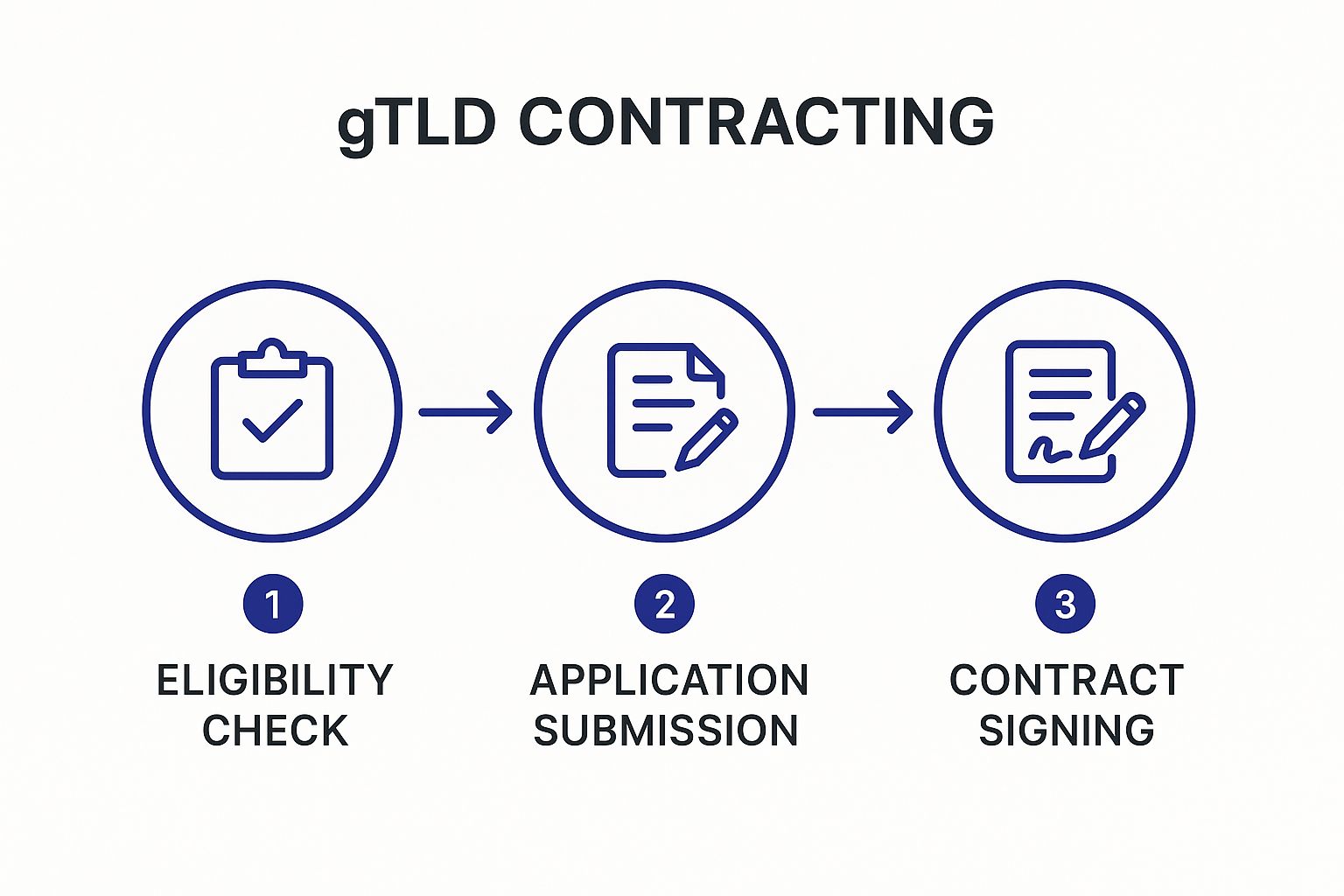
As you can see, signing the gTLD contract is the final major milestone, cementing your status and responsibilities as a registry operator for good.
This 90-day window is packed with critical tasks that have to run in parallel. It’s not just about signing a piece of paper. You’re juggling a legal review, technical validation, and strategic alignment all at once.
The two main components of this phase are:
.coke) or community TLDs (e.g., .scot)The evaluation fee for new gTLD applications is around $227,000. Having a rock-solid plan for this post-approval phase is absolutely essential to protect that investment. Missing a deadline here means a huge amount of capital goes down the drain.
This 90-day period is an intense sprint, and you need to be ready from day one. Here’s a high-level look at what that race against the clock looks like.
| Milestone | Key Objective | Typical Deadline | Critical Note |
|---|---|---|---|
| Contract Invitation | Receive official notice from ICANN to begin the contracting process | Day 1 | The 90-day clock starts now. No grace period |
| Legal Review & Execution | Review and sign the Base Registry Agreement (RA) and all relevant annexes | Days 1 – 30 | The RA is largely non-negotiable. Focus on verifying that your application commitments are accurately reflected |
| Initiate Pre-Delegation Testing (PDT) | Your technical provider begins the formal technical testing process with ICANN | Days 1 – 15 | Coordinate with your Registry Service Provider before the invitation arrives. Any delay here puts the entire timeline at risk |
| Pass PDT | Successfully complete all technical tests to ICANN’s satisfaction | Days 15 – 75 | This is the most variable part. Technical issues can cause significant delays, so robust preparation is key |
| Final Contract Submission | Submit the executed RA to ICANN | Before Day 90 | ICANN will not delegate your TLD until the signed contract is received and PDT is passed |
This timeline isn’t just a suggestion; it’s a hard requirement. Every step is a potential bottleneck, so preparation and coordination between your legal, financial, and technical teams are everything.
So, why the big rush? ICANN’s goal is to ensure that only serious, well-prepared organizations operate new TLDs. The 90-day limit acts as a filter, weeding out any applicants who lack the resources, readiness, or technical expertise to manage a piece of the internet’s core infrastructure.
It forces you to have your legal, technical, and operational teams perfectly aligned and ready to execute from the get-go. This guide is your pragmatic roadmap for navigating the ICANN gTLD contracting process and successfully crossing that finish line.
The ICANN Base Registry Agreement (RA) is the legal bedrock of your entire gTLD. If you’re picturing a drawn-out negotiation with lawyers trading redlines like a high-stakes corporate merger, you need to adjust your expectations – dramatically. This isn’t a negotiation; it’s an acceptance.

The RA is a standard, one-size-fits-most contract. ICANN presents it on a largely take-it-or-leave-it basis, holding nearly all the cards. This standardized approach is how they maintain fairness and consistency across hundreds of new gTLDs, from .pizza to .bank.
Once you receive the invitation to contract, the clock starts on a tight 15-day window to request any amendments. Don’t get too excited, though. These aren’t for haggling over terms you don’t like.
Amendments are only considered in truly extraordinary circumstances, like a direct conflict between a contractual clause and your country’s national laws.
You can’t just fire off an email with a few suggestions. You must submit a formal request with redlined text and a robust legal justification explaining why the change is absolutely necessary. Unsurprisingly, in the last gTLD round, the vast majority of these requests were denied. The message is crystal clear: the RA is a standardized instrument, not a starting point for debate.
The real purpose of the ICANN gTLD contracting phase is to transform all your application promises into legally binding duties. Everything you committed to on paper is about to be etched into contractual stone. This is where the aspirational language of your application gets real, fast.
The RA acts as a master document, pulling in several key components from your application and making them enforceable for the life of your gTLD.
.scot or .ngo, the specific rules that define and restrict who can register a domain are formalized here.amazon or .google, this specification outlines the unique, more flexible rules that apply to your closed registryThis contractual phase is the point of no return. The commitments you codify here will dictate your operational reality for years. A poorly defined promise in the application can become a significant compliance burden once it’s locked into the RA.
This is the exact moment your application’s compelling story becomes a set of legal obligations. Did you promise to protect a specific community? That’s now a contractual duty. Did you volunteer to implement enhanced security measures? You are now legally required to do so. Our guide to the draft applicant guidebook for gTLDs highlights how these upfront commitments shape your entire journey.
Failing to understand the gravity of this step is a classic rookie mistake. The RA isn’t just paperwork; it’s the constitution for your new corner of the internet. It defines your rights, your responsibilities, and the rules you’ll live by as a registry operator. Your legal team’s job isn’t to fight the unchangeable but to ensure the final document accurately and realistically reflects what you can actually deliver.
If signing the Base Registry Agreement is the legal hurdle, then Pre-Delegation Testing (PDT) is the technical trial by fire. This isn’t some theoretical exam or a pop quiz; it’s a full-on, live-fire exercise where ICANN methodically verifies that you and your chosen Registry Service Provider (RSP) can actually operate a gTLD securely, reliably, and up to global standards.

This is where your technical proposal transforms from words on a page into a functioning reality. It’s the ultimate “show, don’t tell” moment in the entire ICANN gTLD contracting 2026 journey.
The PDT process is exhaustive and unforgiving, built to probe every critical function of your registry. Think of it as a top-to-bottom inspection of your gTLD’s engine before it’s even allowed on the internet highway. ICANN’s technical team will put your systems through a rigorous battery of tests to confirm you’re truly ready for primetime.
Here are the key areas that go under the microscope:
This is exactly why your choice of RSP is so mission-critical. If you haven’t finalized this decision yet, our guide on Registry Service Providers (RSP): How to Choose the Right Backend breaks down what ICANN expects and how to avoid costly technical failures. Trying to cut corners with a cheap or inexperienced provider is a recipe for absolute disaster. Failing PDT can trigger expensive delays, frantic last-minute fixes, and, in the worst-case scenario, put your entire application in jeopardy.
The internet’s stability depends on every single registry operator – from giants like .com to newcomers like .music - meeting a baseline of technical competence. During the first six months of enforcing new DNS abuse rules, ICANN initiated 192 investigations with registries and registrars, leading to the suspension of over 2,700 domain names. This gives you a pretty clear idea of how seriously ICANN takes operational integrity, and it all starts with PDT.
Pre-Delegation Testing isn’t about just checking boxes. It’s a live demonstration that you are a trustworthy steward of a piece of the internet’s core infrastructure. A failure here is not just a technical setback; it’s a signal to ICANN that you may not be ready for the responsibilities of a registry operator.
The market for new gTLDs is getting more competitive as users search for alternatives to legacy domains. In fact, the combined registrations for .com and .net recently saw a 2.5% year-over-year decline. This shift is driven by things like price saturation and rising costs –.com wholesale prices jumped 28% from 2021 to 2024.
This creates a huge opportunity for well-run new gTLDs to grab market share, but only if they are technically sound from day one. You can dive deeper into the dynamics of the domain market and its ongoing shifts.
Success in PDT is all about proactive preparation, not last-minute heroics. Your technical team and RSP need to be working in lockstep long before that official invitation to contract even arrives.
Here’s how to set yourself up for a smooth testing process:
By treating PDT as the final exam it truly is, you can navigate this technical gauntlet with confidence and get one step closer to launching your new gTLD. It’s a challenging but essential milestone on your journey to becoming a full-fledged registry operator.
Once your gTLD is officially delegated into the internet’s root zone, your title changes from applicant to Registry Operator. A whole new world of responsibilities opens up. The frantic sprint of the ICANN gTLD contracting 2026 phase is over, but now the marathon truly begins.
Your primary business relationship is no longer with ICANN; it’s with the entire ecosystem of ICANN-accredited registrars who will sell your domains to the public.

This transition means you need to create a standard Registry-Registrar Agreement (RRA). This is the foundational document that governs how registrars will sell domains in your TLD. Crucially, you have to offer this agreement to all accredited registrars without discrimination. No playing favorites or offering special backroom deals – fairness and equal access are the name of the game.
As a registry operator, you are now a steward of your own corner of the internet, and that comes with significant oversight. Your pricing, for example, is now regulated. You can’t just wake up and decide to triple your wholesale domain fees.
Any changes to your fees must follow the specific notice periods outlined in your agreement. This rule is in place to prevent market-disrupting price shocks and protect both registrars and the people who ultimately register the domains.
Beyond the business side, your long-term commitment to operational integrity starts now. This isn’t a one-and-done task; it’s a continuous responsibility.
This is not a short-term project. It’s a long-term commitment, and ICANN’s compliance team will be your constant companion, ensuring you live up to every promise you made.
Your new role also means competing in a vibrant and growing market. As of the first quarter of 2025, total new gTLD registrations hit 37.8 million, a significant 13.5% jump year-over-year.
However, the data also shows that new gTLDs have a renewal rate of around 34.2%, compared to 74.3% for legacy gTLDs. This signals that keeping customers is a major challenge for new players. For more on these market dynamics, check out the full Domain Name Industry Brief for Q1 2025.
Becoming a Registry Operator is like being handed the keys to a new city. You are responsible for its infrastructure, its rules, and its safety. Your success depends not just on attracting residents (domain registrations) but also on governing wisely to ensure they want to stay.
Ultimately, life after delegation is less about passing tests and more about building a sustainable, trustworthy, and valuable digital asset. Your focus shifts from application strategy to operational excellence and market growth, all while sticking to the strict set of registry operator obligations you signed up for. The work has only just begun.
The path from a successful applicant to a delegated registry operator is paved with potential landmines. While the excitement of winning your gTLD is immense, the ICANN gTLD contracting phase is where small oversights can lead to catastrophic failures. Let’s be blunt: this is where dreams die if you’re not paying attention.
The journey is rewarding, but it demands careful navigation. The entire domain name ecosystem is expanding, with total registrations hitting 371.7 million across all TLDs by the second quarter of 2025. During this time, new gTLD registrations surged by an impressive 15.3%, showing a clear market appetite for fresh, relevant domain extensions like the one you’re about to launch. You can explore the full domain name industry report from Verisign to get a better sense of these market shifts.
The most common – and most fatal – mistake is underestimating the 90-day contracting deadline. This isn’t a soft target; it’s a hard stop. ICANN rarely grants extensions, and when they do, it’s for circumstances akin to an act of God, not because your legal team was on vacation.
Failure to execute the ICANN Base Registry Agreement and pass PDT within this window means your application is terminated. Full stop. All the time, effort, and capital you invested simply vanishes. It’s the ultimate unforced error in the gTLD world.
Another classic blunder is trying to negotiate the standard terms of the Base Registry Agreement. Many applicants waste precious weeks sending redlines back and forth on clauses ICANN has absolutely no intention of changing. It’s a futile exercise that only burns the one resource you can’t get back: time.
Your legal review should be laser-focused on verification, not negotiation. The goal is to ensure the agreement accurately reflects the commitments you already made in your application, not to rewrite ICANN’s boilerplate contract. For a deeper dive, check out our article on the key legal considerations when applying for a new top-level domain.
The Point of No Return: Your 90-day contracting window is not the time for strategic pivots or second-guessing your commitments. It’s about execution. Every day wasted on non-starters is a day closer to potential failure.
On the technical front, a shockingly common pitfall is underestimating the rigor of ICANN pre-delegation testing (PDT). This isn’t just a simple check-the-box exercise. It’s a deep, technical audit designed to find any and every weakness in your infrastructure.
An overloaded technical team or an unprepared Registry Service Provider (RSP) can easily lead to failed tests. This triggers a frantic scramble against the clock, often requiring expensive, last-minute fixes and creating immense pressure. A failed PDT can single-handedly derail your timeline and put your entire launch at risk.
Here are a few common technical missteps we see all the time:
Finally, a critical but often overlooked pitfall is failing to ensure perfect alignment between your original application and the final contract. Every promise you made – especially your Public Interest Commitments (PICs) and Registry Voluntary Commitments (RVCs) – must be realistically and accurately written into the agreement.
A vaguely worded commitment from the application stage can transform into a costly and ambiguous compliance nightmare once it becomes legally binding. This final review is your last chance to ensure the registry operator obligations you’re signing up for are clear, achievable, and sustainable for the long haul.
Success in the ICANN gTLD contracting 2026 phase boils down to one simple thing: preparation. Waiting for ICANN’s official invitation to get your house in order is a rookie mistake, and it puts your entire investment on the line. That 90-day clock is unforgiving, so your game plan needs to be locked in and ready to go from day one.
Think of it like a product launch. You wouldn’t wait until launch day to line up your suppliers or test your systems, right? The same logic applies here. A proactive, organized approach transforms the contracting period from a frantic sprint into a confident, methodical march toward delegation.
Your first move? Line up your legal team for a fast review. They need to be briefed, deeply familiar with the standard ICANN Base Registry Agreement, and ready to dive in the moment it lands in their inbox.
Their job isn’t to kick off a long, drawn-out negotiation – that’s a losing battle with ICANN. Their mission is to perform a surgical review, making sure every single commitment from your application, especially your PICs and RVCs, is accurately reflected in the final document. Speed and precision are everything.
Next, get proactive with your Registry Service Provider (RSP). Don’t let the official ICANN Pre-Delegation Testing (PDT) be the first time your systems are put through their paces. Pre-test your systems with your RSP to get ahead of any potential issues.
These dry runs are invaluable. They’ll help you iron out any technical wrinkles, fix configuration errors, and close process gaps long before the official clock starts ticking. A smooth, one-pass PDT isn’t just a win; it’s the hallmark of a great technical partner and a clear signal to ICANN that you’re ready to operate.
Your application fee was a major investment. Failing to prepare for the contracting and testing phase is like building a skyscraper and forgetting to inspect the foundation. Every detail now protects that initial capital outlay. Our guide on gTLD application fees and timing explained breaks down why this phase is so crucial for your ROI.
Third, run one last, rigorous audit of all your application commitments. Ensure the commitments in your RA (PICs, RVCs) are realistic and enforceable. Any ambiguity left in the contract is just a recipe for future compliance headaches.
Finally, start building relationships with registrars early. They are your primary sales channel to the market for gTLDs like .shop or .club. Getting them excited about your new gTLD, explaining its value, and making their onboarding process seamless will be absolutely critical for a successful launch.
You’ve made it through the long haul of the gTLD application, but the final contracting stage can feel like its own special kind of confusing. The jargon, the deadlines – it’s a lot to take in, especially with the ICANN gTLD contracting 2026 round on the horizon. Let’s clear up some of the most common questions that pop up at this critical stage.
Simply put, you lose. Missing the 90-day deadline to sign the Base Registry Agreement is a catastrophic, unrecoverable error.
ICANN will treat your application as failed, meaning your entire investment is gone for good. Extensions are practically nonexistent; you’d need to prove an extraordinary, unforeseeable event that was completely out of your hands. Treat this deadline as if it’s carved in stone.
Technically, you can. But you absolutely shouldn’t. Swapping your RSP during this 90-day window is a massive gamble and strongly advised against.
Making a change would mean notifying ICANN, redoing a ton of technical prep work, and seriously risking your ability to pass the mandatory ICANN pre-delegation testing. Your choice of RSP for your gTLD, whether it’s something fun like .coffee or professional like .cloud, needs to be locked in long before that contracting invitation ever hits your inbox.
Remember, the evaluation fee for a new gTLD application is around $227,000. Switching a core technical partner during the most time-sensitive part of the whole process is playing with fire.
Both PICs and RVCs are promises you made in your application that become legally binding once the contract is signed. The real difference comes down to who can enforce them.
Don’t let the word “voluntary” fool you. Both are serious contractual obligations that will be monitored for the entire life of your TLD. Make sure any commitment you make is crystal clear and something you can actually deliver on, year after year.
For the most part, no. ICANN uses the ICANN Base Registry Agreement as a standardized contract to keep the playing field level for every new registry operator.
The only real exceptions are for changes needed to comply with your local or national laws. You get a very brief, 15-day window to request these kinds of edits, but they must be backed by solid legal justification, and even then, there’s no guarantee ICANN will approve them.
Navigating the complexities of the 2026 application round isn’t something you should do alone. At TLDz, we provide end-to-end advisory services to help turn your domain idea into a powerful digital asset. Schedule a free consultation to validate your concept and prepare for a successful launch.