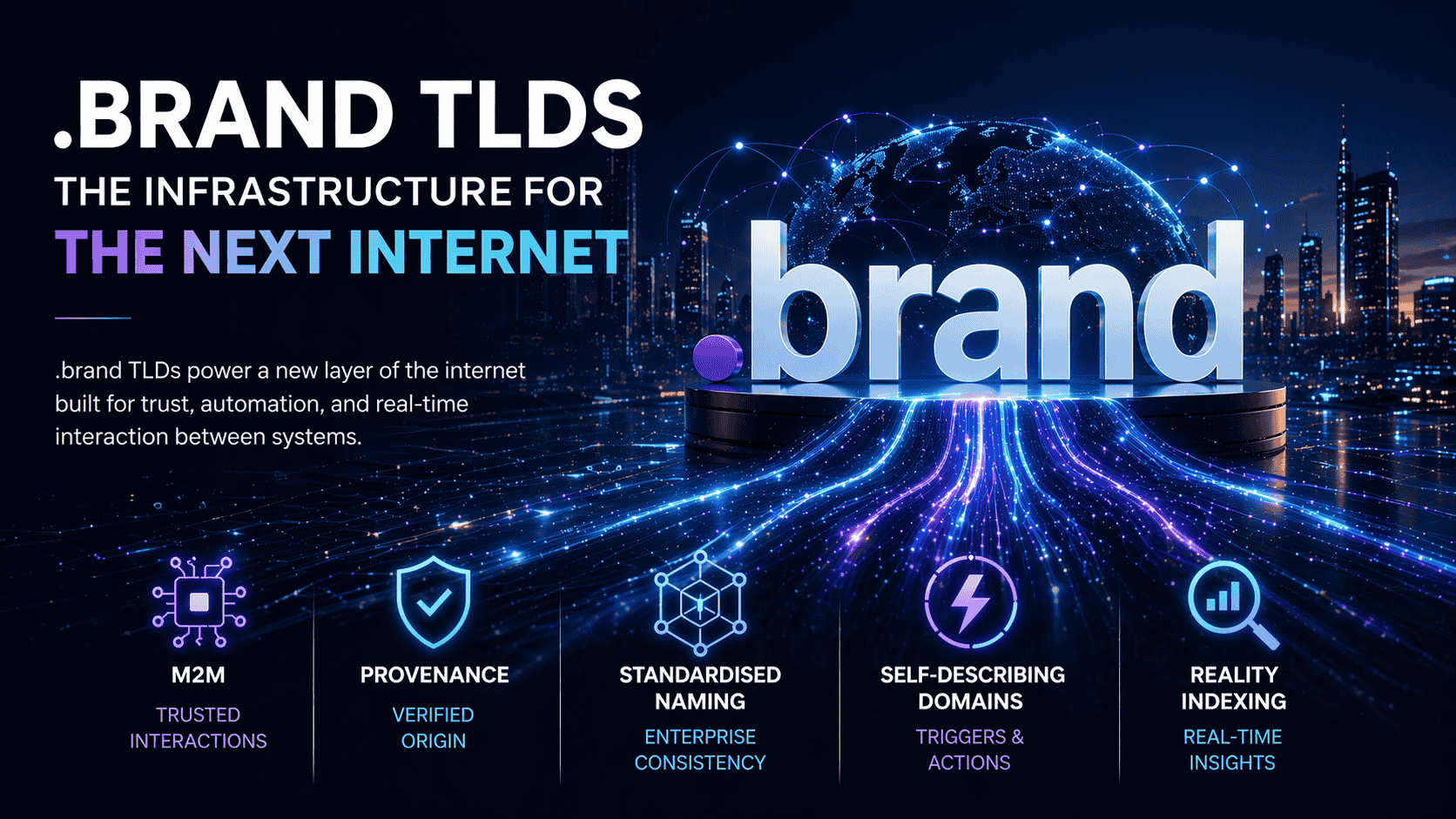
The role of domains is evolving from a marketing and brand protection tool into a more strategic component of digital infrastructure.
As organisations adopt AI, automation, and machine-to-machine (M2M) interaction models, the need for trusted, structured, and controlled digital environments is increasing.
A .brand TLD enables this by providing a controlled namespace, where all domains and endpoints are attributable, governed, and inherently trusted.
Key Implications:
Strategic Consideration:
A .brand TLD represents a capability to structure and control digital interactions, rather than simply a defensive asset.
As the internet shifts toward automation and real-time execution, the question becomes:
Who controls the namespace those interactions depend on?
For much of the internet’s history, domains have been treated as a surface-level asset – supporting websites, marketing campaigns, and brand protection strategies. Even today, most organisations continue to frame domain strategy in those terms.
However, that perspective is becoming increasingly incomplete.
At TLDz, this is something we see consistently in conversations with large enterprises and global brands. What begins as a discussion about brand protection or presence quickly shifts. The focus moves to control, structure, and enabling advanced digital capabilities.
Because the underlying context is changing.
The internet is evolving from a system designed for human navigation to one that supports automated interaction, real-time decision-making, and machine-led execution. As this transition accelerates, the role of domains – particularly .brand TLDs (Top-Level Domains) – is shifting from visibility to something far more foundational:
Control over trust, structure, and interaction in digital environments.
One of the most significant developments shaping the future of the internet is the growth of machine-to-machine (M2M) communication. AI agents, connected devices, and enterprise systems are increasingly interacting directly – initiating transactions, executing workflows, and coordinating processes without human intervention.
In our work at TLDz, this is no longer a theoretical discussion. Increasingly, technology and digital teams are asking how their infrastructure will support automated interaction at scale – and where trust will sit within that model.
In this environment, traditional markers of trust – design, branding, or user experience – become irrelevant. Systems do not browse; they require certainty.
A .brand TLD gives organisations direct control over a defined, authoritative namespace, where every endpoint clearly belongs to a single entity. This approach establishes a deterministic model of trust, which becomes critical in automated environments where systems make decisions in milliseconds.
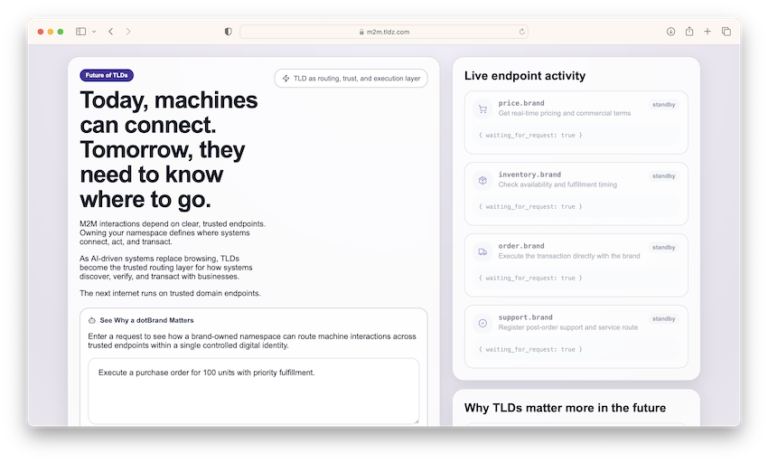
The m2m.tldz.com demo brings this to life. An AI agent executes a transaction across structured, trusted .brand endpoints – not by navigating, but by acting. This demonstrates how domains operate as a routing and trust layer for machine execution, rather than simply pointing to destinations.
Alongside the rise of M2M interaction is an increasing focus on digital provenance – the ability to verify the origin and authenticity of data, services, and interactions.
In conversations with brand and security teams, this often surfaces as a growing concern. The cost and complexity of verifying interactions – across multiple systems and third-party dependencies – is increasing, particularly as environments become more distributed.
A .brand TLD provides an alternative model based on controlled origin rather than retrospective validation. By operating a closed namespace, organisations can ensure that all domains, services, and endpoints originate from a trusted source.
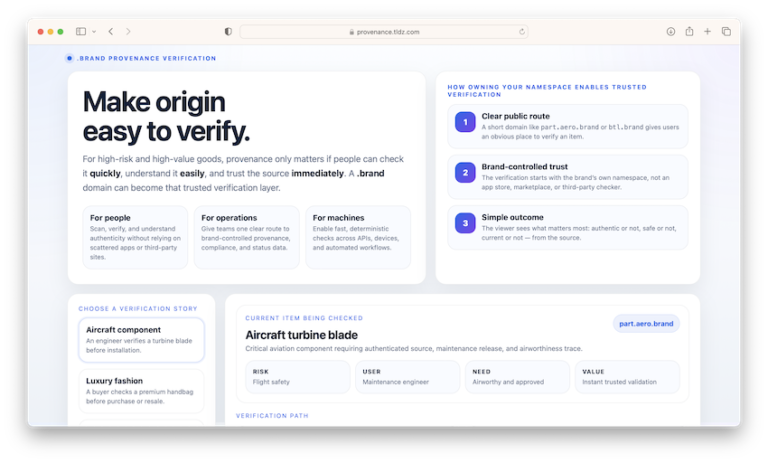
This concept is demonstrated in the provenance.tldz.com demo, where a .brand namespace functions as a real-time source of truth.
Across the organisations we work with at TLDz, a recurring theme is inconsistency – different naming conventions across systems, APIs, regions, and environments. Over time, this creates friction that is rarely visible in isolation but becomes significant at scale.
A .brand namespace enables the design of a unified naming architecture, providing consistency across digital assets and services. Standardisation reduces ambiguity, improves interoperability, and enables systems to interact more efficiently.
These internal use cases are often where the conversation becomes most commercially grounded – shifting from conceptual interest to measurable operational impact.
Another shift we are seeing is a change in how domains are conceptualised.
Within a structured .brand TLD, a domain can represent a service, an API endpoint, or a specific business function. This transforms domains into machine-readable signals, enabling systems to interpret and act on them without extensive configuration.
This is still emerging, but it is increasingly relevant for organisations investing in automation and AI-driven processes.
As digital environments become more dynamic, value is increasingly tied to real-time state rather than static content.
A .brand TLD can provide a structured namespace for real-time services and data endpoints, enabling organisations to organise and access live information across systems and environments.
This represents a shift from indexing information to structuring operational reality – a distinction that is becoming commercially significant.
Taken together, these developments point to a broader shift in how domains should be understood.
At TLDz, what has changed most over the past 12–18 months is not the technology itself, but the nature of the conversation. Organisations are moving beyond questions of brand protection and into discussions about infrastructure, control, and long-term digital strategy.
A more complete view is that .brand TLDs provide a mechanism for introducing structure, trust, and control into increasingly complex digital environments.
Not every organisation will require a .brand TLD. But for those operating at scale – particularly where automation, integration, and real-time systems are priorities – the strategic relevance is increasing.
What begins as curiosity is increasingly becoming a question of readiness.
At TLDz, we work with organisations exploring how .brand TLDs can move beyond traditional use cases and support broader digital strategy.
That often starts with a simple question:
If your systems are going to interact autonomously,
how do you want trust, structure, and control to be defined?
The demos referenced here – m2m.tldz.com and provenance.tldz.com – are designed to make these concepts tangible, and to support more informed discussions as organisations consider their options.
With new TLD application windows approaching, those conversations are becoming more immediate.
Subscribe to Our Monthly Newsletter
Join our mailing list to receive exclusive content only our newsletter members have access to.