Owning your own Top-Level Domain (TLD) is the ultimate power move for your brand online. It’s the difference between renting a slice of digital real estate and owning the entire city block. When you control the namespace after the dot – think .google or .aws – you gain absolute authority over your digital identity, security, and branding in a way a standard .com never could.
For years, your brand has likely been renting a digital apartment at YourBrand.com. It’s a great spot, no doubt. The location is prime, the address is easy to remember, and it serves its purpose well. But at the end of the day, you’re still a tenant. You pay your annual rent (domain registration fees), but the landlord—the registry operator for .com– owns the building and sets the rules.
This guide is about flipping that script. We’re moving past the technical jargon and looking at this as a strategic business decision. Think of it as graduating from leasing the penthouse to owning the entire skyscraper.
Visionary brands are already making this leap. They’re no longer content with just renting a domain; they’re building their own digital neighborhood with a .Brand TLD. This isn’t just a vanity project – it’s about seizing total control over your brand’s destiny online.
The internet’s addressing system has come a long way. Initially, we had just a handful of familiar, trusted TLDs that felt like established, old-money neighborhoods:
.com (The bustling commercial district)
.org (The non-profit and community square)
.gov (The official government center)
Then came the boom of new gTLDs, which created thousands of dynamic, specialized communities. Suddenly, you could set up shop in neighborhoods like .ai for tech startups, .xyz for creative thinkers, or even .pizza for, well, you know. With over 1,200 gTLDs now in existence, the digital world has expanded exponentially.
Owning your TLD is the next logical step in this evolution. It’s no longer just about choosing a neighborhood; it’s about building your own city with your brand’s name on the map.
This transition from renting to owning gives you advantages that are simply impossible to achieve with a standard domain. When you own the entire namespace, you get to set the rules for every single address within it.
The difference between renting a domain and owning a TLD is profound. Renting is tactical; owning is strategic. It’s the ultimate commitment to your brand’s future, ensuring every digital interaction is unmistakably and securely yours. Let’s break down the two approaches using the real estate analogy.
Attribute | Renting a Domain (.com, .net) | Owning a TLD (.YourBrand) |
|---|---|---|
Control | Limited to a single address. You follow the registry’s rules. | Absolute control over the entire namespace. You create the rules. |
Security | Vulnerable to cybersquatting and phishing on similar domains. | Eliminates cybersquatting within your TLD. Creates a secure, trusted ecosystem. |
Credibility | Standard level of trust, shared with millions of others. | Establishes ultimate authority and authenticity. Signals a secure environment. |
Revenue | No direct revenue model from the domain itself. | Potential to create new revenue streams by selling or leasing subdomains. |
By making this move, you’re not just securing a web address; you’re future-proofing your brand’s identity for decades to come.
As you explore why to own a TLD, keep in mind that the next ICANN application window is anticipated for April 2026. Forward-thinking organizations should be planning their move from tenant to landlord now, and TLDz provides the expert guidance to get you there.
If you want the strategic brand rationale behind owning a top-level domain, see our complete guide to custom top-level domains for brands.
Operating on a standard .com or .org often feels like a defensive game. You’re always on the lookout for cybersquatters, typo-squatters, and competitors trying to chip away at your brand’s digital real estate. But when you own your TLD, you’re no longer just defending a single address – you’re defining the entire digital landscape your brand lives in.

This changes everything. A scattered online presence instantly becomes a unified, logical ecosystem where every single link reinforces who you are. Suddenly, your web addresses transform from purely functional tools into intuitive and powerful marketing assets.
Think about the user experience. With a traditional domain, your careers page might be yourbrand-careers.com or jobs.yourbrand.net. It works, but it’s clunky and disconnected. Owning a dotBrand TLD lets you create a seamless naming system that just makes sense.
For Customers: shop.yourbrand, support.yourbrand, login.yourbrand
For Job Seekers: careers.yourbrand, life.yourbrand, apply.yourbrand
For Investors: investors.yourbrand, news.yourbrand, reports.yourbrand
Each address is short, memorable, and immediately trustworthy. There’s zero ambiguity. This consistency creates an intuitive map of your entire digital world, helping users find exactly what they need while strengthening your brand at every click.
Just look at how tech and automotive giants have mastered this. Google uses blog.google, ai.google, and about.google to organize its vast empire. BMW creates distinct, authoritative destinations like nextgen.bmw, making sure every digital touchpoint feels official and connected to the parent brand.
This isn’t just about tidy URLs; it’s about building an authoritative digital world where your brand is the central, organizing principle. Every link becomes a stamp of authenticity.
This strategy extends far beyond your main website. You can spin up memorable, campaign-specific domains like summercollection.yourbrand or newrelease.yourbrand that become marketing assets in their own right. That level of agility is simply impossible when you’re renting space in a crowded gTLD like .com. As you can imagine, key considerations for a dotBrand TLD are the first step in shaping this strategy.
Maybe the single biggest advantage of owning your TLD is the security it brings. It allows you to build a digital moat around your brand, instantly wiping out a major threat: domain squatting.
Cybersquatting is a relentless and expensive problem. In 2022 alone, the World Intellectual Property Organization (WIPO) handled a record 5,128 cybersquatting cases. When you own .yourbrand, you make it impossible for bad actors to register confusingly similar domains within your namespace.
No one can register promotions.yourbrand without your explicit permission. You control 100% of the inventory. Period.
This proactive defense saves countless hours and legal fees that would otherwise go to chasing down malicious actors. It’s a strategic move that secures your turf, hardens your security, and guarantees that every communication channel is unmistakably yours. You’re not just organizing your brand; you’re fortifying it for the long haul.
In a world overflowing with phishing emails and clever digital scams, trust isn’t just a brand asset – it’s your most valuable currency. When you own your TLD, you aren’t just polishing your brand image. You’re building an impenetrable, walled city for your customers, a place where they feel completely safe.
This move dramatically boosts security and consumer confidence in ways a standard domain simply can’t. A dotBrand TLD creates a clear, unambiguous signal of authenticity. It trains your audience to instantly recognize the real thing.
Think about it. When customers know that legitimate emails and websites will only ever come from a .yourbrand address, they can immediately spot fakes. An email from security@updates.yourbrand is instantly credible. One from yourbrand-security@random-domain.com raises a massive red flag.
This creates a powerful, structural defense against phishing that goes far beyond typical security software. It’s no surprise that financial institutions are leading the charge here, since their entire business is built on customer trust.
Take Barclays, for example. By operating on .barclays, they signal a secure, official environment for every digital interaction. Customers are taught a simple rule: if it doesn’t end in .barclays, it’s not from Barclays. This empowers them to protect themselves.
This approach flips the script, turning TLD ownership from a marketing line item into a critical investment in customer protection. You’re not just buying a domain; you’re engineering a safer experience for everyone who interacts with your brand.
The internet is always growing, and user expectations are changing right along with it. The domain name industry reflects this, with total registrations hitting 368.4 million across all TLDs by the first quarter of 2025.
While legacy domains like .com still hold the top spot with 157.2 million registrations, their overall market share has slightly eroded. This shows that brands and individuals are actively looking for more specific and trustworthy alternatives. You can find more details in the domain industry’s Q1 2025 performance report on DNIB.
This trend highlights a growing awareness that not all TLDs are created equal. As users become more savvy, the authenticity signaled by a dotBrand TLD will become an even greater differentiator. It cements your reputation as a trusted leader who puts security first. The vibes of other popular gTLDs, like .tech or .store, just don’t offer the same level of exclusive trust.
Owning your TLD gives you the ultimate security advantage: you control the entire namespace. This means no one else can register a domain that could be used to impersonate you, because you own all the available inventory.
The decision to own your TLD is more than a technical choice. It’s a public declaration of your commitment to security and authenticity. It shows you’re willing to invest in the highest level of brand protection available.
This move has a profound effect on how your brand is perceived. It builds a foundation of trust that influences everything from customer loyalty to conversion rates. When a customer feels safe, they are far more likely to engage, transact, and advocate for your brand. Understanding the impact of TLDs on consumer perception is key to grasping the full value of this strategic decision.
By creating a secure and predictable digital environment, you do more than just protect your customers – you build a lasting legacy of trust. This fortress isn’t just about keeping threats out; it’s about making your audience feel truly at home with your brand.
So far, we’ve covered the crucial defensive plays for owning your TLD – locking down your brand, tightening up security, and building a foundation of trust. These are the table stakes, the reasons you graduate from being a digital tenant to a landlord. But what if that piece of digital real estate could do more than just sit there? What if it could become a profit engine?
Beyond just protecting your turf, owning your TLD gives you the keys to unlock entirely new revenue streams and marketing assets that are simply off-limits with a standard domain. This is where you stop thinking about just occupying digital space and start actively building on it. Let’s break down the two main ways to make this happen.
The “closed” or dotBrand model is where your organization keeps the TLD all to itself. You’re not selling domains to anyone else, but the marketing and branding upside is massive. You can spin up hyper-memorable, campaign-specific domains on a whim that are short, trustworthy, and just plain cool.
Think about the creative freedom this gives a major car brand:
Product Launches: Instead of some long, clunky URL, the debut of a new vehicle gets its own stage at TheNewModel.carbrand
Seasonal Campaigns: A big holiday promotion lives at a dedicated hub like WinterEvent.carbrand
Exclusive Access: Imagine a loyalty program for current drivers hosted at Owners.carbrand
Each of these isn’t just a web address – it’s a marketing statement. It reinforces the brand at every turn, looks killer on a billboard, and is impossible for a customer to mistype or mistake for a phishing scam.
The second, more ambitious path is the “open” gTLD model. This is where you become the official registry for an entire industry, community, or idea, selling domains directly to the public. You’re no longer just a brand-builder; you’re an infrastructure owner. Think of the pioneers behind extensions like .art, .dev, .music, or even the cheeky .sucks.
By launching an open gTLD, you’re not just creating a product – you’re creating a digital identity for an entire community. Imagine launching
.pizzaand becoming the official digital home for every pizzeria on the planet.
This model transforms your TLD into a scalable, recurring revenue business. You write the rules, set the prices, and establish the positioning, becoming the definitive hub for a specific niche. It’s a huge undertaking, no doubt, but the rewards – both financial and strategic – can be astronomical.
The market is already signaling a major shift in this direction. New generic Top-Level Domains (gTLDs) are seeing explosive growth. By the first quarter of 2025, these new gTLDs accounted for around 37.8 million domain registrations worldwide, a jump of 13.5% from the previous year. This surge shows a clear and growing demand for unique, descriptive domain endings – a trend that smart organizations can ride. If you want a closer look at this expansion, you can dive into more detailed domain name statistics and see how the newcomers are shaking things up.
Whether you opt for a closed model to fuel creative marketing or an open one to build an entirely new business, the core idea is the same. Owning your TLD grants you the ultimate power to innovate within your own digital universe. With the next application window on the horizon, now’s the time to figure out your strategy, and expert guidance from TLDz can help you map it out.
We’ve covered the immense strategic value that comes with owning your own piece of digital real estate – the brand control, the built-in trust, and the new revenue streams it opens up. The benefits are clear. Now you’re probably thinking, “This all sounds great, but how do I actually do it?”
It’s time to shift from inspiration to action. While the journey to own your TLD means navigating the ICANN application process, it’s not some insurmountable technical maze. Think of it more like a strategic expedition – one that becomes clear and manageable when you have an expert guide.
This process isn’t for the faint of heart, but it’s a defined path with clear milestones. The brands that succeed don’t just show up on application day. They spend years preparing for it.
The real work begins long before any forms are filed. It starts with validating your concept and building a rock-solid business case. Are you planning a closed dotBrand to unify your global presence, or an open gTLD designed to serve an entire community?
From that initial decision, the journey unfolds across several key stages:
Preparing a Watertight Application: This is where your strategy meets execution. A winning application demands deep financial, technical, and operational planning to prove to ICANN that you can run a stable and secure registry.
Building the Technical Backend: This involves setting up the core registry infrastructure – the engine that will power your corner of the internet.
Planning a Successful Launch: This is about much more than just flipping a switch. You need a go-to-market strategy that drives adoption and ensures your TLD achieves its goals from day one.
It’s a continuous loop: defining your audience, creating campaigns for your new TLD, and analyzing engagement to refine your approach.
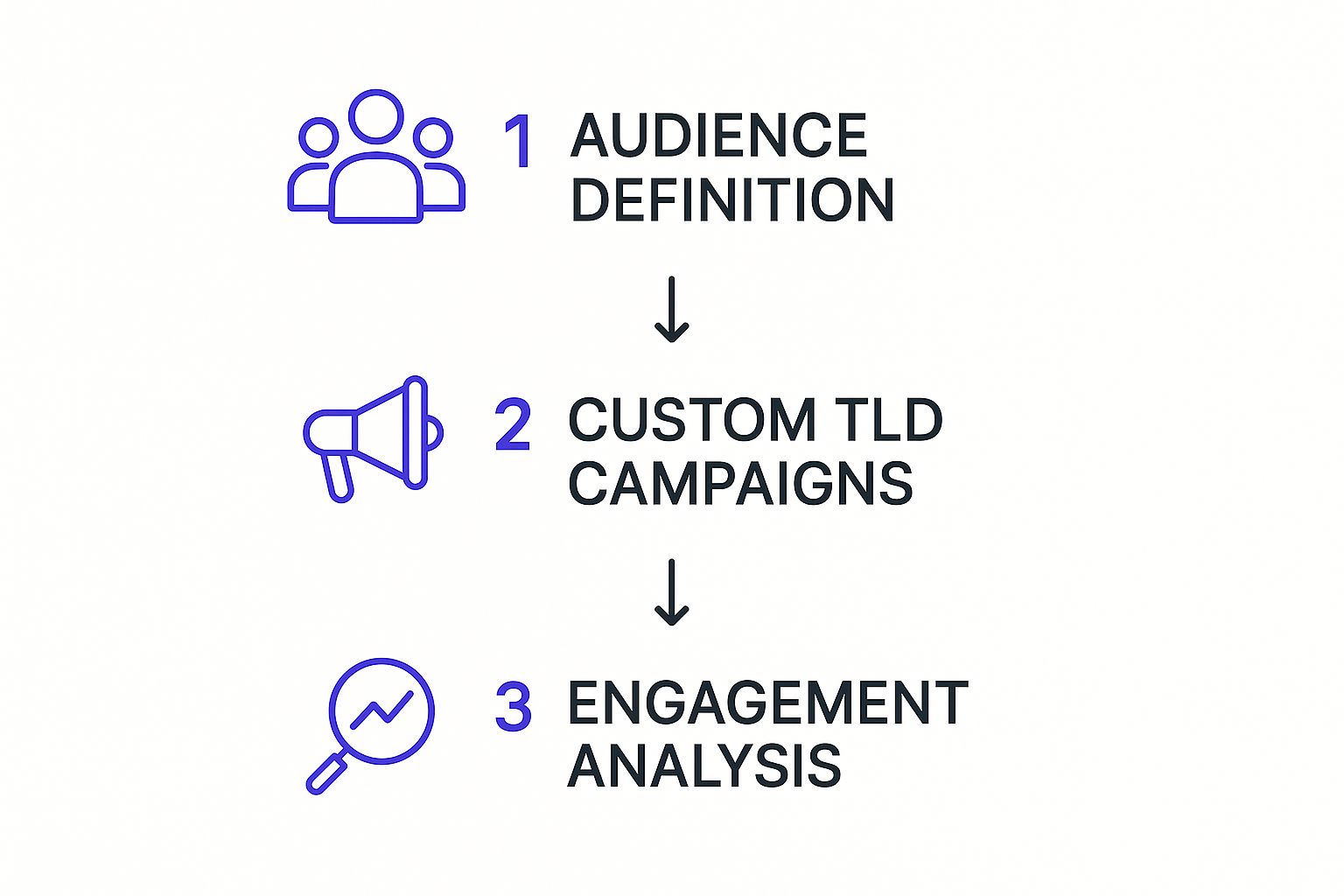
As this shows, a successful TLD strategy isn’t a one-and-done project. It’s a cycle of understanding your audience, delivering value, and using the results to get even better.
Our goal here isn’t to drown you in technical jargon but to highlight the critical role of strategic guidance. This process demands real foresight and expertise.
ICANN doesn’t keep the application window open forever. The last round was way back in 2012, and the next one is widely expected to open in April 2026. That might sound like it’s a long way off, but for a move this significant, the time for forward-thinking brands to start planning is right now.
The digital economy is expanding at a dizzying pace. As of early 2025, over 33,000 new domains are registered every single day. That’s roughly one every 2.6 seconds. The United States is at the forefront of this growth, with over 141 million registered domains, making it a pivotal market for anyone looking to carve out a unique digital identity. These numbers scream urgency for brands wanting to secure their own namespace before the internet gets even more crowded.
With the next application window on the horizon, the question isn’t whether you can afford to own your TLD. It’s whether you can afford not to. The brands that act now will be the digital landlords of the next decade.
This journey is complex, but you don’t have to walk it alone. TLDz provides the seasoned guidance needed to navigate every milestone, from the initial concept all the way to a successful launch. We’re here to help you secure your piece of the internet and turn a bold idea into powerful digital infrastructure.
To get started, it’s essential to understand the ins and outs of the ICANN process. We’ve put together a comprehensive guide on how to apply for your own TLD that breaks down the steps and timelines you’ll need to know.
Stepping into the world of TLD ownership can feel a bit like learning a new language. You’ve got the big idea, but there are probably a few key questions bouncing around your head. Let’s tackle the most common ones so you can see the path forward clearly.

Let’s break it down with an analogy. A generic Top-Level Domain (gTLD) like .app, .xyz, or the ever-popular .ninja is like an open neighborhood. Anyone can come in, buy a lot, and build their digital home. The registry runs it as a public-facing business.
A dotBrand TLD, on the other hand, is a private, gated community. It’s still a type of gTLD, but it’s one that a company like Google or Amazon owns for its exclusive use – think .google or .aws. These are closed ecosystems built to unify a brand’s entire digital presence. The general public can’t buy property there.
I’ll be direct: owning a TLD is a serious strategic investment, not something you buy on a whim. The process kicks off with a hefty ICANN application fee of $227,000 USD. On top of that, you’re looking at significant ongoing costs for the technical operations, compliance, and marketing needed to run it successfully.
This is a multi-year financial commitment. The best way to think about it isn’t as an expense, but as what it truly is: building a piece of permanent, critical digital infrastructure for your brand’s future.
ICANN, the organization that manages all of this, only opens up application windows for new TLDs periodically. The last round was all the way back in 2012 – basically the Jurassic period in internet years.
The next window is widely expected to open in April 2026. Because it takes so long to prepare a winning application, the smartest brands are already deep in the planning stages right now. Getting expert guidance today is the key to being ready when the starting gun fires. You can dive deeper into the 2026 timing and what it means for you on our main page.
Not at all. While you see plenty of dotBrands from corporate giants, the strategy to own your TLD is a powerful move for many different kinds of organizations. We’ve seen it work wonders for:
Industry associations creating a dedicated digital home for their members
Geographic locations like .nyc or .berlin building a powerful city-wide identity
Passionate communities uniting under a shared banner, like the one built for .art
Success isn’t about company size. It’s about having a clear strategic vision and a sustainable model for the value your new TLD will create for its community.
The internet isn’t finished being built; it’s just getting started. Owning your TLD is more than a status symbol – it’s a declaration that you’re not just participating in the digital future, you’re actively building it. It’s the ultimate power move, turning your brand from a digital tenant into a digital landlord with the power to shape your own corner of the internet.
Ready to explore how you can own your own TLD? The journey is a significant undertaking, but it’s one you don’t have to navigate alone. TLDz provides expert guidance at every step, from hashing out the initial strategy to celebrating a successful launch. Explore how we can help you secure your piece of the internet.